Homelessness ends when we all have safe, affordable and accessible housing.
But our communities are facing unprecedented challenges to our collective safety and efforts to house all of our neighbors.
This page serves as a resource for those fighting back against occupation in Washington, DC, as well as other communities that have been experiencing militarization and abductions of immigrants, people of color, and people who are unhoused.
With Congress’s passage of the mega budget deal today, we have witnessed the most disastrous legislation in modern history. The budget bill steals from the poor to give massive tax cuts to the wealthy. And these tax breaks are such enormous giveaways to the rich that they will increase the deficit by nearly $4 trillion, even with the draconian cuts to health care and food assistance.
The Bill will also create a private force as large as most countries to push the cruel anti-immigration policy. It adds $4 trillion to the national debt.
It does not address the growing concerns of inflation and job loss. The bill will result in a loss of an average of $1,000 in income for families below the poverty line.
We fought hard, but the fight is not over.
We must get ahead of the next budget discussion. Today’s blow will be significantly magnified by projected loss of critical housing and supportive services foretold in the Presidential Administration’s “skinny budget” request for next year.
We cannot let elected officials forget who they have harmed by their decision to transfer even more wealth to the ultra rich, on the backs of seniors, people with disabilities, families unable to put food on the table. NCH encourages all of us who will be impacted by this dastardly budget to continue contacting our Congressional members – sharing how their callous decision will hurt their constituents.
We may rest this weekend, but we will keep fighting for true justice, equity, and a permanent end to homelessness.
In Solidarity, Donald H. Whitehead Jr. Executive Director
“It demands unwavering commitment, concerted efforts, and the courage to challenge the status quo.”
As we reflected on Dr. Martin Luther King Jr. Day, it was imperative to acknowledge the enduring significance of his legacy and the persistent struggle for racial justice and equality. The commemoration of this day served as a powerful reminder of the progress made and the challenges that remained. It was more important than ever to honor Dr. King’s vision by actively working towards a society where justice and equality are accessible to all.
Despite the progress achieved since Dr. King’s time, systemic racism and inequality have persisted in various forms. The recent resurgence of white supremacists highlighted the ongoing struggles faced by marginalized communities. Issues such as disproportionate representation in the unhoused population, criminalization of people experiencing homelessness, police brutality, economic disparities, unequal access to education, and healthcare inequities underscored the need for continued efforts towards racial justice.
As we honored Dr. Martin Luther King Jr. and looked towards the future, it was crucial to recognize that the fight for racial justice and equality was far from over. It demanded unwavering commitment, concerted efforts, and the courage to challenge the status quo. By continuing to pursue Dr. King’s dream of a just and equitable society, we could create a world where every individual is treated with dignity and respect, regardless of their race or ethnicity.
Recently, I witnessed an aura of hopelessness at a time when hope was required to change the trajectory of homelessness, which is at record levels. Housing justice remains the unfinished business of the civil rights movement. Although there was a feeling of despair for many after the election of Donald Trump, we could not waver in our pursuit of housing justice. We needed all of those who believed in housing justice to stand tall and work even harder until the dawn rises. We could not give up; we had to stand up in this moment of uncertainty in our country’s history.
The commemoration of Dr. Martin Luther King Jr. Day and the inauguration of new political leaders served as reminders of our collective responsibility to advance the cause of racial justice. Let us continue striving to be the change-makers who turn dreams of equality into reality, ensuring a brighter and more just future for all.
Authored by: Donald Whitehead, NCH Executive Director of NCH
Over 700 people rallied in front of the U.S. Supreme Court during oral arguments on Monday morning, April 22, 2024. Over 30 communities across the country held solidarity events, and nearly 5000 watched livestreams. The atmosphere was electric. (Read more about the Rally, Photo of Donald Whitehead speaking at the rally by Kevin Wolf, AP)
The case being considered by the court, City of Grants Pass v. Gloria Johnson, addresses the legality of using a blanket to keep warm when forced to sleep outdoors.
Regardless of the court’s decision, this case will not create any housing, nor directly address persistent poverty and homelessness. Rather, this case could set a precedent for municipalities to address homelessness and housing insecurity with ineffective and extreme punitive actions.
The case has sparked a national conversation about the intersection of housing policy, poverty, and civil liberties. Laws that prohibit things like sleeping, laying down or even eating in public spaces, are common, yet they reflect discriminatory practices that have led to deep inequities.
Grants Pass, Oregon, was itself a “Sundown Town” – communities that mostly sprang up during the mid-1800’s, where the movement of non-white residents was restricted after dark. Policies that continued through the 20th Century like Anti-Okie laws, Red-Lining and Jim Crow laws have all been collectively understood to be discriminatory and in violation of U.S. civil rights practices.
Yet as the Supreme Court prepares to hear this Johnson vs. Grants Pass, the situation for Americans forced to live outdoors in an increasingly unaffordable housing market sounds similar to how poor and nonwhite Americans have been treated in past centuries. A recently law in Tennessee has made sleeping outside a felony, and the Florida governor recently signed into law banning sleeping or “camping” in public spaces.
A recent study, published in the Journal of the American Medical Association found that ticketing, jailing, and displacing people forced to sleep outdoors can actually lead to significantly higher mortality among folks who are unhoused. Moreover, fines and compounded tickets lead to criminal records for otherwise law-abiding citizens, creating further barriers to getting unhoused Americans back into a home.
“The Johnson vs. Grants Pass case is monumental,” states Donald H. Whitehead, Jr., Executive Director of the National Coalition for the Homeless. “It has the potential to instigate a barrage of draconian policies that cause significant harm to people experiencing homelessness in our country.”
The National Coalition for the Homeless, dedicated to organizing a movement led by those most affected to end homelessness, calls on our communities to invest in proven housing solutions. Hundreds are expected to rally in front of the U.S. Supreme Court building in support of Housing, Not Handcuffs.
A Call to Unity in Johnson v. Grants Pass
In the face of ongoing challenges, the resilience of our community—particularly those with lived experience of homelessness—continues to inspire and drive change. One such pivotal moment of change is upon us, as the Supreme Court prepares to hear a case that could significantly impact the rights of homeless individuals across the nation: Johnson v. Grants Pass.
This landmark case centers on the rights of homeless individuals in Grants Pass, Oregon, challenging ordinances that penalize life-sustaining activities in public spaces. At its heart, Johnson v. Grants Pass isn’t just about one town; it’s a reflection of the broader struggle for dignity, respect, and the right to exist in public spaces without fear of harassment or punishment.
The Issue at Hand
For too long, our brothers and sisters without homes have faced legal and societal barriers that criminalize their existence. Sleeping, eating, and performing other necessary life activities in public spaces—their last resort—are met with penalties rather than support. Johnson v. Grants Pass brings these injustices to the forefront, challenging us all to reconsider how we treat the most vulnerable among us.
Your Voice is Your Power
This case is a rallying cry for all who believe in justice and human rights. It’s a reminder that together, we can challenge the status quo and advocate for policies that uplift rather than oppress. Your voice is critical in this fight.
Call to Action
Your involvement signifies more than just your support; it embodies hope, unity, and the unwavering belief that change is possible. Let’s stand together for justice, for dignity, and for the rights of all individuals to live freely and without fear.
Here’s how you can stand in solidarity:
Sign the Petition: Add your name to the growing list of individuals calling for an end to the criminalization of homelessness. Each signature sends a strong message to policymakers about the public’s demand for compassionate and humane treatment of all individuals, regardless of their housing status.
Join us for the Housing Not Handcuffs Rally on April 22, 2024, at the Supreme Court: Mark your calendars and make your presence felt. This rally isn’t just about making noise; it’s about showing the strength of our community and the depth of our commitment to change.
Join with communities across the country in holding coordinated actions on April 22nd! Click here to let us know about your local event, or to learn more about what might be happening in your community. Check out our Organizing Skill Share guide for action inspiration and guidance.
We know that laws are passed and enforced locally. Your City Council, Mayor, and police are the ones implementing anti-homeless policies (such as sweeps) now. So, local actions are really important, in addition to actions in front of the U.S. Supreme Court.
A small group of people can have a BIG impact! Together, we can demonstrate the collective power of individuals united for a common cause.
The Journey Ahead
The path to justice is long and fraught with challenges, but it’s a journey worth taking. Johnson v. Grants Pass is more than a legal battle; it’s a moral one. It’s about affirming the right of every individual to live with dignity and without fear. As we stand on the brink of this historic moment, let’s come together to support those who have been marginalized and to show that humanity and compassion can prevail over indifference and injustice.
Together, We Can Make a Difference
To learn more about Johnson v. Grants Pass and stay informed on the latest developments, here are several avenues you can explore:
Supreme Court’s Official Website: The United States Supreme Court’s official website offers access to court documents, including briefs, oral arguments, and opinions related to the case. This is a primary source for accurate and up-to-date information.
Congressional leaders have unveiled the FY24 THUD spending bill, earmarking significant funding for the Department of Housing and Urban Development (HUD) programs focused on affordable housing and homelessness. The bill allocates $70 billion to HUD, marking an $8.3 billion increase from the FY23 levels. This funding boost is seen as a major achievement for the National Low Income Housing Coalition (NLIHC)’s national HoUSed campaign, advocates nationwide, and congressional supporters such as Senators Brian Schatz and Cindy Hyde-Smith, along with Representatives Tom Cole and Mike Quigley.
– The Housing Choice Voucher (HCV) program receives a substantial increase, funded at $32.4 billion, allowing for the renewal of all existing rental assistance contracts and expanding assistance to 3,000 additional households.
– Homeless Assistance Grants see a $418 million increase, totaling $4.05 billion.
– The Public Housing Capital and Operating Funds receive modest increases, with the Capital Fund at $3.41 billion and the Operating Fund at $5.5 billion.
– The Native American Housing Block Grant is boosted by $324 million, reaching $1.1 billion.
– Despite some programs facing cuts, such as the HOME Investment Partnerships Program and the Choice Neighborhoods, significant resources are allocated across various housing and homelessness initiatives.
Analysis of Specific Programs:
– Tenant-Based Rental Assistance is set at $32.4 billion, aiming to renew all existing contracts and expand support.
– Public Housing funding includes slight increases for capital and operating funds, with a total of $3.4 billion for the capital account.
– The bill also emphasizes homelessness programs, allocating $4.05 billion for Homeless Assistance Grants, indicating a focused effort to address the homelessness crisis.
Overall Impact:
The FY24 spending bill represents a significant step towards addressing affordable housing and homelessness challenges in the U.S. While it marks progress, NLIHC and its allies continue to advocate for sustained and comprehensive investment in housing assistance to meet the growing needs of Americans facing housing insecurity.
Homes Not Sweeps Actions Continue September 6 – 11, 2022
The National Coalition for the Homeless is declaring the first week of September a Homes Not Sweeps Week of Action. We will host demonstrators, protests, and marches across the nation to call attention to the unjust “sweeping” of homeless encampments.
“This is exactly the wrong approach and will only make the problems associated with homelessness dramatically worse,” said Donald Whitehead, the Executive Director of the National Coalition for the Homeless. “Attacking people who are homeless for personal gain is the most despicable thuggery I can imagine, and we shouldn’t let it happen without a fight.”
Actions are being held to ask federal and city officials to stop criminalizing homelessness. We are urging our communities to respond to the needs of our unhoused neighbors with trauma-informed service and care. The social service needs of the community need immediate attention, and the local leaders need to start addressing the affordable housing crisis in our cities. Ordinances that criminalize people for sleeping outdoors only exacerbate the issues that cause homelessness.
The National Coalition for the Homeless (NCH), an advocacy organization committed to ending homelessness, will host the Washington, DC, premiere of the documentary “No Address: Atlanta” by filmmaker Caletta Harris. Following the free film screening at American University will be a panel discussion featuring civil rights activists and homeless policy experts discussing the negative effects of sweeps on a community and the setbacks it causes in the life of those living on the streets.
NCH is partnering with local coalitions in Phoenix, Los Angeles, Austin, and Miami to warn the community that local governments are bullying, harassing and in some cases arresting taxpayers for the crime of being without housing. DC law enforcement are also harassing and regularly moving people around the city.
Our DC event will be on September 8 at 7 p.m. at the American University Woods Amphitheater at 4400 Massachusetts Ave NW. in DC. We have the Battelle Atrium if there is rain on September 8.
The participants in the panel discussion include:
Filmmaker Caletta Harris, who also does a number of podcasts around poverty and homelessness.
NCH executive director Donald Whitehead, who has 25 years working in homeless organizations and got off the streets of Cincinnati in the late 1990s
Antonia Fasanelli, the executive director of the National Homelessness Law Center and a former activist in the Baltimore region will talk about their work stopping criminalization
Professor Dan Kerr of American University and author of Derelict Paradise which details the history of homelessness in Cleveland will join the discussion
Attorney and Georgetown Professor Joe Mead will talk about his history of work protecting the civil rights of those without housing in his career.
The event is free and will focus on the devastating impact criminalization has on the 66 cities currently endeavoring to “sweep” unhoused people out of sight.
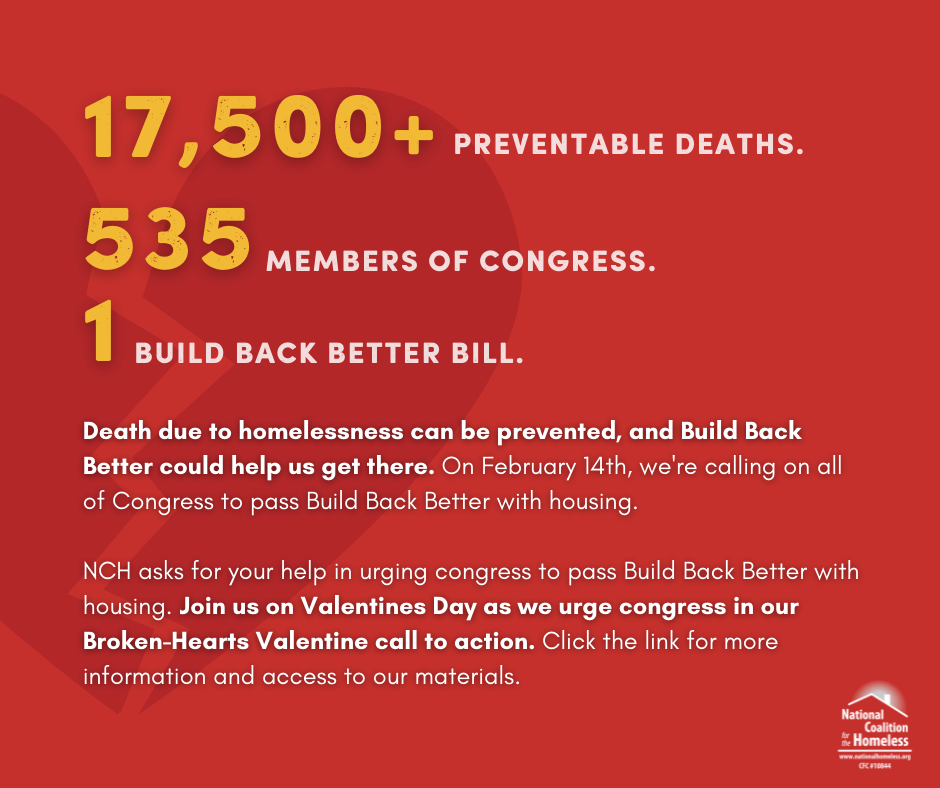
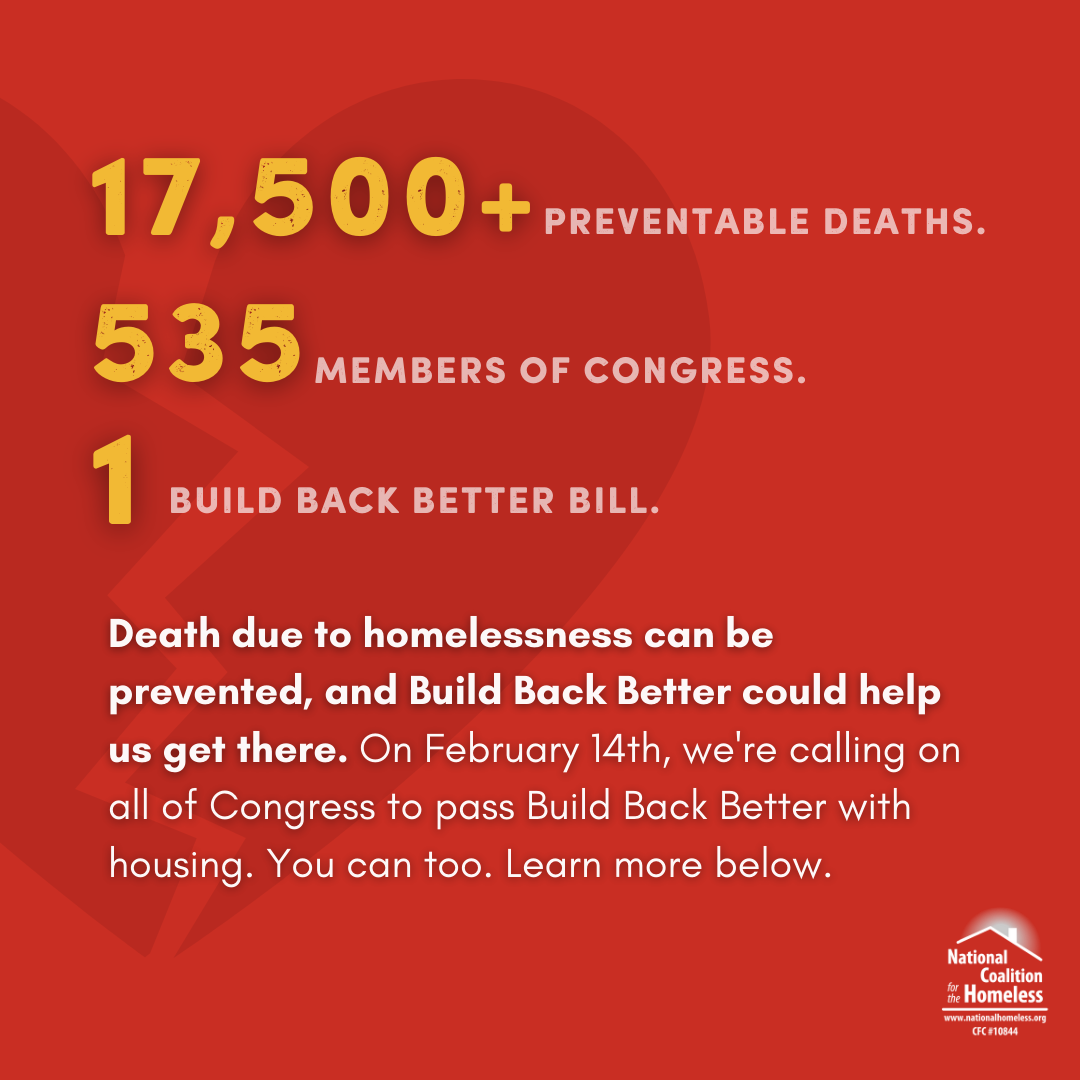
We are Broken Hearted this Valentine’s Day Over the Deaths of our Neighbors whose lives were cut short by Homelessness. Urge our Elected Leaders to Do More to Create and Build More Affordable Housing.
In 2018, National Healthcare for the Homeless estimated that at least 17,500 people experiencing homelessness died without a home. That’s at least 49 mothers, fathers, brothers, sisters or friends dying everyday because they were unable to afford safe housing and adequate health care. How many more people have to die before Housing is a Human Right in this country?
Those who died were artists, teachers, first responders, those laid off because of the pandemic, and business owners. They were followers of nearly every major religion and spent countless hours volunteering to serve others. They lived in the richest country on the planet and yet died because they did not have the basic income needed to pay the bills or to afford housing or quality health care. Each of their lives counted, even though they were cast aside by their country and communities.
The National Coalition for the Homeless (NCH), and hundreds of partners across the country have remembered their names and their stories for over 30 years on National Homeless Persons’ Memorial Day, held symbolically on the winter solstice. On February 11, 2022, NCH Staff and Advocates who have experienced homelessness will read over 3,000 names of individuals whose lives were cut short due to the effects of unstable housing.
But we need to do more than remember their names. We can begin by passing the Build Back Better Act, which includes direly needed and historic investments of almost $170 billion in housing accessibility programs. NCH is sending “Broken Heart” Valentine’s Day messages to every member of the US Senate that include the names of constituents who have died without housing.
We are urging you to send a similar message to your elected leadership in your local, state or national leaders.
Does your heart break for the 17,500+ people without homes who die each year? The Senate must pass the critical housing investments in #BuildBackBetter to prevent more unnecessary deaths! #BrokenHeartValentine #HomelessDeaths #HousingNOW #PassBBB
My heart breaks for the more than 17,500 people who die without homes each year. We have to do better! We can start with passing nearly $170 billion in critical housing supports in #BuildBackBetter! #BrokenHeartValentine #HomelessDeaths #HousingNOW #PassBBB
Data shows that between 17,500 and 46,500 people die without housing each year. That’ s at least 17,500 people dying due to extreme weather, violence or unattended health conditions. That’s at least 17,500 people dying preventable deaths. #PassBBB #BuildBackBetter #BrokenHeartValentine #HomelessDeaths https://nhchc.org/homeless-mortality/
Dear Senator: You have the power to undo decades of disinvestment in housing programs and communities that could prevent more of your constituents succumbing to deep poverty and homelessness. Pass #BuildBackBetter with housing. Save lives, [your state] needs you. #BrokenHeartValentine #HomelessDeaths #HousingNOW #PassBBB
October 20: Bring America Home NOW Rally & Press Conference
National Organization for Women, National Coalition for the Homeless and End Homelessness Advocates Demand Investments to Solve Housing Inequality Crisis
Washington, D.C. – The housing crisis in the United States has reached a critical point due to long-standing structural inequities compounded by the impacts of the COVID-19 pandemic. As Congress debates President Biden’s “Build Back Better” Infrastructure Bill, advocates from across the affordable housing, women’s rights, and social justice movements have come together in an unprecedented coalition calling on Congress and President Biden to prioritize investments to solve this public housing crisis.
The coalition, led by the National Organization for Women and the National Coalition for the Homeless, is urging Congress not to cut over $300 billion in much-needed funding for long-overdue renovations of severely dilapidated public housing, an expansion of over 500,000 units of affordable housing for low- income Americans, and the removal of toxic lead paint from public housing. As millions of Americans fall behind on their rents and mortgages, and with the imminent risk of evictions during freezing winter weather conditions, advocates are also urgently calling for an extension of the CDC moratorium on all evictions throughout the duration of the pandemic to avoid the needless tragedy of unhousing possibly millions of families, women, and children.
“Homelessness is a feminist issue that NOW’s activists are deeply invested in solving. We know numbers show that women – especially women of color – are disproportionately affected by homelessness,” stated Christian F. Nunes, president of the National Organization for Women (NOW). “This issue is compounded by gender-based economic inequality, racial discrimination and the impacts of domestic and sexual violence, which contribute to women, children and families becoming the fastest-growing segments of the homeless population.”
“America is the wealthiest country in the world, and we can easily afford to pay for the President’s bill, and therefore not cut the housing investments in the legislation. We must have the political will and emergency citizen advocacy to make this happen,“ said Donald Whitehead, executive director of the National Coalition for the Homeless. “The majority of the American people, both Democrats and Republicans, support the President’s plan. Now we the people are organizing a mass mobilization to demand that Congress and President Biden pass the bill, without any cuts to the desperately needed housing provisions.”
“We as a nationwide progressive end homelessness/housing for all movement will not allow millions of Americans to be evicted and thrown into the streets during the lethal Covid-19 pandemic. Have we no shame,” added Joel Segal, national director of the Bring America Home Now Campaign. “Furthermore, the national BAHN campaign’s most important priorities right now are to stop any cuts to affordable housing in the President’s Infrastructure Bill and a zero-tolerance policy for any evictions during the Covid-19 Pandemic and freezing winter temperatures. It’s unamerican, immoral, and cruel for we the people not to intervene now to stop the unnecessary, life-threatening, and destabilizing nationwide eminent eviction emergency.”
In addition to calling for investments within the Build Back Better infrastructure package, the coalition has also called for meetings with Housing and Urban Development Secretary Marcia L. Fudge and Treasury Deputy Secretary Wally Adeyemo to discuss allocating funds to the development of housing crisis “navigators,” emulating the success of the Affordable Care Act program to simplify the application process for rental assistance. The coalition hopes to meet with Speaker Pelosi, Senate Majority Leader Chuck Schumer, and other congressional leaders to discuss how our country can create lasting solutions and provide housing security for our most vulnerable populations.
WHAT: Bring America Home NOW Rally & Press Conference
WHEN: Wednesday, October 20th at 10:00am-12:00pm ET
WHERE: Capitol Hill, Constitution Ave & New Jersey Ave. NW (Robert Taft Memorial)
WHO: Bring America Home NOW Campaign featuring NOW & the National Coalition for the Homelessness, members of Congress, and other guest speakers
MORE INFO: Additional confirmed speakers and logistical details, including location, will be updated here. Members of the media interested in attending or connecting with speakers can contact press@now.org or dwhitehead@nationalhomeless.org.
After the Peachtree-Pine Shelter was forced by the city of Atlanta to close its doors in 2017, Anita Beaty has remained dedicated to activist efforts in the homeless community, continuing her decades-long career advocating and providing for those in need. Beaty, who oversaw the Peachtree-Pine Shelter for twenty years, has worked in the homeless community for much longer, her history of activism stretching as far back as the eighties. Whether it was activism or overseeing the shelter, Beaty consistently abided by a philosophy that no one should be left behind or left out. She has always placed high value on “letting the people who needed the service run the service,” and described how this philosophy of care for others informed her activism through the years.
In one story, Beaty described a march she organized every year for twenty-nine years to celebrate homeless memorial day on November 1st. Various shelters, congregational groups, or other facilities would carry banners representing their group, made in the Peachtree-Pine art studio, along with a procession of crosses with the names of homeless people who had died that year. Each year, she recalled, there would be around 60 to 80 crosses. The procession finished at the Cathedral, where there would be a ceremony addressing the issue of homelessness, with a Litany created by the Task Force, and remembrances of the dead, name by name.
Beaty and her organization, the Metro Atlanta Task Force for the Homeless, would hire buses to pick people up at every shelter that would participate, and the cathedral served them a hot meal. Looking back, Beaty recalled the event with fondness for the community it fostered.
Beaty also reflected that a key component of her personal philosophy was an element of playfulness. “I need to enjoy what I do,” she said. In one story she recounted, Beaty and the Task Force were protesting the improvement project the city of Atlanta was undertaking at Woodruff Park prior to their hosting of the 1996 Summer Olympics. The park had been a gathering place for members of the homeless community, so when the mayor of Atlanta showed up in a hard hat for a photo-op groundbreaking on the construction, several of the protestors laid in the hole the mayor was to stand in, completely preventing their chance at a photo-op. Beaty chuckled as she recalled how the mayor’s face turned purple with rage, and when he retreated to his car the protestors followed, and it looked as if he was the one leading the march. Beaty also recalled a city council meeting they attended, when she handed out signs to everyone with them that said “true,” “false,” and “bald-faced lie.” When one of the council members said something about homelessness, the crowd held up their “bald-faced lie” signs, and Beaty recalled it was “hysterical” as the council member tried to talk down the signs.
Drawings by Anita Beaty
The visual arts have always been a major part of Beaty’s activism. During her time as its leader, Beaty opened an art studio at Peachtree-Pine, where shelter residents could come to draw, paint, and be creative. Beaty sometimes brought in artists from around the country, especially artists who had been homeless or experienced similar struggles. They “had a ball with us,” she remembered. “It was so exciting to intentionally bring in like-minded people who can show folks who’ve been excluded from all that that they, too, can dream.” Beaty emphasized that giving shelter residents access to resources that they would not otherwise have access to was a way of lifting them up: “There are artists who don’t even know it, don’t have the leisure to explore that, or could become artists and become part of that culture.” Beaty’s art studio is living proof that art has the power to bring out the best in people who are experiencing homelessness, mental health issues, or other problems. Not only that, Beaty noted that putting shelter residents’ work on display helped to bust public stereotypes about them.
“Let’s break the mythology,” she said. “Let’s take care of the fear by being together in fun places: food, art, coffee.”
Beaty is sure to acknowledge that activist efforts do not always turn out the way we hope they will. When she took part in the Housing Now March on Washington in 1989, she recalls the immense expectations they had: “It was an action that we thought was gonna change the world, change this country at least, and sensitize the policymakers to the absolute necessity of changing laws,” she remembered. Obviously, the march did not have the effect Beaty and its organizers hoped it would. The funding of a growing homelessness services “industry” was a direct result, but the right to housing, permanent affordable accessible housing, was then and is still the emergency need.
But Beaty also believes the march did make a difference, even if it wasn’t on the wide scale she had hoped it would. “Success is relative,” she said, recalling many times when she thought an effort she was part of was more successful than it was. But activism can still be successful, even if it’s in the smallest of ways. One outcome that Beaty pointed out from the Housing Now March was HUD policy, which, she says, she is still looking at to determine how it has evolved over the decades since the march.
Beaty’s long career in activism shows us that success, whether small or large, can be found through determination to make a difference and a passion for celebrating inclusion. It is the stories of activists like Beaty that have the most to teach us about how to make change happen, and Beaty’s stories remind us that change happens in and with communities, leaving no one behind, including the excluded in operating, managing, and developing of all services designated for those very people, and working together to foster a just and creative world.
I have interviewed so many unhoused people who have found the violence, victimization and exploitation of homelessness to be overwhelming.
Many people experiencing homelessness reject the shelters based on reputation or bad personal experiences within the system. From theft to staff mistreatment, the shelter system in the United States has gone from emergency housing by people of good will to permanent institutional incarceration. I hear all the time, those without housing begging for someone who will understand and will listen in order to help them steer through this most difficult time in their lives. The amount of danger living on the streets is far greater, but there is a degree of freedom outside. US citizens love their freedom. The tremendous loss associated with homelessness in the destruction of family relationships and the giving up all your valuables is often too much to bare for some. These individuals accept their fate as a forever condition and stop trying to find housing or stability.
This is a mock groundbreaking that a group of artists staged in Cleveland for the development of a new women’s shelter designed, built and run by those experiencing homelessness. It never materialized but it was a good idea.
Unfortunately, the social service system is not built to be supportive of the unique needs of most of the population. It is built to be cost effective, sterile, with a rigid code of conduct. It is run like a military barracks with curfews, lights out, no pets or anything comfortable, a schedule for eating, rules and mandates that many compare to a jail that kicks out everyone in the morning who then voluntarily return at night. It is not the shelter provider’s fault. They are dealt a hand that would be impossible to manage in the best of times with full employment, universal health care and cheap housing. The shelters are stuffed every day full of people with multiple barriers to housing. They are regularly over-capacity and the only way to keep order is with strict lock down type procedures. This is the system we have built in the United States. We have created a mental health/ drug treatment system disguised as a homeless system.
We need a safe space for those experiencing homelessness to come to relax, listen and talk about the issues they are facing. We need alumni to come back and be willing to provide some advice to their peers. We need the people who oversee local homeless funding to come to the space as guests and hear from those struggling with housing about the messy system they have created. Those without housing need to push community leaders to make changes in a timely manner and then come back to show that these changes are in the works. The unhoused need help with the mundane like cutting through the bureaucracy of getting ID to the major undertakings of getting a crime from 12 years ago expunged from their record. They need government to get their boots off their necks and not be so tied to the sacred property rights of abandoned housing/warehouses/land. They need landlords, employers, health care professionals to forgive and see every person entering the office for their humanity and not their past mistakes or solely their economic status in society. If we provided safe spaces, leaders would emerge to push good ideas to provide affordable housing to the masses. A million good ideas would bloom. Some would work and some would fail, but in the end fewer people would give up and sleep on the nation’s sidewalk.