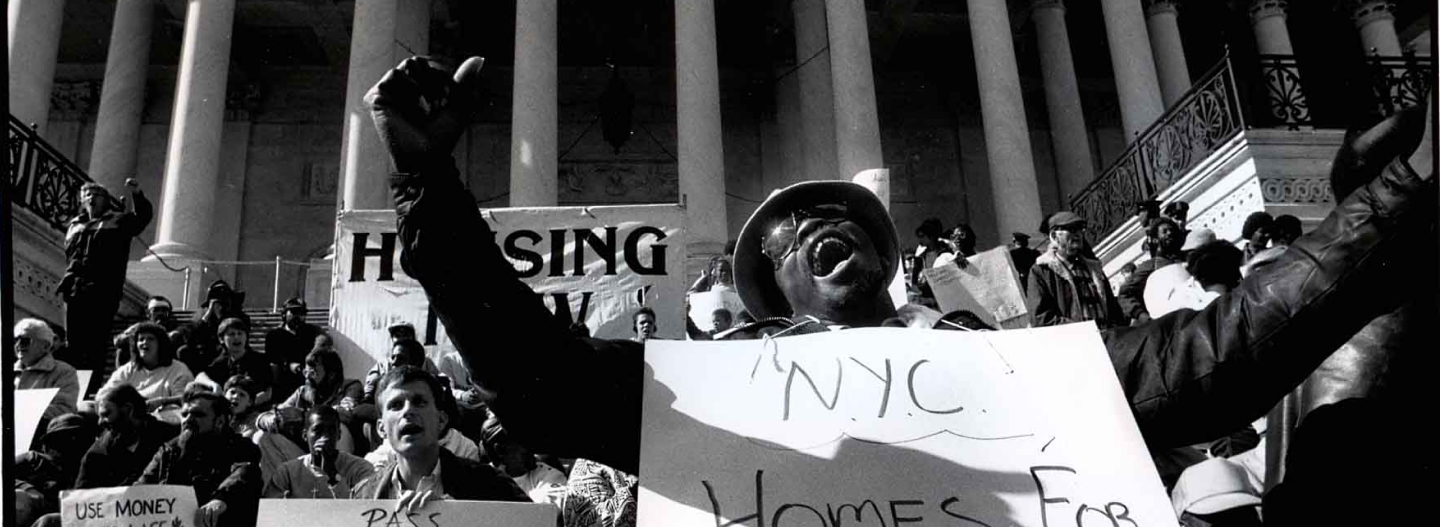
National Day of Action for Housing

The National Coalition for the Homeless invites you to join a NATIONAL DAY OF ACTION FOR HOUSING in Washington, DC, and in communities across the country, on Saturday, April 1, 2017. (view and share the flyer)

We are calling on you and those in your community to take action to demand action to fix the affordable housing crisis, address racial inequality in our cities, and end the criminalization of poverty.

On Saturday, April 1, 2017 we will hold a rally and overnight vigil on the National Mall, and at city and state legislative buildings across the country. Bring tents, bring signs, bring your friends and families and stand up for our collective need for safe, decent and affordable housing.

Here is what we are asking:

  1. Preserve funding and create further local, state and national Housing Trust Funds that fund housing solely for extremely low to moderate income households.
  2. Stop ordinances, policies and practices that criminalize and harrass people who are unhoused, promote racial discrimination, and prevent equal treatment of immigrants and those who identify as LGBTQ, especially in access to housing, employment and healthcare.
  3. Ensure that safety net programs like food assistance and emergency housing are available to all of those who experience the loss of stable housing.

By standing together we can make the changes necessary to end homelessness in America!

New report once again misleads lawmakers and the public about the supposed ‘decline’ in numbers of people experiencing homelessness in the United States.

Housing UndercountWashington, December 19, 2016 –
As we rapidly approach the end of another year, cities around the country are preparing vigils recognizing those who have lived and died without adequate housing in 2016. November’s release of the Annual Homeless Assessment Report (AHAR) to Congress by the Department of Housing and Urban Development may give those attending some small cause for hope, describing a 3% decrease in the number of men, women, and children experiencing homelessness, counted on a single winter night, over last year’s number.

Unfortunately the report leaves out some important information. For instance, the count in question tallies those staying in emergency and transitional shelters, as well as those who can be located outside. HUD’s recent decreases in funding for such shelters means fewer members of the homeless population are easily accounted for. HUD provides bonuses to communities that decrease their count, creating a disincentive for those conducting counts to locate every unsheltered person in their neighborhoods.

Furthermore, HUD only asks communities to report those who it considers “literally homeless.” This doesn’t include the large numbers of individuals and families who are doubled up or “couch surfing” with friends and relatives. This unrealistic definition of homelessness explains why HUD reported just over 120,000 children experiencing homelessness on a given night, while the Department of Education has reported well over ten times as many children youths registered as homeless in recent years, a number that has more than doubled over the last decade.

The reports of HUD and other governmental and non-governmental organizations purporting to chart a decline in the numbers of those experiencing homelessness are doing a disservice to those men and women who we have lost this year without the basic dignities afforded by secure housing. While so many of those who are tasked with ending homelessness in America won’t admit to the actual scope of the problem, they cannot be relied upon to enact meaningful solutions to it.

The National Coalition for the Homeless calls upon the Department of Housing and Urban Development to face up to the reality that homelessness is not diminishing in America. We call on HUD and its allies to work with us and other organizations to put into place housing policies and investments that will ensure an end to the memorial vigils that have become a disgraceful necessity every December 21st, the longest night of the year.

Press Contact:
Megan Hustings, Interim Director
Phone: (202) 462-4822 ext. 234
Email: mhustings @ nationalhomeless.org

hhaw-logo-websiteToday, hundreds of colleges, churches, community groups, and service agencies across the country announced the start of Hunger and Homelessness Awareness Week, an annual week of action where people come together to draw attention to poverty in their communities. Participating organizations will spend the week holding educational, community service, fundraising, and advocacy events to address these critical issues.

“This is the time of year when we all reflect on our lives, finding gratitude and peace in where and who we are,” said Megan Hustings, Director of the National Coalition for the Homeless. “But there are so many families that will not be able to come together during the season, strained by poor paying jobs, the lack of affordable housing, and even destitution. Hunger and Homelessness Awareness Week brings communities across the country together to educate ourselves and our elected officials about what is really happening in our communities.”

H&H Week: A Quick Reference Guide

Hunger and Homelessness Awareness Week is co-sponsored by the National Coalition for the Homeless and the National Student Campaign Against Hunger and Homelessness. The event originated at Villanova University in 1975, and now takes place in nearly 700 communities across the country.

“Hunger and homelessness are epidemics that sadly affect every community across America,” said James Dubick, Director of the National Student Campaign Against Hunger and Homelessness. “Hunger and Homelessness Awareness Week gives local groups a collective opportunity to tackle these issues head on, rally public support, and call for solutions.”

Let us reiterate, it is imperative that we let our voices be heard that homelessness and hunger need to be addressed in real ways. We need to hold our elected officials and communities accountable to ensuring that all of our neighbors have access to safe, affordable housing, and the supports needed to maintain that housing.

Ideas for raising awareness

National data suggest that only 75% of the need for emergency shelter is being met. As a result, encampments of people experiencing homelessness have sprung up as homelessness has become more visible.

With everything from sleeping bags, tents and camp stoves to tiny homes, makeshift communities are attempting to fill important gaps in shelter, housing and other social services. Homeless encampments also serve as a point of access for outreach workers and others looking to engage those experiencing homelessness.

Unfortunately, these encampments have been met with varying levels of hostility by the wider communities in which they are located. The National Coalition for the Homeless’ new report, Swept Away: Reporting on the Encampment Closure Crisis, examines the disturbing trend of forced removal of outdoor sleepers by law enforcement, city workers, or even private contractors.

“We understand that municipal governments are trying to respond to a difficult situation,” says Megan Hustings, Director of the National Coalition for the Homeless, “But further displacing people who have nowhere else indoors to go is an inhumane response.”

In cities where well-publicized events are being hosted, the sweeping of homeless encampments is particularly aggressive. In the run-up to San Diego’s recent Major League Baseball All-Star Game, camp residents across the city were threatened with fines and destruction of property if they did not relocate within 72 hours, an effort repeated during the popular Comic-Con international convention. San Diego has continued to disrupt encampments on a regular basis, seemingly copying a much criticized similar effort in Denver, Colorado.

In San Francisco, California, where current law already prohibits the building of encampments, a ballot initiative with the somewhat misleading title, “Housing Not Tents,” has been introduced with the intention of allowing authorities to remove encampments with as little as 24 hours written notice and the offer of a shelter bed or the acceptance of a bus ticket. The initiative would empower the city to seize residents’ personal property and dispose of it after a set period of time.

Despite efforts to the contrary, encampment residents regularly lose life-sustaining materials like tents and blankets, but also personal property, including valuables, identification, and medications. Swept Away looks more closely at the causes behind the rise of encampments, the way various communities have chosen to confront the issue, and recommendations for how our unhoused neighbors deserve to be treated in their own communities.

Proponents of measures aimed at facilitating the removal of encampments have suggested that allowing the existence of such camps somehow enables homelessness — a notion unsupported by the lack of affordable housing nationwide. Additionally, breaking up homeless communities can leave individuals more vulnerable to those who prey upon them, as outlined in our recent report, “No Safe Street: A Survey of Hate Crimes and Violence Committed Against Homeless People in 2014 & 2015.”

While dedicated to ending homelessness, the National Coalition for the Homeless also recognizes the need to protect the lives of those currently experiencing homelessness, especially during times when they cannot all be housed. Cities considering urban camping restrictions should follow the lead of a select few that have already passed more humane laws regarding encampment sweeps, such as Indianapolis. Encampment residents should be given ample warning prior to a sweep, and it is imperative that cities do not immediately discard the belongings of homeless residents. Most importantly, sweeps should not be conducted without available housing and supportive services for those who are displaced as a result.

At a time when those experiencing homelessness far outnumber the number of shelter beds allocated to them, we must find a better way to serve our unhoused neighbors without destroying the camps they so often call home.


Read the full report.

Learn more about the Criminalization of Homelessness.

The National Coalition for the Homeless is deeply saddened by the recent senseless attacks on men sleeping outdoors in San Diego that have left three dead and one more critically injured.

But we are not surprised.

Over the last several months, San Diego has been sweeping homeless encampments, constantly displacing residents who have nowhere else to go and disposing of items of personal and survival value. Quietly, the city laid down boulders beneath an overpass, on a side walk often used by houseless folks to rest.

Should any of us be surprised that a high school cheerleader was recently charged, along with two teenage brothers, in the beating death of a homeless man just outside of the city?

In the early 1990’s, the National Coalition for the Homeless noticed that a growing number of cities were passing ordinances banning everyday activities carried out by people who were homeless. Bans on panhandling, camping, or even sharing food in public places have since become common place in cities across the country, just as poverty and homelessness have been increasing.

No Safe Street: A Survey of Violence Committed against Homeless People a new report published by the National Coalition for the Homeless finds that over the last 17 years, at least 1,657 people experiencing homelessness have been the victims of violence perpetrated for the sole reason that they were unhoused at the time. This number includes 428 men and women who lost their lives for being homeless, and in the wrong place at the wrong time.

It is easy to see a correlation between the appearance of laws criminalizing homelessness, and the increase of hate crimes or violent acts against homeless people. A 2014 report from the National Law Center on Homelessness and Poverty found that out of 187 cities that have enacted some type of law criminalizing daily activities often carried out by people without stable housing, 21 cities were located in California (11%) and 17 were in Florida (9%). No Safe Street finds that out of 199 attacks against homeless persons in 2014-2015, the largest share of incidents took place in California (43 attacks) and Florida (18 attacks).

One possible explanation for this is the message that criminalizing homelessness sends to the general public: “Homeless people do not matter and are not worthy of living in our city.” This message is blatant in the attitudes many cities have toward homeless people and can be used as an internal justification for attacking someone.

No Safe Street cites more than double the number of fatalities from bias motivated violence against people who are homeless than the FBI has tracked for all federally protected classes combined. Professor of Criminal Justice at California State University San Bernardino, Brian Levin, finds that “the characteristics of bias attacks against the homeless are very similar to that of hate crime in general. As with other hate crimes, offenders fit a pattern: typically, young male “thrill offenders” acting on stereotypes, seeking excitement and peer validation.”

Moreover, in communities across the country (except for a handful of progressive cities and states), it is perfectly legal to discriminate against someone who is unhoused in employment, housing, or even in delivery of health or social services. What message are our municipalities sending to their residents?

As we have attempted to legislate homelessness out of sight in our communities, we have created a hostile environment for people who fall on hard times. Social services have not kept up with the pace of need, and in many cases have been cut or restricted. Instead of responding with compassion and generosity, on the whole, our communities have responded with prejudice and judgement.

Study after study has found savings for public services when someone is housed versus homeless. In fact, the University of Denver’s School of Law released a report earlier this year which found that just six Colorado cities have spent more than five million dollars enforcing 14 anti-homeless ordinances over the last 5 years through policing, court and incarceration costs.  Our failure to end homelessness has only brought financial and human costs to our communities.

As we look towards a change in our federal leadership, the National Coalition for the Homeless calls on our fellow citizens to prioritize compassion over comfort. The solution to homelessness, and the best method for preventing further violence, is simple: housing.


Read the full report.

View more about Hate Crimes against people experiencing homeless.

7 ways to help the homeless sleep safeCollege students pulling all nighters to write a paper, newborn babies keeping their parents up at all hours, breathing disorders, your partner’s snoring, a good book, stress – there are any number of things that keep housed folks up at night. There is loads of research that shows that Americans are terrible at getting enough sleep. But are we all aware that we can add our cities’ own bad policy to the list of things keeping us from a good nights rest?

March 6-13th marks National Sleep Awareness Week, and while many are learning about powering down their devices before bed or other relaxation techniques, there are thousands of Americans who are being all but sleep-deprived by anti-camping bans and ordinances disallowing sitting or lying in public places.

Homelessness is at crisis levels, and there is simply not enough shelter space for the shear number of people who have lost permanent housing. This past August, the US Department of Justice suggested public camping bans could be unconstitutional, saying, “Criminally prosecuting those individuals for something as innocent as sleeping, when they have no safe, legal place to go, violates their constitutional rights.”

Homelessness is tough in so many ways, but we don’t always realize the critical role sleep plays in helping our neighbors get back on their feet. It has been well documented that not having your own bed in which you can relax, feel safe and rest can be damaging to one’s health. Watch this video from our partner Denver Homeless Out Loud, where a young woman details how the lack of sleep has affected her since she became homeless.

Its high time we stopped punishing our neighbors for losing their home and being down on their luck, and started to invest again in affordable housing. Help us promote #SafeSleep and the #Right2Rest during National Sleep Awareness Week!

El Niño rains in California, blizzard conditions in the northeast, mother nature seems to be reminding us that outdoors is no place for humans to live.

If you are in need of shelter, or if you see someone needing assistance, here are some tips:

  • If you or someone else appears to be in a dangerous situation, do not hesitate to call 911. 
  • In some cases, it will be safer for people to remain in their outdoor encampments. Be sure you have or help folks with getting enough warm clothing and bedding.
  • Be courteous! Treat folks with respect and compassion!
  • Arm yourself with warm cloths (hats, gloves, etc), food or food vouchers, and most importantly, information about local emergency shelters and hotlines. See below!
  • There is generally not enough shelter beds for the number of people experiencing homelessness, most cities will have some time of warming center or overflow shelter, but your city may not.

We have a larger list of local resources in our Directory, or see below a quick list of emergency hotlines in each state (if you do not see your city, a good rule of thumb is to contact your city or county government, or find your local Continuum of Care):

Phoenix, AZ 602-263-8900
Los Angeles, CA 1-800-548-6047
San Diego, CA Dial 211
San Jose, CA 408-510-7600
San Francisco, CA Dial 311
Denver, CO Dial 211
Washington, DC 1-800-535-7252
Jacksonville, FL Dial 211
Atlanta, GA Dial 311
Chicago, IL Dial 311
Indianapolis, IN Dial 311
Louisville, KY Dial 311
Boston, MA Dial 311
Baltimore, MD 410-433-8145
Detroit, MI Dial 211
Minneapolis, MN 612-348-4111
Kansas City, MO 816-474-4599
Charlotte, NC 704-432-7233
Omaha, NE Dial 311
New York, NY Dial 311
Las Vegas, NV 702-828-1556
Columbus, OH 1-888-474-3587
Oklahoma City, OK 405-415-8410
Portland, OR Dial 211
Philadelphia, PA Dial 311
Memphis, TN 901-260-4663
Nashville, TN 615-880-2526
Austin, TX Dial 311
Dallas, TX 214-428-4242
El Paso, TX 915-546-8150
Fort Worth, TX 817-810-9797
Houston, TX Dial 211
San Antonio, TX Dial 311
Seattle, WA Dial 211
Milwaukee, WI Dial 211

Though our offices are closed for the Federal holiday, we are plotting how we will work towards a true end to homelessness in 2016.

Here is our holiday wish list for the coming year:

  1. For each one of the Presidential candidates to explain how s/he will reinvest in affordable housing and work to end homelessness.
  2. That each of our cities stops ticketing, harassing and arresting our homeless neighbors because they have nowhere but public spaces to eat, sleep, store personal items and take care of their hygiene and bodily needs.
  3. That more landlords will lease their properties to renters who have housing vouchers.
  4. That Congress will fully fund, and preserve funding for, the National Housing Trust Fund.
  5. That more cities and states will adopt Homeless Bill of Rights legislation that protects people who are unhoused from discrimination.
  6. That Congress adopts a minimum wage that is a living wage based on local cost of living.
  7. For more community engagement around housing and homelessness through participation in the Faces of Homelessness Speakers’ Bureau, National Hunger & Homelessness Awareness Week, and National Homeless Persons’ Memorial Day.
  8. For all states to expand Medicaid under the ACA, and to invest in mental health infrastructure.
  9. That Federal and municipal governments follow through on their promise to end chronic and veteran homelessness by the end of 2016.
  10. That cities expand emergency services to meet the needs of everyone who experiences homelessness or struggles to maintain housing, including youth, ex-offenders, families and the elderly.

Will you help us realize these goals?

Here are 3 quick reasons to support NCH:

  1. Have you visited our website this year to learn more about homelessness?
    It takes one staff member (there are 3 of us) at least one full day per week to keep our site updated – during that time, an average of about 1,500 people (per day) have accessed our pages. In 2016, we’ll be working to release updated reports and factsheets, as well as build a tool you’ll be able to use to quickly find info about homelessness in your community. Give to help provide research for other students, reserchers and advocates!
  2. Have you ReTweeted or shared our posts on Twitter, Facebook or Instagram?
    We daily search through current events to bring you the most up to date and relevant news about advocacy to end homelessness. We’re serious about reaching you where you are. We hope you’ll be serious about supporting our work through your favorite online giving site: Network for Good, PayPal, Razoo, GoodSearch, AmazonSmileJustGive, or find us on other sites using our Tax ID #52-1517415!
  3. Have you seen a Faces of Homelessness panel speaker tell their story?
    We work with partners across the country – from BBYO, the Religious Action Center and the CloseUp Foundation, to schools like Villanova and Georgetown Universities – to schedule over 300 Faces presentations each year. If you are one of the approximately 15,000 people who met a speaker this year, you benefited from NCH programs! Give today so that others will have the opportunity to hear James read his poem “Arugula Salad” or to give Steve a big bear hug!

In recent years, as the fashion of criminalizing the people experiencing homelessness in the United States by local governments has grown more popular, the nation’s capital, Washington, DC, has largely respected the rights and needs of its poorest residents. Unfortunately, it seems that even as the city’s new mayor has publicly dedicated her administration to giving those experiencing homelessness within her jurisdiction the supports they need, her office is moving to displace the small number of men and women who have formed their own refuge from the city’s dangerous streets and chaotic shelters. A very troubling way to celebrate National Hunger & Homelessness Awareness Week (Nov. 14-22).

Postcard FrontErected atop an empty stretch of grass in the Foggy Bottom neighborhood of Washington, co-existing alongside foreign embassies and luxury hotels, a small community of tents serves as home for a tight-knit, diverse community of unhoused Washingtonians. In recent weeks, that community has had to face the possibility of dislocation, despite the fact that many of the camp’s housed neighbors support them. According to WTOP, a local news station, Marina Streznewski, who serves as president of the Foggy Bottom Association, believes homeless residents are better off where they are than in the city’s notoriously overcrowded shelter system. “It may be cold out here, but it’s safer.”

By the time you read this, these men and women may already have been relocated. The city moved on Monday to close down the camp, but media attention and an alleged refusal by local law enforcement to assist the mayor’s office in the tear-down has meant that many of the tents remained in place at noon of the following day. However, members of the besieged community believe it’s only a matter of time before they and their belongings face an uncertain future back out on the street. Worse yet, vans sent to relocate residents have reportedly refused to tell them where they’d be taken if they complied with the city’s order.

If you are a resident of the District of Columbia, or if you care about the plight of these and other people experiencing homelessness in the most powerful city in the world, we encourage you to contact Mayor Muriel Bowser’s office by phone (202-727-6300), email (eom@dc.gov), or on social media (tweet @MayorBowser), and remind her that all of her constituents deserve to be treated with respect, and to be sure these and all unhoused residents of the area are offered safe and accessible shelter or permanent housing.

While you’re at it, you can sign our petition asking the District government to join Rhode Island, Connecticut, Illinois, and Puerto Rico in enacting legislation to end legal discrimination against our unhoused neighbors.

Awareness Week Logo '14Today kicks off our annual week of raising awareness and taking action against on our ongoing homeless crisis.

Hunger and Homelessness Awareness Week originated 40 years ago, in 1975, at Villanova University in Pennsylvania. From the school’s website, “The initiative began when a group of Villanova students, recognizing the power education could play in the fight against homelessness, decided to coordinate a week of activities around the issues.” The National Coalition for the Homeless has since partnered with the National Student Campaign Against Hunger & Homelessness to bring greater awareness of the effects of poverty to communities nationwide. Annually, at least 750 schools and community groups take part in the week.

Though we are thrilled with the ongoing participation in National Hunger & Homelessness Awareness Week, we also wonder how much longer we will have to keep building awareness before as a country, we enact policies that house and support our neighbors. Join us over the next week to continue our fight for greater investment in affordable housing, to support our labor through living wages, to listen to the struggles of those who are currently unhoused, and those who are at risk of losing their homes and to work in partnership with our neighbors and policy makers to protect our basic human rights and dignity.

Be sure to register your event, look for an event nearby, or find out more at https://nationalhomeless.org/about-us/projects/awareness-week/

Some more highlights over the coming week:

  • NCH’s Faces of Homelessness Speakers’ Bureau will be traveling to six states and the District of Columbia to share personal experiences with homelessness.
  • For the second year in a row, Storied Streets will be hosting free screenings of this powerful documentary November 13-15, with a live Twitter chat on Sunday, Nov. 15th at 8:30pm EST. Be sure to follow @StoriedStreets to take part.
  • Faith leaders will be holding town hall meetings on homelessness in Washington, DC on Sunday Nov. 15 and Monday the 16th. See the Presbyterian Network to End Homelessness for more.
  • We will be posting lots of great information about poverty, hunger and homelessness to our social media, as well as highlighting others doing great work. Be sure to follow and share on Facebook, Twitter and Instagram, hashtag #NHHAW.
  • We will be releasing an update to our report on feeding restrictions, one of the more disturbing efforts by cities to move homelessness out of sight.

Stay tuned for more, and thank you for being a part of the movement! Together we can end homelessness.