Bring America Home NOW Rally

For Immediate Release 

October 19, 2021

Contact:
National Organization for Women, NOW Press Team,  press@now.org 
National Coalition for the Homelessness, Donald Whitehead, dwhitehead@nationalhomeless.org 

October 20: Bring America Home NOW Rally & Press Conference 

National Organization for Women, National Coalition for the Homeless and End Homelessness Advocates Demand Investments to Solve Housing Inequality Crisis 

Washington, D.C. – The housing crisis in the United States has reached a critical point due to long-standing structural inequities compounded by the impacts of the COVID-19 pandemic. As Congress debates President Biden’s “Build Back Better” Infrastructure Bill, advocates from across the affordable housing, women’s rights, and social justice movements have come together in an unprecedented coalition calling on Congress and President Biden to prioritize investments to solve this public housing crisis.  

The coalition, led by the National Organization for Women and the National Coalition for the Homeless, is urging Congress not to cut over $300 billion in much-needed funding for long-overdue renovations of severely dilapidated public housing, an expansion of over 500,000 units of affordable housing for low- income Americans, and the removal of toxic lead paint from public housing. As millions of Americans fall behind on their rents and mortgages, and with the imminent risk of evictions during freezing winter weather conditions, advocates are also urgently calling for an extension of the CDC moratorium on all evictions throughout the duration of the pandemic to avoid the needless tragedy of unhousing possibly millions of families, women, and children.

“Homelessness is a feminist issue that NOW’s activists are deeply invested in solving. We know numbers show that women – especially women of color – are disproportionately affected by homelessness,” stated Christian F. Nunes, president of the National Organization for Women (NOW).  “This issue is compounded by gender-based economic inequality, racial discrimination and the impacts of domestic and sexual violence, which contribute to women, children and families becoming the fastest-growing segments of the homeless population.”

 “America is the wealthiest country in the world, and we can easily afford to pay for the President’s bill, and therefore not cut the housing investments in the legislation. We must have the political will and emergency citizen advocacy to make this happen,“ said Donald Whitehead, executive director of the National Coalition for the Homeless. “The majority of the American people, both Democrats and Republicans, support the President’s plan. Now we the people are organizing a mass mobilization to demand that Congress and President Biden pass the bill, without any cuts to the desperately needed housing provisions.” 

“We as a nationwide progressive end homelessness/housing for all movement will not allow millions of Americans to be evicted and thrown into the streets during the lethal Covid-19 pandemic. Have we no shame,” added Joel Segal, national director of the Bring America Home Now Campaign. “Furthermore, the national BAHN campaign’s most important priorities right now are to stop any cuts to affordable housing in the President’s Infrastructure Bill and a zero-tolerance policy for any evictions during the Covid-19 Pandemic and freezing winter temperatures. It’s unamerican, immoral, and cruel for we the people not to intervene now to stop the unnecessary, life-threatening, and destabilizing nationwide eminent eviction emergency.” 

In addition to calling for investments within the Build Back Better infrastructure package, the coalition has also called for meetings with Housing and Urban Development Secretary Marcia L. Fudge and Treasury Deputy Secretary Wally Adeyemo to discuss allocating funds to the development of housing crisis “navigators,” emulating the success of the Affordable Care Act program to simplify the application process for rental assistance. The coalition hopes to meet with Speaker Pelosi, Senate Majority Leader Chuck Schumer, and other congressional leaders to discuss how our country can create lasting solutions and provide housing security for our most vulnerable populations. 

WHAT: Bring America Home NOW Rally & Press Conference

WHEN: Wednesday, October 20th at 10:00am-12:00pm ET

WHERE: Capitol Hill, Constitution Ave & New Jersey Ave. NW (Robert Taft Memorial)

WHO: Bring America Home NOW Campaign featuring NOW & the National Coalition for the Homelessness, members of Congress, and other guest speakers

MORE INFO:  Additional confirmed speakers and logistical details, including location, will be updated here. Members of the media interested in attending or connecting with speakers can contact press@now.org or dwhitehead@nationalhomeless.org.

Flyer for rally in DC on October 20, 2021, calling to Stop Evictions, Housing is Infrastructure

Bring America Home Now Campaign Supports the Build Back Better Act

Bring America Home Now: A Comprehensive Grassroots Campaign to End Homelessness in the U.S. is led by people who have themselves experienced homelessness and is focused on the passage of federal legislation aimed at addressing the interconnected solutions to the decades-long epidemic of homelessness in the United States. 

Bring America Home is focused on six key policy areas: 

  • Housing
  • Health
  • Livable incomes 
  • Education/Training 
  • Civil Rights 
  • Racial Equity

Bring America Home, therefore, supports Build Back Better as it includes important provisions within many of the Campaign’s core elements. Specifically, if passed, the Build Back Better Act would help move us toward the goal of preventing and ending homelessness by making significant investments in Housing Choice Vouchers, the Housing Trust Fund, rural rental housing, HOME, and CDBG programs. Additionally, the Act contains important provisions around zoning, fair housing protections, and addressing homeownership disparities through a down payment fund. Beyond housing, Bring Back Better further seeks to secure broader economic security, as envisioned by the Campaign, through job training and workforce investments, an expansion of the child tax credit, extending family leave, and increasing childcare options. 

It is urgent to act. To ensure the inclusion of these critical investments in Build Back Better, it is necessary your Senator and Representative hear from you immediately. Call Now and express your support for these provisions within the Bring Back Better Act. To find your representative and Senators, click here: GovTrack.us: Tracking the U.S. Congress or call the U.S. Capitol Switchboard at (202) 224-3121

For more information on Bring America Home Now

National Coalition for the Homeless Bring America Home NOW! – National Coalition for the Homeless (nationalhomeless.org)

Bring America Home NOW logo

By Zach Bernstein

Joel Segal has spent the last several decades answering a question that plagues activist organizations while he worked on Capital Hill as well as out in the field—how do we get things done? His vast wealth of experience with outreach, activism, and policymaking at every level of government has allowed him to gain a thorough understanding of how to make change actually happen. Segal is a problem-solver, utilizing a systemic understanding of issues to craft policy solutions to resolve those problems with a conviction that we can overcome barriers facing the voters through collaboration and setting a goal to make change happen. Segal was recently hired to take on the campaign of the National Coalition for the Homeless “Bring America Home Now“—a comprehensive strategy to end homelessness in the United States. 

Show them how to solve it, and how to pay for it,” he said. “Get experts together and write bills—but do it with the people impacted. Then you’ve got to pass the bill.” Segal’s intense focus on helping those experiencing oppression is what sets him apart from most other policymakers in DC. “We can’t dance around be nice to the system,” he said. “You’ve got to shine a big mirror, show them this is what you’re doing to people.” Making people aware of the struggles of others and amplifying the voices of the oppressed is a major part of Segal’s strategy, one which lends itself to a model of social justice which is intent on making things happen.

One of Segal’s major achievements has been as a pioneer of the universal healthcare movement and as a co-writer of the original Medicare for All Bill as a staffer for Rep. John Conyers, introduced in Congress in 2003. Segal’s fight for Medicare for All began when he was kicked out of George Washington University Hospital for being uninsured. After the experience he promised himself he would start a universal healthcare movement—and he did just that. He began by meeting and getting to know other uninsured people online, then he began attending meetings of the Gray Panthers, an activist group, with whom he discussed the possibility of fighting for universal healthcare. He started holding town hall meetings on the issue, and eventually launched his campaign with a speech on the steps of the Capitol with Rep. Barney Frank and then-Rep. Bernie Sanders. 

Four weeks later, Segal was hired to the staff of Rep. Conyers, with whom he traveled to congressional districts around the country, holding town halls to promote the cause of universal healthcare. He brought together people who were uninsured, activists, and members of Congress. Segal firmly believes in the power of town hall meetings—they “take the emotion and anger and frustration, and bring it right to the doorstep of elected officials and civil society leaders,” he says. More importantly, town halls transform people’s feelings. “People aren’t going to talk to homeless people,” he remarked. “You have to bring the pain and suffering to them.” Segal also advocated for a systemic approach: “Always try to show how structural deficits create an amazing amount of trauma and pain that is immoral. Just because you have a system that’s in place doesn’t mean that it’s a moral system.” 

The next step is to organize around policies, says Segal. Mobilize in the streets, and then pass reforms, he says. Segal is insistent that legislation should be the most important goal of the movement, saying that while suburban activists may deny the importance of policy, legislation has the power to make a real difference to the lives of people living in shelters or on the street. Always tie your activism to legislation, always march with a purpose, he said. That’s how you create a movement.

Segal centers his activism around building passionate communities. In order to build a movement, “you’ve got to find the right people,” he believes. Building communities and families with similar interests, compassionate hearts and sometimes a little humor is the key to successful organizing. Segal cites his Jewish heritage and upbringing as a major inspiration for this philosophy. For thousands of years, he explained, the Jewish people survived by laughing, by caring for each other, and by enjoying life—even in the face of great adversity. This is the sort of community Segal seeks to emulate in the movements he creates. “You don’t build a community by being corporate,” he said. Building a community by fashioning relationships with one another is how you create a successful movement. And, he pointed out, by building those relationships, people who aren’t necessarily invested in the specific issue will offer support if they like the person pitching their support and if they have developed a connection. 

But it’s not always such smooth sailing for Segal—he is as aware as anyone that the work of an activist can be discouraging. But, he said, “righteous indignation will keep you going.” He recalled some work he did in Congress, when he and others plastered the halls with a laminated picture of an uninsured family. That’s what keeps him going, Segal reflected. There are poor people, sick people, and seniors in this country with no rights to healthcare or housing—“and those are things they can’t live without,” he said. “We’re the richest country in the world, so we’ve got to figure this out.” “Go where the pain is, keep with those people, walk with them,” he said. Doing that, seeing and understanding the hardships they are going through, should get you through any discouragement.

It’s important to Segal that he always walks with the people he’s trying to help, never above them. He always is sure to organize “the people at the tip of the oppression” first in order to build communities based on love and care. In one story he told, Segal started up an emergency winter shelter by taking over a park with about 120 people from a shelter, promising the people living in tents they wouldn’t be left out in the cold. The key, Segal recalled, was going directly to the people in the tents and teaching them how to organize, how to do TV interviews and other such skills. Segal is well-practiced in building bridges, especially with people with whom he, or the organization he is working with, might have little in common. “Respect the person when you first meet them and ask them what they are working on,” he said. The most important thing, he advised, is to ensure “everyone benefits from the work you are doing. That’s how you build a coalition.”  He will work to organize diverse communities to put in place legislation that fundamentally changes the injustice that every unhoused person in America understands and has to overcome with BAHN.

“The problem with this country is we evolved into a Reagan nation,” Segal said—a nation where you look out for yourself and no one else. “How do we get people to care about each other again?” Segal wondered. “How do we get that back, just caring about each other?” That, Segal emphasized, is the crucial work of any activist but especially those working on behalf of a traditionally marginalized group. Not only must we fight for our political goals, but to do that we need to build coalitions, build power and in the end build families. By creating families of people dedicated to a cause, we can get things done. We can bring the pain of the people to the doorsteps of the powerful; we can get people to understand that pain; and most importantly we can write bills and pass laws to alleviate that suffering. Segal firmly believes that we can make the world a better place by working with one another. “There’s nothing more powerful than caring about each other,” he said as he begins his journey to Bring America Home. 

The pandemic has caused great disruption in our economy. But even before COVID started to spread across the world, decades of institutional racism had caused racially-based inequity in housing, education, employment, criminal justice, civil rights and health care. It is this underlying discrimination, plus ongoing political inaction to address the root causes of homelessness, that has left the U.S. with a situation where our emergency housing systems are in no way capable of assisting millions of households that may become homeless.

Our systems are already overwhelmed – We do not need another big wave of homelessness!

State and Local Guide to getting help

Read more about the current situation and need for rental assistance during the ongoing pandemic economic downturn:

Legal and Institutional Resources:

State and City Rental Assistance Examples:

******

The National Coalition for the Homeless (NCH) and the National Organization for Women (NOW), along with advocates, tenants, and community leaders will gather in late October, in Washington, DC, and communities across the country to push for the prevention of anyone falling into homelessness.

National Organization for Women and National Coalition for the Homeless call for addressing the emergency of evictions

“The homeless social service sector cannot accommodate any more people during this national health emergency with rising levels of COVID-19 in many communities. There are millions of dollars sitting on the table from the federal government and we need state and local officials to move mountains to get rental assistance out to those facing evictions,” said NCH executive director Donald Whitehead.  

In August, CNBC reported 11 million households are behind on their rent, but even if only 1 million get evicted the homeless shelters and services will collapse. Whitehead said that shelters have had to de-concentrate due to the pandemic and do not have the means of taking more people in to provide a safe place to stay while they look to find other housing options.  

We are urging the Governors to do whatever they can to stop any evictions into homelessness or they will see the huge rise in those living outside that Washington DC, San Francisco, Seattle, Los Angeles, Miami, Austin, and Phoenix have seen over the last year.  

The Problem

As of Thursday, August 26, 2021, the federal moratorium on evictions related to COVID was lifted. As many as 35 million people in the United States, whose livelihoods have been negatively impacted by pandemic-related economic shut down, are at risk of homelessness. 

What’s more, there are hundreds of thousands of people and families who were placed into hotel rooms with CARES Act funding that is due to expire. Many of these folks will be forced back onto the streets, and into congregate shelters, with desperately increased risk of contracting COVID.

This is a massive economic and public health crisis, disproportionately affecting people of color. We must protect individuals and families – and especially our children and youth.

What we Know

Without safe housing, millions of people will be forced into congregate settings, increasing the risk of transmitting COVID-19, at a time when hospitals are operating at capacity.  

Lack of capacity at the state and local level, combined with bureaucratic red tape, has prevented up to 75% of aid from the Federal government from reaching renters and desperate to maintain their housing. 

Even though it is illegal, there is the danger that families forced back into homelessness risk losing custody of their children. Studies have shown overwhelmingly that safe housing has more to do with a child’s wellbeing and achievement than any other single factor. 

People who are unhoused face targeted enforcement and criminalization of life-sustaining activities. This over-criminalization separates families, eliminates employment options and further jeopardizes the mental and physical health of those affected.

What has been done

Through the CARES Act and the American Recovery Plan, the federal government has allocated over $85 Billion to housing and homelessness programs, including $25 billion specifically for Emergency Housing Vouchers. Many communities have used these recovery dollars to house folks temporarily in hotel and motel rooms, and further secure individual housing accommodations. But many of these programs are closing and people are being returned to congregate shelters or the streets.

The U.S. Treasury has provided explicit direction to local agencies distributing funds to allow renters and landlords to attest to their need without onerous documentation. The U.S. Departments of Agriculture (USDA), Health and Human Services (HHS), Housing and Urban Development (HUD), and Veterans Affairs (VA) have also taken action to protect and support vulnerable renter households. The Secretaries of HUD and Treasury, along with the Attorney General, wrote a letter to governors, mayors, county Executives, and chief Justices and state court administrators to issue their own moratoria, stay evictions while rental assistance applications process, and use ERA and State and Local Fiscal Recovery Funds to enhance tenant access to legal representation. 

But we know that landlords and eviction courts are eager to start processing evictions that have been held up. We know too that without legal representation, tenants overwhelmingly are not able to exercise their full rights to remain in housing.

What we Need

NOW and NCH are urging local and state elected officials to assign additional staff, enlist every housing non-profit in their communities to get this money to the people in need! Additionally, struggling Americans need:

  • Congress to pass legislation halting any eviction until ERA and Recovery applications are fully processed. 
  • Emergency Rental Assistance and other recovery programs should assume presumptive eligibility, instead of forcing long drawn out documentation of need. 
  • Landlords should get paid all back rent, either through direct payment and/or tax credit within 30 days.
  • There needs to be broad civic education on renter rights and eviction and homelessness prevention, in addition to ending and addressing the underlying causes of poverty and homelessness.

******************************

The National Coalition for the Homeless (NCH), founded in 1981, is the oldest national organization focused on ending homelessness in America.  It is a national network of people currently experiencing or who have experienced homelessness, activists and advocates, community-based and faith-based service providers, and others committed to their mission of: To end and prevent homelessness while ensuring the immediate needs of those experiencing homelessness are met and their civil rights protected. NCH’s advocacy addresses the root causes of homelessness including lack of affordable housing, and partnering to write landmark legislation including the McKinney-Vento Homeless Assistance Act of 1987. 


The National Organization for Women is the largest grassroots organization of feminist activists in the United States. NOW has hundreds of thousands of contributing supporters and members in chapters in all 50 states and the District of Columbia. Since its founding in 1966, NOW’s purpose is to take action through intersectional grassroots activism to promote feminist ideals, lead societal change, eliminate discrimination, and achieve and protect the equal rights of all women and girls in all aspects of social, political, and economic life.

There are cities throughout the United States moving displaced citizens onto public land typically in tents calling these locations “sanctioned encampments.” It is the position of the National Coalition for the Homeless that housing is a human right which is defined as a safe, affordable, accessible place to call a home. The issue is that by identifying a “sanctioned encampment” cities by default are declaring that there are “unsanctioned” encampments.  NCH does not believe that people who are experiencing a period of homelessness should become involved with law enforcement while trying to survive. 

Photo credit: Justin Sullivan
  • It should go without saying, but in the current divided society with words being distorted to become propaganda for those who want to make it illegal to be without housing, we must say that a tent is not a permanent solution to homelessness.  Secure, safe, accessible and affordable housing should be available to every family or single individual who requests a place to live. 
  • In a free society, a person should be able to congregate with others and peacefully assemble in groups of their choosing not forced to live where the municipal government decides with neighbors of their choosing.
  • No one should be forced by any authority or coerced to choose between a place with large numbers packed together or face criminalization for being homeless and living without shelter. Whether this is forcing someone into a congregate living facility that strips a person of their dignity or sending them to a government sanctioned site to pitch a tent, people living in the United States have always cherished the free will to not be told what neighborhood or municipality to reside in by government or government funded organizations.
  • Persons who refuse forced entry into any facility must not be categorized as “service resistant” and thereby face incarceration or exclusion from services. They should receive trauma informed care by trained professionals and be met with services they request not services forced on them. 
  • In the current environment in which municipal governments have largely given up on affordable housing solutions to homelessness and instead resorted to using law enforcement as the primary point of contact for those without housing, we see a broader trend in which the mere offer of any kind of assistance or social service is enough for local governments and law enforcement to justify penalty, arrest or a threat to withdraw a person’s liberty for those who reject the help.  We believe that sanctioned encampments will be used as permanent placements for local jurisdictions to avoid providing safe, affordable, accessible and permanent housing.
  • Sanctioned encampments are an inexpensive alternative to building housing or shelters that serve the needs of those individuals and families who are experiencing homelessness. 
  • Local governments should not act as nannies for adults and force them to a segregated section of town to live under a set of rules developed by strangers under threat of arrest if the taxpayer strays from the sanctioned encampment.  

By Zachary Bernstein, Summer 2021 NCH Civil Rights Intern

During our conversation, Loh asked me to imagine my family and I were victims of one of the wildfires currently ravaging the western part of the country. Imagine your documents—passports, birth certificates, etc.—were destroyed in the fire, Loh said, and you do not qualify for assistance based on your economic status. It takes a while to get those documents back, Loh pointed out, and meanwhile you have nothing, and no help—nothing more than people staying in shelters, or tents in the woods, or directly on the street. “This is how people fall into deep poverty,” Loh told me.

Cleveland is one of the most historic cities in the United States, Loh said, and yet they allow nearly half the children in the city (46.1% in 2019) to live below the poverty line. That means one of every two children does not have enough to eat and goes to bed hungry nearly every night in Cleveland. This is clearly not the fault of each individual person, Loh emphasized again and again, but a failure of the system to keep people from slipping into poverty. 

Loh, a community activist in Cleveland, Ohio, works with the Northeast Ohio Coalition for the Homeless, the Homeless Congress, and with the Poor People’s Campaign to amplify the voices of those struggling with housing.  Loh has experienced homelessness for the past ten years. We spoke for just ninety minutes, but over the course of that time, Loh painted me a portrait of a system of shelters, service providers, and government bureaucracy that has failed its most vulnerable citizens at every level. Having dealt with activism and struggling as a person experiencing homelessness and as an activist, Loh understands the ins and outs of this system in great detail—Loh understands why it has allowed its citizens to live on the street, why it has allowed its shelters to fall into disrepair, and why it has repeatedly stonewalled efforts to help these people. But most importantly of all, Loh understands how to thwart that system.

To Loh, the most important principle of organizing for the homeless is that you cannot solely organize people experiencing homelessness. The reason people are homeless, Loh points out, is because they do not have resources, they are already overwhelmed with their own economic and personal issues. In addition, Loh observes, homeless people often do not want to go out of their way to let people know they are homeless. Loh believes that organizing for homeless advocacy must involve targeting those who are housed as well as those with resources and political will. A key is to target the powerful and those who have decision-making authority to enable the movement to thrive and achieve its goals. 

In one story Loh told, a class at the Cleveland Institute of Art wanted to start an artistic outreach project for the homeless community, but had several eye-opening experiences attempting to gain access to people staying in shelters, realizing the extent of the systemic failure experienced by the homeless. Working with Loh and other members of the Homeless Congress, one student in the class changed his project to stage mock groundbreaking and ribbon-cutting ceremonies that included testimonials from homeless people about their experiences in shelters. The project got publicity in newspapers, and Loh recalls how people were amazed at the stories that shelter residents had to tell. This is merely one example, but it demonstrates the power of pairing the knowledge of people who are experiencing or have experienced homelessness (such as Loh) with the power, time, and resources of those who are not. “You have to be able to organize people outside the system,” Loh emphasizes. Loh is a fixture at the County Council meetings railing against the lack of oversight of the shelters and services by the funders.  By respecting the resources and points of view each other brings to the table, we can build activist movements which have power and influence and are also built around those with lived experience and knowledge of the system.

In speaking about the importance of a systemic understanding, Loh emphasized that it is not enough to merely understand that the police do bad things to the homeless community, or that the justice system is broken, it is necessary to grasp the wider scope of the problem, to understand how systems interlock with one another to produce the problem. This is especially important, Loh says, because homeless people do not have the time or energy to think about why the system does not work. Several of Loh’s stories from the field have demonstrated how the system has failed the homeless community. The story of the art class attempting to reach out to the homeless community is especially demonstrative—at every step, Loh related, the government and service providers would delay or divert their attempts to reach out. When they wanted to create a sculpture for a shelter, they were told that the sculpture had to be metal because, a director told them, the people in the shelter were crazy, angry, stupid, and violent, and would destroy the sculpture in a short time. The reduction and mischaracterization of an entire community based on a dangerous stereotype is just one example of the pervasive and ingrained misunderstanding of the issue of homelessness.

Loh has extensively documented the mistreatment and horrible conditions at shelters with some amount of creatively particularly in the use of photography and poetry.  The shelter Loh stays at, which Loh refers to as “The HELL”. In a series of photos and captions, Loh shows insects on the floor of the only area the homeless people are allowed to eat, mold growing on the showers, and broken toilet stall doors. In a poem, Loh describes the inadequate facilities at the shelter which were originally built as two business buildings, and now involves lots of stairs, heavy doors to navigate. Loh characterizes her experiences as painful due to the injuries sustained from the unsafe environment of the shelter. Loh views these problems as a direct result of systemic failure, a system which causes Loh and thousands of others physical pain because of their lack of care. Loh described to me the network of service providers and government agencies in a dizzying flurry of acronyms. These agencies, which purport themselves to be non-profits, have no real intention of helping homeless people, Loh told me, they simply play politics to make more money. “Society produces homeless people,” Loh often says, because there is simply a lack of care and effort put into solving the problem, and these seemingly impenetrable systems of bureaucracy and capital foreclose any attempt at undermining it.

But that does not mean that there are no ways of doing so—in fact, Loh has successfully staged resistance from the inside. On one occasion, Loh was offered housing in response to complaints about the quality of the shelter. When they offered it, Loh asked if they could give 200 units because there are other people with problems like Loh’s—but they refused. Loh observed how demonstrative this experience was of the systemic failure: “You claim you are an organization to help homeless people and especially those with mental health struggles, but you have no real intention to help them.” But Loh also shows us how the system can be undermined—Loh’s request of 200 housing units is a perfect example of a way in which we can take a stand in spite of the failure of the system. Loh’s tireless dedication to solving the problem of homelessness for all and keen focus on understanding the very roots of that problem can inspire us to think in new ways about homelessness and the systems that perpetuate it. After all, if we can understand what causes the problem, we are one step closer to finding its solution.

After the Peachtree-Pine Shelter was forced by the city of Atlanta to close its doors in 2017, Anita Beaty has remained dedicated to activist efforts in the homeless community, continuing her decades-long career advocating and providing for those in need. Beaty, who oversaw the Peachtree-Pine Shelter for twenty years, has worked in the homeless community for much longer, her history of activism stretching as far back as the eighties. Whether it was activism or overseeing the shelter, Beaty consistently abided by a philosophy that no one should be left behind or left out. She has always placed high value on “letting the people who needed the service run the service,” and described how this philosophy of care for others informed her activism through the years. 

In one story, Beaty described a march she organized every year for twenty-nine years to celebrate homeless memorial day on November 1st. Various shelters, congregational groups, or other facilities would carry banners representing their group, made in the Peachtree-Pine art studio, along with a procession of crosses with the names of homeless people who had died that year. Each year, she recalled, there would be around 60 to 80 crosses. The procession finished at the Cathedral, where there would be a ceremony addressing the issue of homelessness, with a Litany created by the Task Force, and remembrances of the dead, name by name. 

Beaty and her organization, the Metro Atlanta Task Force for the Homeless, would hire buses to pick people up at every shelter that would participate, and the cathedral served them a hot meal. Looking back, Beaty recalled the event with fondness for the community it fostered. 

Beaty also reflected that a key component of her personal philosophy was an element of playfulness. “I need to enjoy what I do,” she said. In one story she recounted, Beaty and the Task Force were protesting the improvement project the city of Atlanta was undertaking at Woodruff Park prior to their hosting of the 1996 Summer Olympics. The park had been a gathering place for members of the homeless community, so when the mayor of Atlanta showed up in a hard hat for a photo-op groundbreaking on the construction, several of the protestors laid in the hole the mayor was to stand in, completely preventing their chance at a photo-op. Beaty chuckled as she recalled how the mayor’s face turned purple with rage, and when he retreated to his car the protestors followed, and it looked as if he was the one leading the march. Beaty also recalled a city council meeting they attended, when she handed out signs to everyone with them that said “true,” “false,” and “bald-faced lie.” When one of the council members said something about homelessness, the crowd held up their “bald-faced lie” signs, and Beaty recalled it was “hysterical” as the council member tried to talk down the signs. 

The visual arts have always been a major part of Beaty’s activism. During her time as its leader, Beaty opened an art studio at Peachtree-Pine, where shelter residents could come to draw, paint, and be creative. Beaty sometimes brought in artists from around the country, especially artists who had been homeless or experienced similar struggles. They “had a ball with us,” she remembered. “It was so exciting to intentionally bring in like-minded people who can show folks who’ve been excluded from all that that they, too, can dream.” Beaty emphasized that giving shelter residents access to resources that they would not otherwise have access to was a way of lifting them up: “There are artists who don’t even know it, don’t have the leisure to explore that, or could become artists and become part of that culture.” Beaty’s art studio is living proof that art has the power to bring out the best in people who are experiencing homelessness, mental health issues, or other problems. Not only that, Beaty noted that putting shelter residents’ work on display helped to bust public stereotypes about them. 

 “Let’s break the mythology,” she said. “Let’s take care of the fear by being together in fun places: food, art, coffee.” 

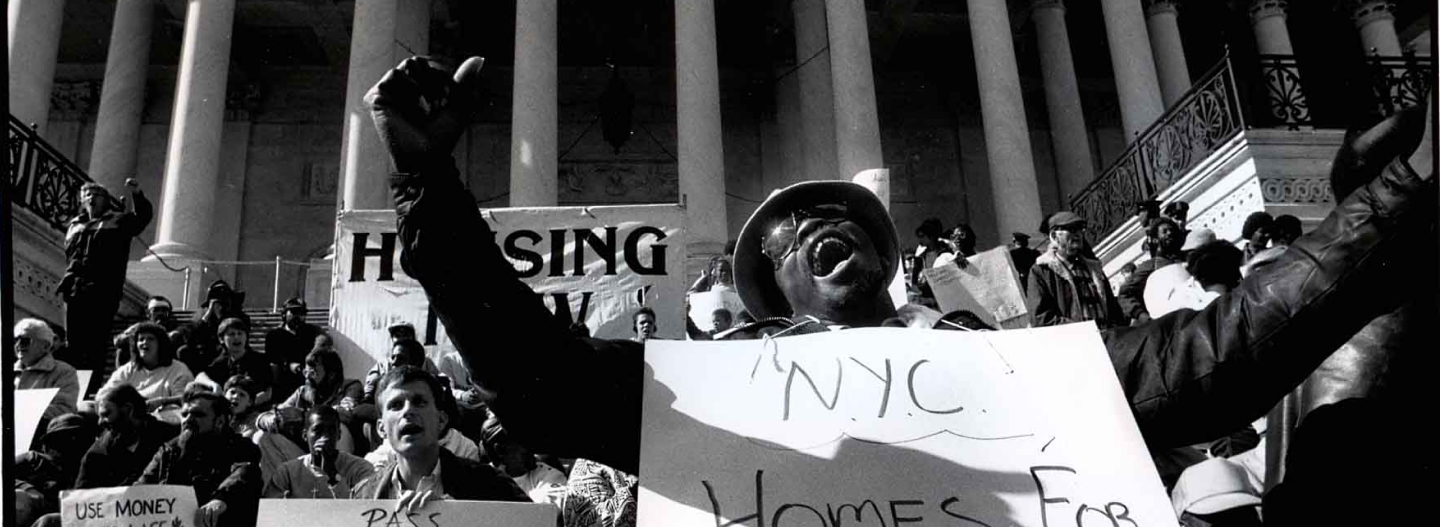
Beaty is sure to acknowledge that activist efforts do not always turn out the way we hope they will. When she took part in the Housing Now March on Washington in 1989, she recalls the immense expectations they had: “It was an action that we thought was gonna change the world, change this country at least, and sensitize the policymakers to the absolute necessity of changing laws,” she remembered. Obviously, the march did not have the effect Beaty and its organizers hoped it would.  The funding of a growing homelessness services “industry” was a direct result, but the right to housing, permanent affordable accessible housing, was then and is still the emergency need.

But Beaty also believes the march did make a difference, even if it wasn’t on the wide scale she had hoped it would. “Success is relative,” she said, recalling many times when she thought an effort she was part of was more successful than it was. But activism can still be successful, even if it’s in the smallest of ways. One outcome that Beaty pointed out from the Housing Now March was HUD policy, which, she says, she is still looking at to determine how it has evolved over the decades since the march. 

Beaty’s long career in activism shows us that success, whether small or large, can be found through determination to make a difference and a passion for celebrating inclusion. It is the stories of activists like Beaty that have the most to teach us about how to make change happen, and Beaty’s stories remind us that change happens in and with communities, leaving no one behind, including the excluded in operating, managing, and developing of all services designated for those very people, and working together to foster a just and creative world.

Has the Federal Emergency Unemployment Insurance contributed to vacant jobs being unfulfilled? Depending upon who you talk to, the response will be different. One thing we do know, unemployment benefits are temporary and does not provide long term stability compared to employment. Millions of jobs are left unfilled, and here are a few reasons why:

The federal minimum wage has remained at $7.25 per hour since 2009. That rate has not kept up with the pace of inflation while corporation revenue increase drastically. An employee at a Missouri hospital received a $6 coupon after surviving COVID. The CEO of the firm that owns the hospital received $30 million. CEOs of public U.S. firms earn 320 times as much as workers. Even some CEOS say the gap is too big. (nbcnews.com)

In this capitalistic society, money does not trickle from the bottom upward. It doesn’t even trickle down from the top in some cases. COVID has opened the eyes of the poor like nothing ever seen in this lifetime. Income, housing, health care, civil rights, and education are all issues that let America know, you are either sitting at the table, or you are part of the menu. Time for all of us to bring our own chairs, pull up, and break bread together in the spirit of reconciliation. Here’s how we can achieve that and close the wealth gap:

See also a previous post on the state governors who are ending federal unemployment benefits early for their residents. Email Kelvin Lassiter, Policy Analyst at klassiter@nationalhomeless.org for more details.

Washington, DC – After what many see as a disappointing April jobs report, state officials in at least 11 states are threatening to cancel the additional $300 per week added unemployment benefits passed in the American Rescue Plan. These benefits, paid for solely by the federal government, are set to expire in September 2021. Governors are attacking the generous unemployment compensation and plan to end the additional subsidy in June. Below are the states that might see pandemic unemployment benefits cut before the rest of the country:

StateBenefit End Date
AlabamaJune 19, 2021
ArizonaJuly 10, 2021
ArkansasJune 26, 2021
GeorgiaJune 26, 2021
IdahoJune 19, 2021
IowaJune 12, 2021
MississippiJune 12, 2021
MissouriJune 12, 2021
MontanaJune 27, 2021
North DakotaJune 19, 2021
OhioJune 26, 2021
South CarolinaJune 30, 2021
South DakotaJune 26, 2021
TennesseeJuly 3, 2021
UtahJune 26, 2021
WyomingJune 19, 2021
All other statesSeptember 6, 2021

Background:
The first pandemic economic recovery bills, passed in bipartisan efforts in 2020, supplemented unemployment compensation benefits with additional federal support of first $600 then $300 to stabilize the US economy and avoid a depression. The new Biden administration bolstered this critical unemployment fund in March 2021 with the passage of the American Rescue Plan, which provided $300 a week in from the unemployment compensation fund through September 2021. After what some consider to be a disappointing April jobs report, some legislators and Governors have stepped up to demonize the program, though economists have reported that these concerns about “too generous” benefits are simply not true.

Why you should take action:
The economy IS recovering with help of the American Rescue Plan, and recovery packages passed in 2020. Unemployment benefits, just like basic income programs, infuse money into the local economy. Households use the extra income to pay rent and utilities or to buy food and clothes for their kids. Here are more facts about the April jobs report and unemployment (thanks to our friends at the Economic Policy Institute):

  • Low-wage sectors—where workers are receiving a higher share of their prior income than in other sectors—saw much faster job growth than higher-wage sectors in April. This is exactly the opposite of what you’d expect to see if the $300 per week was keeping people from working.
  • Labor force participation rose rapidly in April, but the gains were all among men—women actually lost ground. Given that women still shoulder the lion’s share of caregiving responsibilities, this points to care needs being the thing holding back labor supply, not unemployment benefits. 
  • The disappointing net job gains in April were not due to a slowdown in hiring—hiring actually rose. The disappointing April job gains were due to a large increase in layoffs and other job separations among women (most often care-givers, especially for kids where schools are not yet open). 
  • Millions of workers still have legitimate health concerns about returning to work. But numbers show that for every 10% increase adults being fully vaccinated is associated with a 1.1 percentage point increase in employment. (Aaron Sojourner, Labor Economist)

Businesses are slowly opening, and will continue to do so after the CDC’s announcement that fully vaccinated people can resume most pre-pandemic activities. It will take time to get the economy back up and running. In the meantime, contact your Governor to say, “Don’t cut off unemployment! It puts needed cash in the pockets of hurting families, and helps stimulate our local economy!”

Extra cash has contributed to the economy rebounding, and taking away the benefits damages the ability for people to pay the rent or provide food. This philosophy will not incentivize Americans to return to work, but instead will further divide this country. Tell your Governor to #SaveUnemployment!