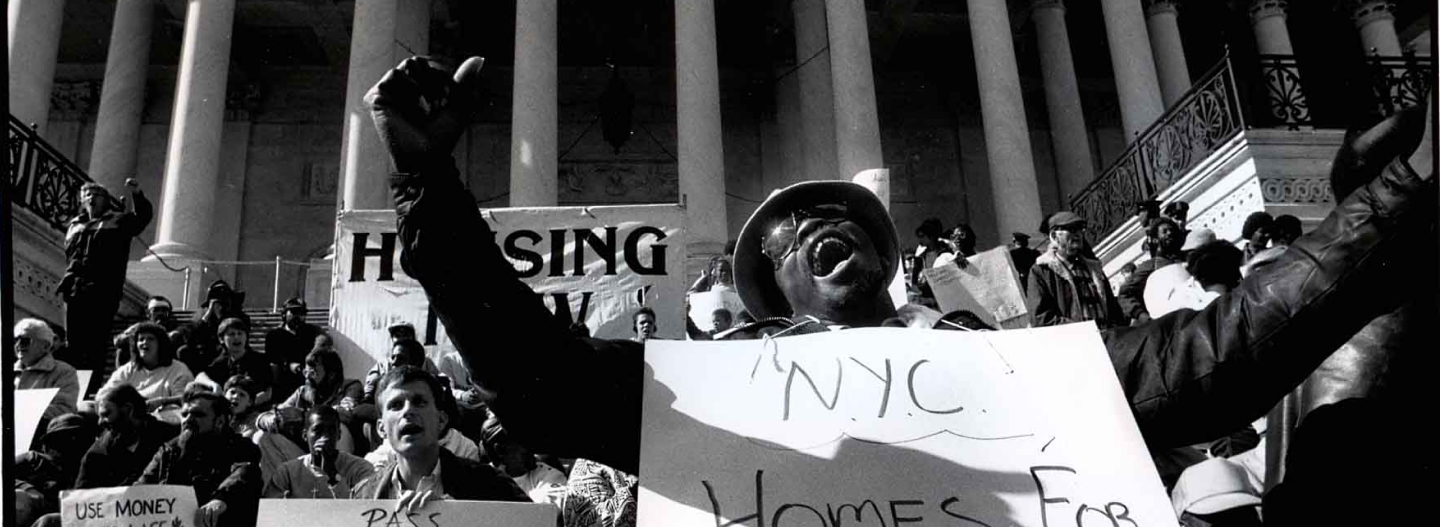
HUD puts teeth into effort to stop criminalizing homeless people

The Department of Housing and Urban Development (HUD) has released a Notice of Funding Availability (NOFA) for the Continuum of Care (CoC) Program for $1.89 billion for Fiscal Year 2015. The CoC Program distributes funding to homeless projects in communities throughout the nation. The deadline for applying for the FY 2015 CoC Program Competition is November 20.

For the first time, HUD will examine whether applicant communities are preventing the criminalization of those experiencing homelessness. In a 2014 report, the National Coalition for the Homeless (NCH) found over 70 cities that had or were considering restricting the sharing of food with people who were homeless. Other laws that disproportionately affect people without a permanent home include bans on camping in public spaces, bans on loitering or begging, even limits to the time someone can spend sitting or lying down on a city sidewalk or park bench.

“The National Coalition for the Homeless is pleased to see HUD continuing the federal proactive approach against the continued criminalization of people experiencing homelessness,” state Megan Hustings, Interim Director, NCH. “NCH is the leading homeless civil rights organization in the nation and have been advocating for this position for at least two decades and our advocacy has finally paid off. If communities continue to enforce anti-homeless ordinances, now they risk losing valuable points in their CoC application, which means a potential loss of funding,” continued Hustings.

Specifically, the NOFA states that up to 2 points will be awarded to applicants that demonstrate their communities have implemented specific strategies that prevent criminalization of homelessness, affirm further fair housing, and ensure that outreach is conducted to homeless individuals and families who are least likely to request housing or services in the absence of special outreach.

This is especially critical given the recent Department of Justice [DOJ] statement of interest in the Bell v Boise, et.al. case where DOJ argued that for communities that lack housing alternatives of for homeless people, anti-camping ordinances violate the US Constitutions 8th Amendment as “cruel and unusual punishment” and as “misguided public policy.”

“It is a new day for protecting the civil rights of homeless people. Lets hope that this is a wake up call for communities to now focus on creating affordable housing that will end and prevent homelessness,” states John Parvensky, Board Chair, NCH and CEO of the Colorado Coalition for the Homeless.

NCH is an advocacy organization focused on organizing and giving a voice to those who have experienced homelessness. NCH’s mission is to prevent and end homelessness while ensuring the immediate needs of those experiencing homelessness are met and their civil rights protected.

The National Coalition for the Homeless recently hosted a Congressional briefing on Trauma Informed Care (TIC) and homeless families. Trauma Informed Care is an important topic that is rapidly gaining notability due to its capacity to teach practitioners how to engage with individuals who have experienced trauma without the use of damaging punitive or paternalistic attitudes.

Representative Alcee L. Hastings of the 20th District of Florida, co-chair of the Congressional Homelessness Caucus, began the briefing with opening remarks. He was then followed by a panel of TIC experts, including Cheryl Sharp, the senior advisor for trauma informed services at the National Council for Behavioral Health, Jennifer Pearlman, the coordinator for trauma informed care for the Colorado Coalition for the Homeless, Leah Harris, the TIC specialist for the National Association of State Mental Health Program Directors, and Barbara Anderson, the director of Haven House Services. The panel was moderated by Carmela DeCandia, the director for child and family initiatives from the Center on Social Innovation. Each speaker brought a complimentary perspective from a different facet of homeless and mental health services, as they informed the audience on their knowledge and experience with trauma informed care.

Each panelist explained that trauma informed care serves as an organizational strategy to help social service agencies gain the awareness, knowledge, and skills to better support individuals on their pathway to recovery. This approach prompts service providers to respond to the recipient’s psychological and emotional needs rather than just provide resources. It necessitates that service providers approach recipients from a perspective of empathy that rejects ideologies of individual blame for issues created by much larger forces. This ideology is pertinent in light of the findings of the SHIFT study that showed, 93% of homeless mothers had a history of trauma, 79% experienced trauma as children, 81% experience multiple traumatic events, and 36% had a lifetime history of post-traumatic stress disorder. The SHIFT study also provides valuable insights on the impact of public policy on the creation of homelessness and poverty.

With the severe lack of affordable housing in this country, only one out of four low-income families that are eligible for federal rental assistance will receive it. Meanwhile, the minimum wage is not sufficient enough to cover the cost of housing in many cities. Without stable housing, traumatic vulnerability occurs, which can result in assault, mental and physical health issues, and substance abuse. More than half of homeless children are under the age of 6, which is a critical time for brain development and resilience. Cheryl Sharp warned that when children do not know if they are safe it impedes upon their development. Traumatized caregivers are more likely to pass adverse experiences onto children, and are less emotionally and physically available. This is compounded on the stressors of being homeless. Even sheltered families can experience trauma because of danger in these environments, instability, and a lack of mental health knowledge among caregivers. This trauma furthers the barrier to successful re-housing. We must demand systemic change to increase our nation’s affordable housing stock, and make TIC funding available in existing shelters and service organizations to allow homeless families pathways to stability and healing. Barbara Anderson stated that ending homelessness and the resulting trauma requires the completion of two main objectives: solving the root causes of homelessness through a paradigm shift to a democratic government that addresses the needs of the people, and healing the trauma of past policies with social service investment. Our political representatives, our shelters, our service providers, our schools, and our culture must implement trauma-informed strategies, because within our current mode of operation, we are only making surviving in America more difficult.

Interested in measuring the TIC in your organization? Check out the ticometer at www.Thinkt3.com.

– Kyra Habekoss and Quinn Kobelak 
   NCH Interns

When did we start expecting that sharing a meal with the hungry and homeless is illegal?

Homeless People Deserve Food TooNCH often receives calls from generous individuals and organizations who wish to feed the homeless in their city.  They call with reasonable questions, aware of the potential illegality of helping others, to ask about food distribution bans or restrictions in their area.  Within the last two years (2013-2015) over 26 cities and communities have passed laws restricting the distribution of food to the homeless, and the number is growing every year.  Those kind enough to want to feed the hungry must jump through hoops and navigate red tape simply to share food with others.

Food-sharing restrictions do not address the root causes of homelessness and poverty in the United States.  Instead, they create barriers for those trying to help.  And yet, over time, these restrictions on food sharing have become the norm.  The idea that sharing meals with others should be regulated by the law is no longer a surprise to most people, in fact, it is expected.

Our societal entrenchment in rules and regulations slows our ability to express kindness and generosity for others.  In order to address poverty, hunger, and homelessness, we must find a way to break free of this attitudinal obstacle and take thoughtful action, free of restraint.

Take a look at our October, 2014 report “Share No More: The Criminalization of Efforts to Feed People in Need” for more details on the state of bans in the country.

-Kara Kennedy
NCH Summer Intern

We are sad to report that Michael Stoops, Director of Community Organizing, is on medical leave as of June 10, 2015. We ask that Michael’s privacy be respected during this difficult time.

Michael and MitchMichael has been a driving force towards ending homelessness for more than 30 years. He has touched so many lives in his tireless work on behalf of those experiencing extreme poverty.

We also ask for your patience as our responses to inquiries about NCH programs and activities may be delayed.


This is the power of the men and women of the Faces of Homelessness Speakers’ Bureau:

In February, the 6th Grade class of Alice Deal Middle School, here in Washington, DC, listened to T. Sanders and John Harrison talk about their experiences with homelessness.  T with her Master’s Degree and John, a clean-cut soft-spoken man, do not fit the stereotype of someone who is homeless. They are both eloquent and motivational speakers, and boy did they motivate.

#Heart4TheHomelessEvery year, students at Alice Deal Middle School dedicate one day near the end of the year to giving back. The students decide what they’d like to do for the day, often volunteering for a low-income meal program or environmental project.

For the last several months, 6th grade students have been working with local homeless advocates to plan a rally in support of a measure that would add housing status to Washington, DC’s anti-discrimination ordinance.

Says one student,

‘I want it to be a chance for the community to stand up for someone more. For people to actually do something.’ Has this project motivated the students to work for homeless rights in the future? ‘Absolutely.’

The rally will be held at Freedom Plaza in downtown DC, Wednesday, June 3rd at 10am.

Stay tuned to Facebook/Twitter/Instagram for more on #Heart4TheHomeless.

Thirty eight grassroots organizations from around the nation gathered in Denver last week to discuss the criminalization of homelessness. NCH helped fundraise for the event, one of the largest strategy sessions with our field partners in many years. A growing trend of criminalization laws have made it illegal for homeless people to eat, sleep or even ask for help. As a consequence, those who inhabit public spaces have their lives constantly interrupted by law enforcement, racking up arrest records for petty crimes that exist only as penalties for being homeless. Advocates came away from the Denver strategy session with renewed energy to fight these policies and protect the civil rights of those experiencing homelessness.

Advocates from across the country show their fighting spirit

Advocates from across the country show their fighting spirit


Infographic on when emergency shelter opens during cold weatherExtreme cold weather has touched just about every region in the country this winter. Snow, ice and below normal temperatures have caused traffic jams and school closings, but many communities have also been opening additional shelter for those who have no other place to stay warm.

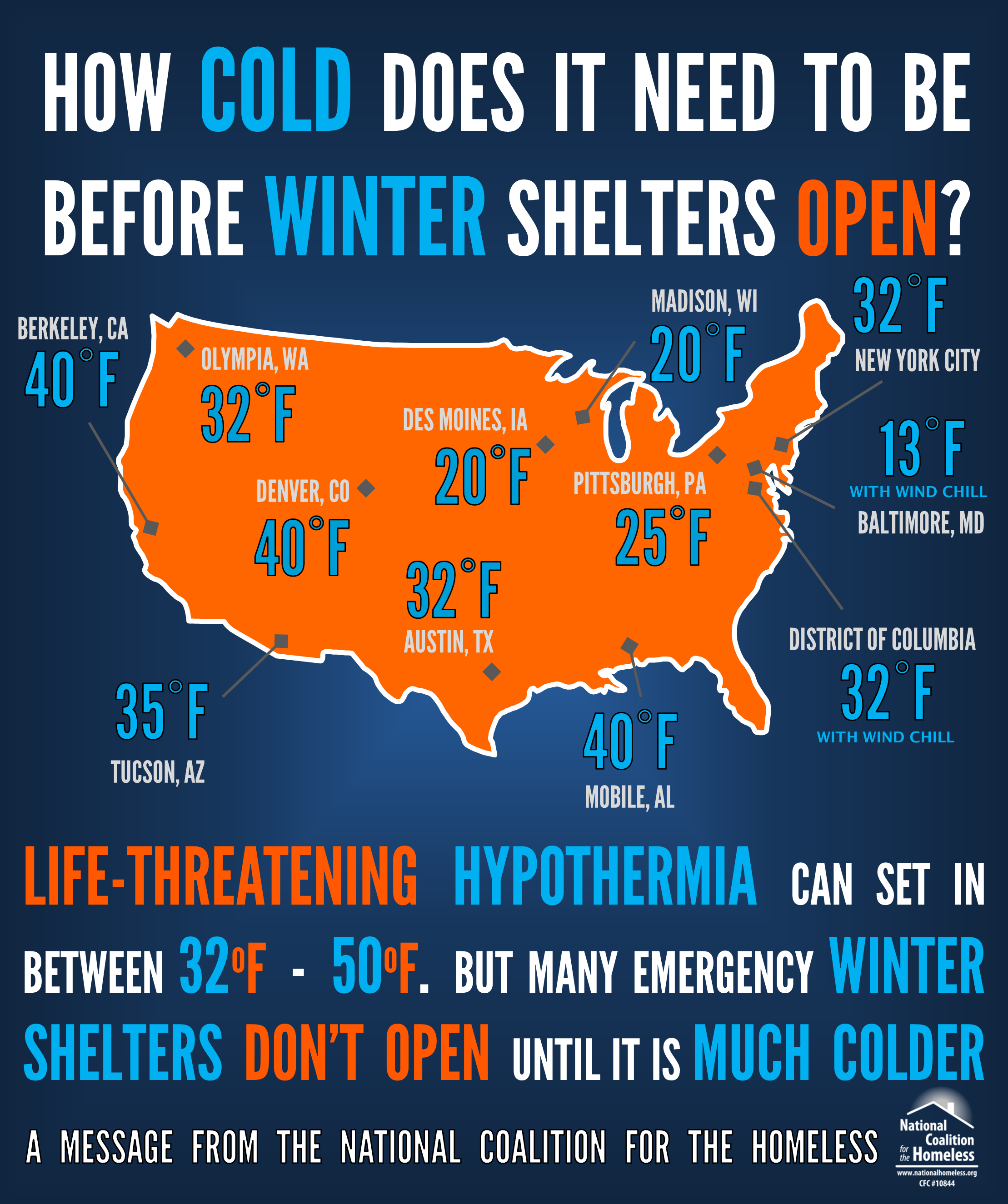
Each year, as winter approaches and the temperature begins to drop, many homeless people move from the streets to their city’s shelter system to escape the cold. However, few communities have city-wide cold-weather response plans, and many of the plans currently in place leave gaping holes in accessibility.

In rural areas, shelters often have no outside resources to help them cope with the increased demand caused by cold weather conditions. Many shelters or cities offer expanded winter services only during certain months or only when the temperature falls below a pre-determined and arbitrary cut-off temperature. Above those cut-offs (hypothermia can occur in weather as warm as 50 degrees Fahrenheit) many cities do not offer resources to help the homeless people escape from the cold.

Without a carefully constructed winter plan, homeless service facilities may find themselves unable to accommodate the influx of residents, and some of those people who seek shelter are turned out into the cold. With nowhere to stay except the streets, people experiencing homelessness have a much higher risk than the general population of developing exposure-related conditions such as hypothermia and frostbite. These conditions can be immediately life threatening and may also increase the risk of dying from unrelated conditions in the future. Increased homeless services, especially additional shelter availability, are necessary to accommodate the amplified need in the winter.

  • Read more about hypothermia and how we can prevent unnecessary homeless deaths in our Winter Services Report >>
  • Share this infographic about how cities respond to the increased needs of people experiencing homelessness during cold weather >>


2012 Hate Crimes ReportSenseless Violence: A Survey of Hate Crimes and Violence against the Homeless in 2012 documents the known cases of violence against homeless individuals in 2012. The report includes descriptions of the cases as well as recommendations to help prevent violence against homeless individuals.

The National Coalition for the Homeless has been tracking hate crimes against homeless individuals since 1999. This year’s report only shows a slight improvement in the number of lethal attacks. In 2012 alone, of the 88 attacks, 18 resulted in deaths. A majority of the perpetrators this past year were young men under 30, and the victims were primarily males over the age of 40.

Some of the most horrific cases include a serial killer targeting the homeless population of southern California because he viewed it as a public service, teens killing a homeless man over one dollar, and a homeless woman set on fire who suffered second and third-degree burns over 20% of her body.

“This violence is prompted by a profound lack of empathy for fellow human beings, the same moral failure that allows our society to tolerate the larger tragedy of homelessness,” said Jerry Jones, Executive Director of the National Coalition for the Homeless. “Homeless people deserve our help and protection. These attacks are a shocking failure in our society’s obligations toward the most vulnerable among us.”

In many cases, homeless persons are targeted for these attacks simply because they are without housing. The National Coalition for the Homeless advocates for the inclusion of homelessness as a protected class in state and federal hate crimes legislation.

Read the full report.

We’ve been hard at work to make our web site work harder for YOU!

Time for an Upgrade!

We hope you find the new site even more useful and informative than ever.

Something Missing?

Naturally, with any site migration, you might experience a broken link or two. Please pardon our dust, but if you’d like to report a missing link please make them known to mhustings@nationalhomeless.org and she’ll be sure to send you the new link to the document you might be looking for.

Have a Suggestion?

We’d be pleased to learn what you have to say about our new site! Just send an email to mhustings@nationalhomeless.org and let her know what we can do better.

I, President (_________–fill in the blank) of the U.S. and How I Ended Poverty.  A True Story of the Future.   (Part II)*

On Inauguration Day, I, President ___________ (fill in the blank) hereby proclaim that I will no longer accept homelessness and poverty in this rich country.

One in eight Americans lives in poverty and the numbers are rising.  Our political parties either cater to the rich or to the middle class, leaving the low-income population behind.

I, like Presidents Franklin Delano Roosevelt and Lyndon Baines Johnson before me, declare poverty to be one of the biggest issues facing America.  I will set benchmarks for eliminating poverty.  Let’s call it an adjustment of American priorities that will take place not in ten years, but in my first term in office.

To pay for this, we will end our legacy of imperialism, and use the money to address our new priorities here at home.

The First 24 Hours of My Presidency

After finishing my rather long Inaugural speech, I will return to the White House lawn where I will pitch a tent and live outside until we achieve the goal of ending poverty in America.

I’ll take along my cell phone and a laptop, so I can conduct the country’s business.  The First Lady/Spouse will join me as well.

Plans of Action:

The First 100 Days of My Presidency

I will forego my $400,000 annual salary and instead will be your President working at a minimum wage salary.  In other words, I will be making $7.00 an hour, as per the established federal minimum wage regulations.  Doing the math, if I work at least 40 hours a week for 52 weeks of the year, I will earn about $379,616 less than my predecessor.

I will not move back inside until every American is permanently housed.  I will then start to pay rent like any other American, 30% of my minimum wage salary.

I also will invite my closest neighbors, the homeless people living across the street in Lafayette Park, to stay in the various unused bedrooms in the White House in what can only be called the “best public housing in the country.”

Emergency/Immediate Measures

Homeless emergency shelters will still be around, but these places will function instead more like the emergency rooms of hospitals where you stay as long as you need to.  I will order every government building to stay open at night so they can function as emergency night shelters. 

I will ask churches, synagogues, temples, and mosques to do the same.

Children, who make up 25% of the overall homeless population, will be the first ones to get help.  If not helped, these children are destined to become the homeless adults of the future.

All local/state/federal elected public officials shall be required to spend a week living on the streets in the largest city in their respective home states until every American is housed.  They will be offered the same benefit levels as the poorest among us with food stamps and the same health care offered to those on Medicaid/Medicare.  We will ask Congress to reduce the salary of every federal elected officeholder and those approved by the Congress for the federal executive branch to the same monthly salary received by those on Social Security disability.  A compromise could be to increase the disability payments to a more reasonable level that will allow many of these individuals to live without the fear of having to move into a shelter. This will keep the officeholders in touch with the 12.7%or almost 40 million Americans who live below the poverty line.

I will ask the U.S. Congress to pass federal legislation making it illegal for cities to adopt laws targeting homeless people for acts such as sleeping, camping, sitting, or panhandling. I am forced to do this, as no city is able to shelter all of its homeless citizens.

Every homeless person who so desires will receive a laptop computer donated by the computer companies so they can connect with the rest of the world and use the Internet to help them get out of their homelessness/low income status.

As our nation’s carmakers are struggling and sales are lagging, every homeless/low income person should get a free fuel-efficient car for either driving to work or living inside it.

Our nation’s coffee shops should give homeless/low income people a “daily fix” of one free cup of coffee.  All coffee shops will henceforth be designated as “homeless-friendly” businesses serving the public interest in exchange for their unreasonably high prices.

Wal-Mart, the nation’s largest private employer, will be unionized at the request/demand by their so-called “associates.”   Their employees will become full-time workers (40 hours a week), and they will finally receive health insurance. I will support the expansion of unions to represent all workers by reducing all corporate friendly barriers to union organizing.

Long-Term Solutions

I will restore the federal low income-housing budget to what it was back in 1979–$83 billion compared to $33.6 billion today.  I will work with the mayors of American cities to create a federal housing policy.

The countless abandoned buildings which plague our inner cities will be turned over to non-profit or municipalities who will provide the resources and training necessary to enable homeless/low income people to repair these homes.  This will be a 21st Century version of the Homestead Act of 1860.

Victims of domestic violence, a leading cause of homelessness among women, will no longer be forced to flee their homes, winding up on the streets or in shelters.   Rather, the victims will stay put in their own homes, and the batterers will be sent either to jail or to shelters designed just for them.

People released from prison will be guaranteed admission into halfway houses with appropriate employment and case management/counseling services.  This will put an end to the established practice of releasing prisoners to the streets without support, setting them up for failure. This same policy will hold for men and women graduating from mental health/alcohol treatment centers.

The minimum wage will henceforth be replaced by a universal living wage. 

A salary cap shall be placed on any one whose goal is to become a CEO or just rich.

New charters will be written for every corporation doing business in America so that their impact on the community would be factored into their bottom line.  So, the amount of pollution, layoffs, salaries that are too low requiring government assistance would be factored into their bottom line profit and loss statement for investors.

I will come up with a 21st Century version of the President Franklin Delano Roosevelt’s Works Progress Administration (WPA) and the Civilian Conservation Corps (CCC) programs.   I got my inspiration for this approach from the words of the late President Ronald Reagan who said, “I think the best possible social program is a job.”

Health Insurance.   Free or low cost if you are homeless/low income.  Expensive if you happen to be rich.

For homeless/low income people with disabilities, I declare these citizens are entitled to treatment on demand for mental health and substance abuse issues.

Expensive residential treatment program catering to celebrities and sports players (e.g. Betty Ford Treatment Center in California) shall set aside 25% of their treatment beds for homeless/low income people at no cost.

As Commander-in-Chief, I make a commitment that any person who serves their country in our armed forces shall not be allowed to become homeless.

State and federal voting laws will be liberalized making it easier for homeless/low income people to vote.  No photo ID or mailing address may be required. I will establish a separate branch of government to oversee elections.  This branch will be independent and not subject to the political whims of current office holders.  I hope to open up the electoral process so that my successor in 2016 could be a homeless/low income person.  I would like to hear political parties talking about neglecting the rich and serving homeless people and low-income citizens in the future.  The only way that this will be done is if elections are not bought and sold by the corporate and privileged class.

Poor people will be exempt from all taxes.  When they break over the federal poverty guideline, then they pay taxes.

Attacking the Root Causes:

I will ask the U.S. Congress to adopt the right to housing like many other countries from around the world.

We will now promise every American the right to housing and health care even if they cannot afford it.

Welfare and food stamps will no longer be necessary, as every American will have a guaranteed annual income.

Since an education is the best way to break out of poverty, a two or four-year college education will now be free as young people are our future in exchange for national service.

The U.S. Congress will issue an apology for allowing poverty to exist/grow and for people to be trapped in poverty for so long in the richest nation in the world.

A new museum will be built along the Mall in the nation’s capital.  This “Museum on Poverty” will remind Americans how poverty remained unchecked in the last century and for the first ten years of this new one.  Poverty is something of our past, and not of the present or our future.

*Part I was published in June of 2007.  Lessons from a Candidate Who Sought to End Poverty *Read Part 1 of the article*

Michael Stoops is the Acting Executive Director of the Washington, DC-based National Coalition for the Homeless (www.nationalhomeless.org).   The inspiration for this pledge/initiative to end poverty in America in the 21st Century comes from Upton Sinclair’s I, Governor of California and How I Ended Poverty.  A True Story of the Future.  1934.  We truly hope this will inspire/educate the candidates running for President of the U.S. in 2008.