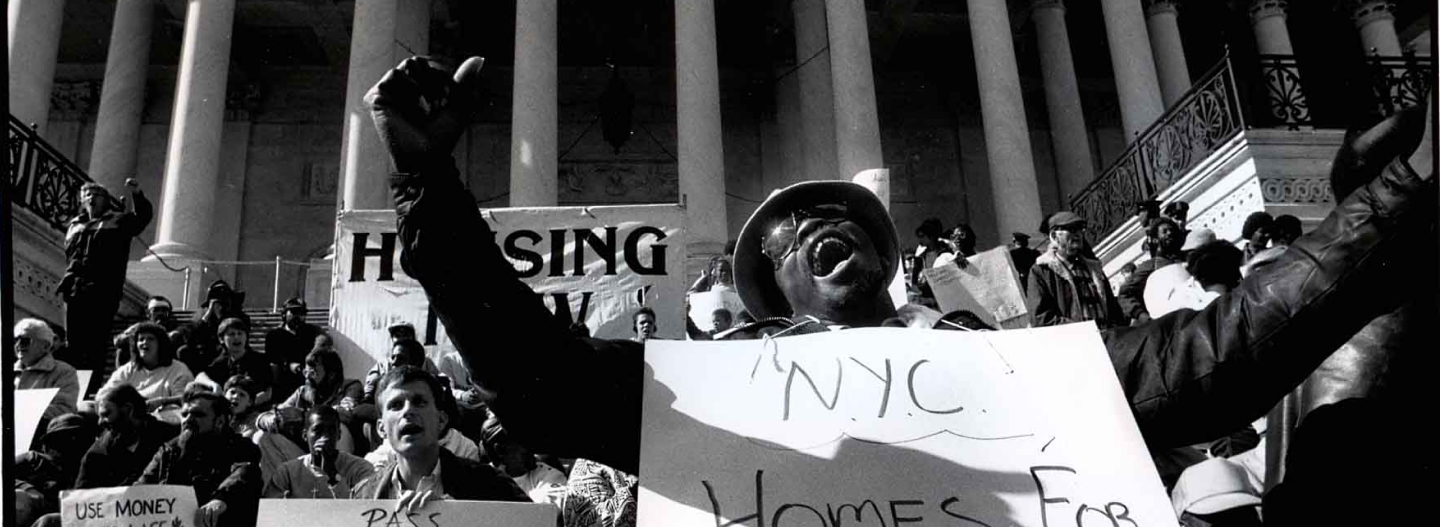
Statement Rejecting Trump Administration Efforts to Criminalize Homelessness – Call for Significant New Investment to End Homelessness Now!

In an act of hypocrisy that is extreme, even when compared to the serial outrageousness we have come to expect from Washington in recent years, the Trump Administration has taken initial action seeking to criminalize homelessness by relocating people experiencing homelessness from the streets of Los Angeles and other California cities to federal facilities.  While appropriate federal investment is desperately needed to address the growing crisis of homelessness in cities across the nation, federal efforts to criminalize homelessness, or to create warehouses to move the homeless out of sight and out of mind are clearly not the answer.

The Trump Administration is complicit in the continuing growth of homelessness.  While it did not start under its watch, the administration has offered no positive proposals to address homelessness nor its main underlying cause — the lack of affordable housing.  Rather, the administration has proposed significant budget cuts to HUD’s affordable housing and homeless funding every year.   Other actions, such as repeated attempts to repeal the Affordable Care Act, cuts to SNAP benefits, and cuts to housing assistance for undocumented individuals in public housing, all undercut state and local efforts to end homelessness.

The growth of mass homelessness beginning in the 1980’s began with massive cuts to federal housing assistance for public housing and the Section 8 program.  Federal funding to specifically address homelessness has never been at a level commensurate with the need nor adequate to end homelessness.

Currently, HUD holds a yearly national competition for funding to award its Homeless Assistance grants to local communities.  In January, HUD announced the distribution of $2.2 Billion in such grants.  However, the vast majority of HUD funding was needed just to renew existing projects housing formerly homeless persons.  Nationwide, 91.3% of projects funded were renewal projects, with only 5.8% ($126 million) being new housing or service projects.  Of these 71% of renewals (totaling $2 billion) were for permanent supportive housing – applications to keep those who were housed through those projects remain housed.

In California, only 4.5% of the $415 million of HUD grants funded new projects to house those currently on the streets or in shelters – the remaining funding was needed just to keep those previously housed from losing their housing. 

Meanwhile, California has committed $1 billion of state funding, and Los Angeles voters approved two $2 billion bonds to address homelessness.

If the Trump administration was serious about ending homelessness in California and across our nation, it would call for a massive new investment of funding for homeless assistance and affordable housing.

We need to demand that the President and Congress significantly increase its funding for homeless assistance programs — to not only continue to house those previously housed who need continued assistance to remain housed, but also to provide new housing those currently living on the streets.  Incremental increases are not sufficient.  

They must also restore affordable housing funding across the board to the levels necessary so that those experiencing homelessness are not continually competing for limited housing with those living at risk of homelessness, on fixed incomes, or working at minimum wage jobs. 

We know how to end homelessness through a combination of affordable housing, health care, and social supports.  Criminalization and warehousing of the homeless are not the answers.

Across the nation, agencies and communities providing housing and services to homeless families and individuals with federal HUD funding are beginning the annual ritual referred to as the SuperNOFA.  This is not some astrological event.  Rather, it is the funding equivalent of a cross between the Hunger Games and Survivor.  Agencies receiving HUD homelessness funding are required to compete with each other to renew their grants for permanent supportive housing, transitional housing, rapid re-housing or other programs.  The losers will be defunded and “voted off the island.”

While competition for funding can be beneficial to ensure that the most worthy projects having the greatest outcomes housing the homeless are funded, the NOFA (Notice of Funding Availability) is structured in such a complex and convoluted way that it traumatizes not only agencies serving the homeless, but the very people the funding is designed to help — formerly homeless families and individuals who are currently residing in supportive housing funded by these grants.

The funding process requires local “continuum of care” entities designated by HUD to hold local competitions for new and renewal projects serving the homeless, and submit a collaborative application which ranks projects based on HUD and locally determined criteria.  The collaborative applications are then ranked by HUD, and projects prioritized by the local continua will be funded or not based on how HUD has ranked their continuum and how the continuum has ranked the project.

The process involves a three month scramble that starts with reading and understanding an 83 page NOFA issued by HUD which changes each year, the issuance of local continuum processes involving scoring matrices and priorities, the writing of new and renewal applications, the ranking of those applications by the local continua, and the submission of the collaborative application to HUD with ranking of local projects.

HUD then takes approximately three months to review, rank, and make announcements as to which projects will be renewed and which limited new projects will be awarded.

Thus, half of each year, agencies housing the homeless with federal funding are working on getting their grants renewed or worried about the prospects of their grants not being renewed.

This might be chalked up to just the “cost of doing business” if it were not for the fact that the final funding decisions are really not about which agencies are funded and not funded, but whether the families and individuals being housed through these programs will continue to be housed or not.  Indeed, the non-renewal of homeless housing by HUD over the past ten years has led to significant reoccurrence of homelessness by thousands of people previously housed in HUD funded programs.

Simply put, families and individuals housed in supportive housing programs funded by HUD should not have their continued housing put at risk for the sake of HUD managing a competitive renewal process.

To make matters worse, HUD has created a process whereby local continua must rank their projects into two tiers – with 6 percent of funding ranked in the second tier.  Projects ranked in the second tier are least likely to be refunded. 

HUD initially created a two tiered ranking system in 2012, when congressional appropriations for the program were significantly cut through the process known as Sequestration.  However, HUD has continued to use the two tiered ranking even though funding in the past few fiscal years has been sufficient to fund all renewal projects.

A yearly national competition for funding might be justified if there were significant funding for new projects each year.  However, the vast majority of HUD funding is needed just to renew existing projects housing formerly homeless persons.  In the 2018 competition, 91.3% of projects funded were renewal projects, with only 5.8% ($126 million) being new housing or service projects.  Of these 71% of renewals (totaling $2 billion) were for permanent supportive housing – applications to keep those who were housed through those projects remain housed.

There is no other funding process in the federal government that places the housing or services of people in need at risk through a competitive renewal process.  Can you imagine if HUD required Public Housing Authorities housing millions of people through public housing or Section 8 housing choice vouchers to annually compete to continue to receive such funding and keep those currently housed from losing their housing?

To make matters even worse, HUD has devised scoring criteria for the national competition that penalizes communities that are experiencing an increase in homelessness due to factors outside of their control.  For example, they provide incentive points for continua that demonstrate an overall reduction of at least 5% in the number of people experiencing homelessness, and for demonstrating a reduction of “first time homeless”.  Similarly, they provide incentive points to continua that demonstrate a reduction in the length of time people remain homeless, demonstrate a decrease of 5% of chronically homeless persons, or a decrease in family homelessness, and for a reduction in the number of homeless veterans.

While there is certainly merit in rewarding communities for improving outcomes, penalizing communities that are struggling with increased homelessness due to affordable housing shortages, increased population, decreased employment opportunities, and other factors out of their control is not only counterproductive, it exacerbates the problem by reducing the very resources these communities need to reduce homelessness.

In what world would it make sense for the Center for Disease Control to reduce its assistance to communities for treating HIV-AIDS or TB because there were more people in those communities needing such treatment?”  That is essentially what HUD is doing in its scoring process.

HUD claims that chronic homelessness has decreased by 26% since 2007, despite recent evidence of increased homelessness in many communities.  Even if true, at that rate, we will not achieve the end of chronic homelessness until 2050.  That is unacceptable in the richest nation on earth.

To truly help communities reduce and end homeless, significantly more federal funding is needed to help leverage state, local and community efforts.  To rely on only 5.8% of funding to provide new housing for people currently on the streets will not end homelessness. 

We need to demand that Congress significantly increase its funding for homeless assistance programs — to not only continue to house those previously housed who need continued assistance to remain housed, but also to provide new housing those currently living on the streets.  Incremental increases are not sufficient.   We must start with at least a doubling of the current homeless assistance program budget.

Congress authorized in the HEARTH Act of 2009 that funding to renew permanent supportive housing be funded through the Section 8 Appropriations Fund rather than through the more limited homeless assistance funding.  HUD has refused to implement this change.  Doing so now would free up over $1 billion dollars of funding to target the newly homeless.

HUD should also end its practice of requiring annual renewals for desperately needed homeless housing and services.

Finally, Congress must restore affordable housing funding across the board to levels necessary so that those experiencing homelessness are not continually competing for limited housing with those living at risk of homelessness and those working at minimum wage jobs. 

The time to act is now.

Throughout our country’s history, there have been people who suffered from homelessness – but there has not always been the same chronic and extensive homelessness we now face. Over the years homeless individuals have been referred to by a variety of different names. During the Revolutionary War homeless individuals were referred to the “itinerate poor,” a result of a society in need of transient agricultural workers, while around the Great Depression words like “tramp” or “bum” came into use.
Timeline of events 1929-1945Timeline of events 1945-1970

Prior to the 1970s homelessness rose and fell with the economic state of the country. Starting in the 1970s policy’s shifted and a sharp and permeant rise in homelessness occurred. Previously, when there was a downturn in the economy the number of the homeless would increase, but this would be fixed when the economy returned to normal. The largest number of homeless up until that point occurred during the Great Depression, but with the help of the New Deal policies homelessness returned to its previous level.

1970s housing policyStarted in the 1970s, however, a trend of chronic homelessness began to present itself as well as different types of individuals suffering from homelessness—women, families, blue

“Anti-poverty” efforts lead to homeless site dismantlement plans and the destruction of single-room occupancy facilities in urban downtowns. Churches begin to take on the burden of creating shelters, and local coalitions develop. Bank deregulation and the start of the farm crisis widen the gap between rich and poor.

Additionally, mental health consumers began to be deinstitutionalized without providing adequate housing and health care resources for community reintegration. As a result, many people with mental illnesses started to end up homeless or in jail.

Fast forward nearly 40 years and policy has continued to ensure economic inequality at staggering levels. Keep a look out next week for a closer look at the history of homelessness in the U.S. after 1980.

Twenty years after “ending welfare as we know it” with the passage of the 1996 Personal Responsibility and Work Opportunity Reconciliation Act, the current administration issued an Executive Order on April 10, 2018 to Reduce Poverty in America by Promoting Opportunity and Economic Mobility.

While the Administration’s Order is more suggestion for Federal departments of government, the National Coalition for the Homeless [NCH] was strongly opposed to the 1996 law and is equally strongly opposed to the direction of the Executive Order, and any attempt to enforce work requirements on social benefits, including food assistance (SNAP) and Medicaid.

The reality is that the 1996 legislation and now the Executive Order goals language is code for reducing the welfare rolls even further by slicing benefits, imposing further work requirements and mandating further time limits on welfare programs.  It is clear that the direction of the Executive Order, and potential work requirements being considered for access to food assistance (SNAP) and Medicaid, is punitive and does nothing to promote self-sufficiency. At a time when our wages are not keeping up with the cost of living, the only direction of economic mobility for many will be downwards, in some cases leading to homelessness.

In 1998 NCH partnered with the Children’s Defense Fund to publish Welfare to What: Early Findings on Family Hardship and Well-BeingThe key findings include:

  • only a small fraction of welfare recipients’ new jobs pay above-poverty wages; most of the new jobs pay far below the poverty line;
  • many families who leave welfare are losing income and not finding steady jobs at all;
  • extreme poverty is growing more common for children, especially those in female-headed and working families;
  • many families leaving welfare report struggling to get food, shelter, or needed medical care; many are suffering even more hardships, including becoming homeless, than before;
  • many families are not getting the basic help they need [for example, child care, medical coverage, food or transportation] that might enable them to sustain work and care for their children on very low wages;
  • many families are denied cash assistance through little or no fault of their own; states often penalize families without assessing their ability to complete required activities.

Twenty years later, the 2018 Farm Bill with significant changes to SNAP [Supplemental Nutrition Assistance Program, or Food Stamps] proposed by House Agriculture Committee Chair Michael Conway is the testing ground for the broader direction of the 2018 Executive Order.

And, just as we said 20 years ago, the Center for Budget & Policy Priorities President Robert Greenstein said in April 2018 that the proposed changes in SNAP would “end or reduce benefits for a substantial number of low-income people… and would widen the nation’s economic divides.”

Clearly the current administrations goal is to “leave no billionaire behind” while punishing low-income people.  We ask the same question of the Executive Order as we did 20 years ago: Welfare to What?

NCH does not believe the current false rhetoric of economic mobility and expanding opportunity.  We know better.  We know that the real direction of work requirements as welfare reform is punitive and the results will be increased poverty and homelessness for children and families, disproportionately impacting people of color, especially African-Americans and Native Americans.

NCH stands ready to partner with local, state and national organizations to demand the real direction of any reforms to welfare results in living wage employment and truly affordable and accessible housing.

-Bob Erlenbusch, NCH Board President
Executive Director, Sacramento Regional Coalition to End Homelessness


Further reading:

New report once again misleads lawmakers and the public about the supposed ‘decline’ in numbers of people experiencing homelessness in the United States.

Housing UndercountWashington, December 19, 2016 –
As we rapidly approach the end of another year, cities around the country are preparing vigils recognizing those who have lived and died without adequate housing in 2016. November’s release of the Annual Homeless Assessment Report (AHAR) to Congress by the Department of Housing and Urban Development may give those attending some small cause for hope, describing a 3% decrease in the number of men, women, and children experiencing homelessness, counted on a single winter night, over last year’s number.

Unfortunately the report leaves out some important information. For instance, the count in question tallies those staying in emergency and transitional shelters, as well as those who can be located outside. HUD’s recent decreases in funding for such shelters means fewer members of the homeless population are easily accounted for. HUD provides bonuses to communities that decrease their count, creating a disincentive for those conducting counts to locate every unsheltered person in their neighborhoods.

Furthermore, HUD only asks communities to report those who it considers “literally homeless.” This doesn’t include the large numbers of individuals and families who are doubled up or “couch surfing” with friends and relatives. This unrealistic definition of homelessness explains why HUD reported just over 120,000 children experiencing homelessness on a given night, while the Department of Education has reported well over ten times as many children youths registered as homeless in recent years, a number that has more than doubled over the last decade.

The reports of HUD and other governmental and non-governmental organizations purporting to chart a decline in the numbers of those experiencing homelessness are doing a disservice to those men and women who we have lost this year without the basic dignities afforded by secure housing. While so many of those who are tasked with ending homelessness in America won’t admit to the actual scope of the problem, they cannot be relied upon to enact meaningful solutions to it.

The National Coalition for the Homeless calls upon the Department of Housing and Urban Development to face up to the reality that homelessness is not diminishing in America. We call on HUD and its allies to work with us and other organizations to put into place housing policies and investments that will ensure an end to the memorial vigils that have become a disgraceful necessity every December 21st, the longest night of the year.

Press Contact:
Megan Hustings, Interim Director
Phone: (202) 462-4822 ext. 234
Email: mhustings @ nationalhomeless.org

On January 27, 2015, Senator Susan Collins (R-ME) and Senator Patrick Leahy (D-VT) introduced a bipartisan bill co-sponsored by Senators Cory Booker (D-NJ) and Kelly Ayotte (R-NH) to expand programs for vulnerable youth who are homeless and on their own. The National Coalition for the Homeless strongly endorses this legislation.

This bill would reauthorize and expand the Runaway and Homeless Youth Act, a law that expired in the last Congress. The new bill, titled the Runaway and Homeless Youth and Trafficking Prevention Act (RHYTPA), will continue programs for unaccompanied homeless youth with increased funding for services such as transitional housing and street outreach. Expansion of RHYTPA also ensures LGBTQ youth are granted access to services free of discrimination. It also expands support for survivors of human trafficking and sexual exploitation.

The National Coalition applauds the work of Senators Collins, Leahy, Ayotte, and Booker on this important piece of legislation. We urge Congress to pass this legislation without delay.

Learning How to Lobby – Jennifer Warner

You are one of 319,247,005 American citizens. That number grows by, on average, one person every 13 seconds. With such a large pool of people, it’s hard to believe that anything you do or say will affect the laws that govern us all. It seems unlikely that any legislator would listen to you and it is intimidating to consider asking them to. As daunting as it might seem, I have seen first-hand that the American political system is designed for each of us to be able to access and influence elected officials, if we take the right steps

Anything a person does to try to influence the actions of legislators is considered lobbying. You may have a negative connotation of this word; in fact, 61% of Americans hold an unfavorable opinion of lobbyists and 81% believe that lobbyists bribe legislators for votes. However, lobbying simply means advocating for policy decisions that you or your organization would like to see. One group I’ve gotten involved with, called SAVE for All, believes budget decisions should protect low-income and vulnerable people. To encourage this, SAVE members visit the staff of Senators and Representatives who sit on funding committees and have an open dialogue about community needs and funding possibilities. These conversations involve both education about the issue and the exchange of personal opinions. This is direct lobbying: a face-to-face exchange of information and opinion.

However, lobbying doesn’t necessarily mean in-person meetings with on Capitol Hill. You can communicate with your Congressperson wherever you are, through letters, email, and phone calls. To find out how to best contact your Senators and Representatives, look up their websites at www.senate.gov and www.house.gov. On their official websites, you can also find the location of their closest district office, which is their office in your local community. When contacting your elected officials, try to pick one or two specific issues that you care about. (For ideas, go to NCH’s “Campaigns” tab!) Research the topic thoroughly and clarify your own stance on the issue. When your write, call, or present to a staff person, be clear and concise with your argument. If you called or sent a letter, ask for a response from the Congressperson, and if you met with a staffer, send a follow up email thanking them for their time.

Your elected officials can only serve your interests if they know what those interests are, so communication is essential. Engaged citizens should tell their local Representatives and Senators what they want, as the primary job of those officials is to represent the interests of their own district or state. Your senators are there to represent each person in your state and your representative works for the 732,203 people in your immediate community. They are your voice among the 319,247,005 in this country—make sure that they are saying things you agree with.

The executive directors and policy staff representing many of the nation’s leading homeless advocacy organizations met yesterday as the Homeless Advocates Group (HAG) to set policy priorities for 2013. Each member organization of HAG has set its own independent set of issues. The goal of this meeting was to reach consensus around a set of common policy priorities that collectively the group could both support and promote within and among each organization’s own allies.

The policy priorities chosen were:

     1)       National Housing Trust Fund

     2)       Criminalization of Homelessness

     3)       Affordable Care Act Rollout and Implementation

     4)       Preservation of Federal Funds Targeted to and for Those Experiencing Homelessness

The National Coalition for the Homeless (NCH) lobbied hard for the Criminalization of Homelessness to be made a top priority and are very pleased with the progress made during this prioritization process. NCH was represented by Neil Donovan, executive director and John Harrison, NCH Speakers Bureau and the Washington DC based Homeless Peoples Advocacy Network (HPAN) group SHARC.

The U.S. Department of Housing and Urban Development (HUD) is expected to publish later this week in the Federal Register interim regulations for the new Continuum of Care (CoC) program under the HEARTH Act and a summary of these regulations.

Eligible activities & program requirements of the CoC program addressed in the regulations are:

  • Permanent housing ( PSH for people with disabilities and rapid re-housing) (PSH)
  • Transitional housing (TH)
  • Supportive Services Only (SSO)
  • Homeless Management Information Systems (HMIS)
  • Prevention (For High Performing Communities designees)

“HUD expects the regulation to be published in the Federal Register in the coming week. The interim regulation will be effective 30 days after publication in the Federal Register. The final Homeless Definition is in effect for administration of the CoC Program interim rule.” -HUDHRE.info

Read the Regulations and Summary