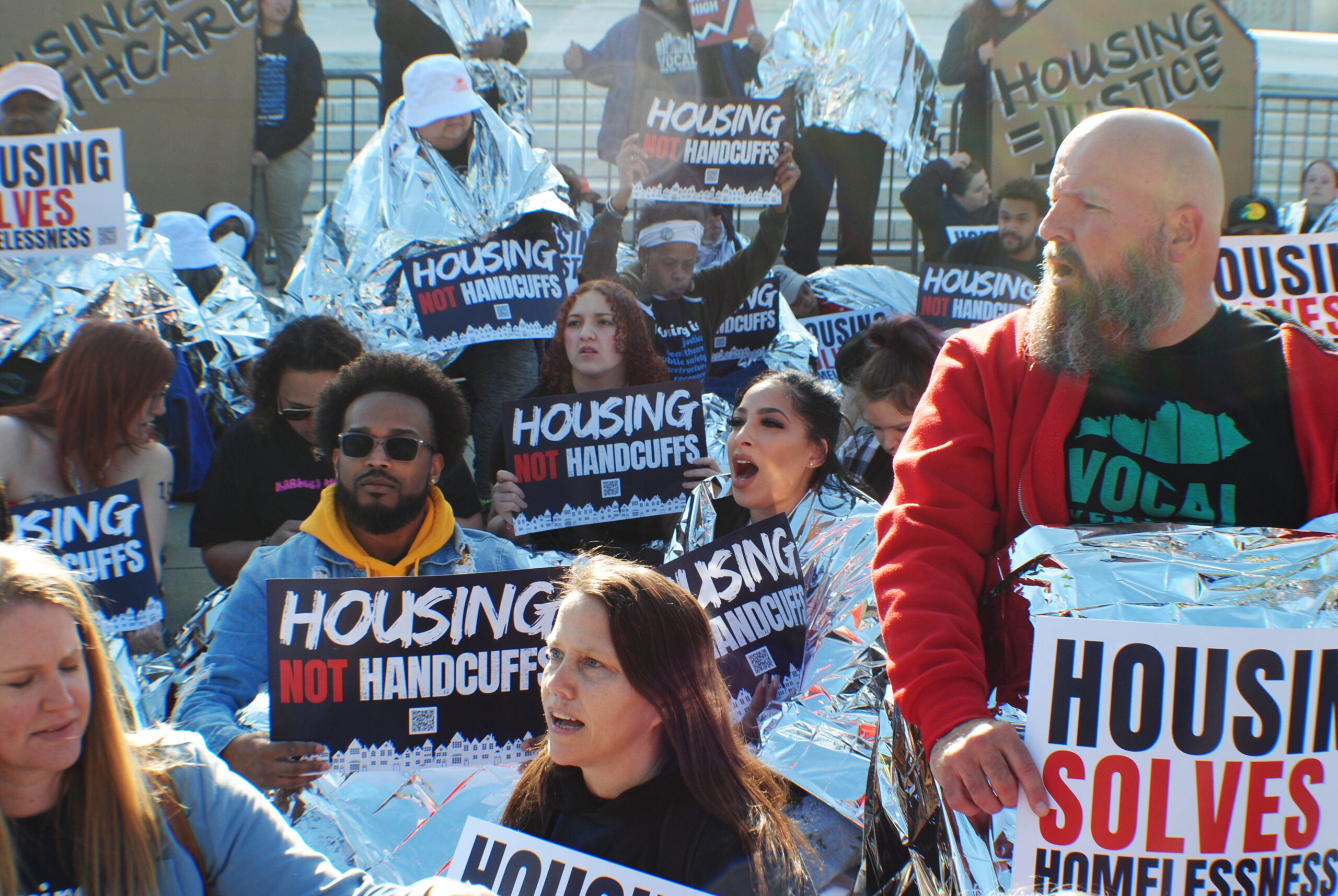
Trump administration issues executive orders that fundamentally misrepresent homelessness

Trump signs two executive orders aimed at “Ending Crime and Disorder on America’s Streets” that will actually make our cities more dangerous for residents who are poor.

WASHINGTON, D.C. – July 24, 2025 – Today, the Trump administration issued two executive orders that fundamentally misrepresent homelessness as a criminal issue rather than a societal challenge requiring compassionate and systemic solutions. The National Coalition for the Homeless (NCH), dedicated to addressing the root causes of homelessness since the 1980s, strongly condemns these directives as ineffective, wasteful, and a grave violation of civil rights.

The first executive order threatens to withhold Housing and Urban Development (HUD) funding from states that protect individuals from involuntary commitment to institutional care. The second order, contradictory to the first, proposes allowing Medicaid funding for mental health treatment.

“Everyone deserves a safe place to live,” stated Donald Whitehead, Jr., NCH Executive Director. “These executive orders ignore decades of evidence-based housing and support services in practice. They represent a punitive approach that has consistently failed to resolve homelessness and instead exacerbates the challenges faced by vulnerable individuals.”

This administration has a concerning record of disregarding civil rights and due process, as evidenced by recent actions concerning immigrants. These executive orders direct Attorney General Pam Bondi to challenge existing judicial precedents and consent decrees in communities where the civil rights of people experiencing homelessness or mental health crises have been violated.

The assertion that the majority of individuals experiencing unsheltered homelessness are “addicted to drugs, have a mental health disorder, or both” is inaccurate. Furthermore, it disregards the reality that many individuals develop mental health or substance abuse issues after prolonged periods of homelessness due to the lack of safe and affordable housing.

As the executive order itself acknowledges, the Supreme Court has established due process protections that safeguard individuals from involuntary confinement in psychiatric hospitals. Historical attempts at mass institutionalization proved destructive to individuals’ lives and financially unsustainable for states. The original intent of deinstitutionalization in the 1970s was to accompany community re-integration with comprehensive housing and support services—a commitment that, tragically, remains underfunded and unfulfilled, both then and now.

The National Coalition for the Homeless reiterates that the definitive solution to homelessness is housing. Ensuring safe places to live and access to support services is not only a moral imperative but also the most effective strategy for building safer and more equitable communities.

With Congress’s passage of the mega budget deal today, we have witnessed the most disastrous legislation in modern history.  The budget bill steals from the poor to give massive tax cuts to the wealthy. And these tax breaks are such enormous giveaways to the rich that they will increase the deficit by nearly $4 trillion, even with the draconian cuts to health care and food assistance

The Bill will also create a private force as large as most countries to push the cruel anti-immigration policy.  It adds $4 trillion to the national debt.

It does not address the growing concerns of inflation and job loss.  The bill will result in a loss of an average of $1,000 in income for families below the poverty line. 

We fought hard, but the fight is not over.

We must get ahead of the next budget discussion. Today’s blow will be significantly magnified by projected loss of critical housing and supportive services foretold in the Presidential Administration’s “skinny budget” request for next year.

We cannot let elected officials forget who they have harmed by their decision to transfer even more wealth to the ultra rich, on the backs of seniors, people with disabilities, families unable to put food on the table. NCH encourages all of us who will be impacted by this dastardly budget to continue contacting our Congressional members – sharing how their callous decision will hurt their constituents.

We may rest this weekend, but we will keep fighting for true justice, equity, and a permanent end to homelessness.

In Solidarity,
Donald H. Whitehead Jr.
Executive Director

*Art courtesy pf Art Hazelwood and the Western Regional Advocacy Project

NCH’s Stand Against the Federal Grants Freeze | Part II

It was so encouraging to witness the overwhelming support for programs and funding for people and organizations across this country when the administration’s executive order halted funding. People organized immediately—it was a testament to people coming together to fight against injustice.

While I am deeply moved by the outpouring of resistance,I am also hopeful that the same level of energy and resistance will continue as we launch our direct action campaign against criminalization. It is our belief that the criminalization actions we are witnessing across the country are direct violations of the Constitution of the United States.

Please keep your eyes open for information about our efforts to stand up for those who, in some cases, cannot stand up for themselves. If you are someone experiencing homelessness, we need you in this fight, and we look forward to partnering with you to ensure that everyone has a path toward housing justice that does not include a carceral approach.

In solidarity,
Donald Whitehead

The U.S. Government has been providing affordable, permanent housing for over 1.8 million families through public housing. Public housing serves a critical role in the nation’s rental market, providing stable, affordable homes for households with low incomes. The families who live in public housing include some of the nation’s most disadvantaged citizens, including older adults, people with disabilities, and working families with young children. 

Not to be confused with other housing subsidy programs, public housing is housing stock that is owned by HUD (U.S. Government) and administered by local Public Housing Authorities (PHAs). Public housing comes in all sizes and types, from scattered single-family houses to high rise apartments for elderly families. 

In 1998, through the Faircloth Amendment, the U.S. Government created an artificial barrier by limiting the number of public housing units that federal authorities could build and has resulted in many people being left without a home. This amendment prevents any net increase in public housing stock from the number of units as of October 1, 1999. Simply put, the Faircloth Amendment sets a cap on the number of units any public housing authority (PHA) could own and operate, effectively halting new construction of public housing. This prevents policymakers from using a vital tool, building more permanent affordable housing, to address our nation’s growing housing and homelessness crisis.

In the two decades since the Faircloth Amendment passed, rent costs have skyrocketed while average incomes have not. The median inflation-adjusted rent has increased 13.0 percent since 2001, while the median inflation-adjusted renter’s income has only increased 0.5 percent during that same period. This obstacle in creating more affordable housing that the amendment created, is happening while there is a $70 billion backlog in funding for maintenance and repairs to existing public housing stock.

Repeal the Faircloth Amendment Act

There are many pieces of legislation that would Repeal the Faircloth Amendment, overturning the 1998 law so there would no longer be a federal limit on creation of new public housing. These are bills currently introduced in Congress that would repeal Faircloth: H.R. 659, H.R. 7191, H.R. 5385, H.R. 2664, H.R. 4497, S. 1218, S. 2234.

Repealing the Faircloth Amendment would not only eliminate a physical ban, but also:

  • Repealing the Faircloth Amendment would not only eliminate a physical ban that has barred access to affordable housing for more than twenty years, but it would also allow for communities, tenants and PHAs to reimagine how building more public housing with permanent affordability could create opportunities for seniors to rest and families to thrive. 
  • Intentionally designing and planning to have public housing integrated in the community where residents thrive in their neighborhoods, where they have access to opportunity, where there’s jobs, resources and public parks can be accomplished, but first Faircloth must be repealed.
  • While few funds are currently dedicated toward new public housing construction, lifting the prohibition from the Faircloth Amendment lays the groundwork for a net increase in the supply of public housing, a crucial step in increased aggregate housing supply.
  • It is not an either fully fund current public housing OR repeal the Faircloth Amendment to create new public housing, it is an AND. Repeal the Faircloth Amendment to remove the barrier to create new public housing AND fully fund PHAs to properly maintain safe, decent, accessible, and affordable housing units that they currently hold.

Congress should uncuff itself from the restraints that the Faircloth Amendment has put on this country’s ability to create affordable housing. Public housing is critical to addressing the nation’s poverty crisis. As a long-term asset, public housing provides decent housing to the nation’s most vulnerable citizens, connects low-income workers to economic opportunities, and spurs regional job creation and economic growth.

There are cities throughout the United States moving displaced citizens onto public land typically in tents calling these locations “sanctioned encampments.” It is the position of the National Coalition for the Homeless that housing is a human right which is defined as a safe, affordable, accessible place to call a home. The issue is that by identifying a “sanctioned encampment” cities by default are declaring that there are “unsanctioned” encampments.  NCH does not believe that people who are experiencing a period of homelessness should become involved with law enforcement while trying to survive. 

Photo credit: Justin Sullivan
  • It should go without saying, but in the current divided society with words being distorted to become propaganda for those who want to make it illegal to be without housing, we must say that a tent is not a permanent solution to homelessness.  Secure, safe, accessible and affordable housing should be available to every family or single individual who requests a place to live. 
  • In a free society, a person should be able to congregate with others and peacefully assemble in groups of their choosing not forced to live where the municipal government decides with neighbors of their choosing.
  • No one should be forced by any authority or coerced to choose between a place with large numbers packed together or face criminalization for being homeless and living without shelter. Whether this is forcing someone into a congregate living facility that strips a person of their dignity or sending them to a government sanctioned site to pitch a tent, people living in the United States have always cherished the free will to not be told what neighborhood or municipality to reside in by government or government funded organizations.
  • Persons who refuse forced entry into any facility must not be categorized as “service resistant” and thereby face incarceration or exclusion from services. They should receive trauma informed care by trained professionals and be met with services they request not services forced on them. 
  • In the current environment in which municipal governments have largely given up on affordable housing solutions to homelessness and instead resorted to using law enforcement as the primary point of contact for those without housing, we see a broader trend in which the mere offer of any kind of assistance or social service is enough for local governments and law enforcement to justify penalty, arrest or a threat to withdraw a person’s liberty for those who reject the help.  We believe that sanctioned encampments will be used as permanent placements for local jurisdictions to avoid providing safe, affordable, accessible and permanent housing.
  • Sanctioned encampments are an inexpensive alternative to building housing or shelters that serve the needs of those individuals and families who are experiencing homelessness. 
  • Local governments should not act as nannies for adults and force them to a segregated section of town to live under a set of rules developed by strangers under threat of arrest if the taxpayer strays from the sanctioned encampment.  

This year has been filled with unpredictability and turmoil. Our way of life has been negatively impacted. We have been forced to distance ourselves from those we love, our co-workers, and our traditions. 

COVID-19 has been incredibly challenging for people experiencing homelessness. Economists estimate that homelessness could increase by up to 32% as a result of COVID-19 related issues.  

With your help, we have been pushing Congress to include both short and long-term housing and other economic relief for everyday people. We are encouraged by the relief package and omnibus budget signed into law by the President this week.

This new $900 Billion COVID-19 relief plan includes:

  • $25 billion for rental assistance (click here see how much your state will receive)
  • Extends the  federal eviction moratorium for 1 month and use of CARES funding set to expire on 12/30/20 to 12/31/21.
  • $13 billion for enhanced Supplemental Nutrition Assistance Program benefits.
  • Provides direct payments of  at least $600 to adults and $600 per child. Families with incomes under $75,000/year. (Two parent household up to $150,000)
  • $284 billion for Paycheck Protection Program /small business loans. 
  • $20 billion for small business grants and $15 billion for live event venues.
  • $300 billion for federal unemployment supplement and temporarily keep in place pandemic-era programs that expanded unemployment insurance eligibility, this will allow 12 million people to remain on  unemployment insurance and enhance the 11 weeks of benefits by $300/week.
  • $20  billion for purchase of  vaccines, $8 billion for disbursement of vaccines and also provides relief to hospitals.
  • $82 billion for schools and colleges.
  • $10 Billion Child Care Assistance

The omnibus Fiscal Year 2021 budget passed includes:

  • A permanent, minimum 4% Low-Income Housing Tax Credit rate, as well as disaster housing credits for qualified states, which could result in the addition of more than 130,000 units of affordable housing;
  • A five-year extension of the New Markets Tax Credit (NMTC) at $5 billion for a total of $25 billion in new NMTC authority;
  • $4.839 billion for the Public Housing Operating Fund;
  • $3 billion for Homeless Assistance Grants; and
  • $2.765 billion for the Public Housing Capital Fund.
  • The 2020 CoC NOFA is postponed and current programs will be re-funded for one year (which we have pushed for since early in the pandemic!)

We still need more, both short and long term housing and other supports for everyday folks who have been impacted most by the pandemic and resulting economic downturn. We look forward to the new Congress and Administration focusing more on these issues as we move into a new decade!

The U.S. Interagency Council on Homelessness announced in June that it would be working to update the coordinated Federal plan to end homelessness. Comments were solicited via the USICH website, though now, all mention of this comment process have been removed.

Below are the concerns and comments that the National Coalition for the Homeless shared:

NCH Comments on the Federal Strategic Plan to End Homelessness
Submitted to the US Interagency Council on Homelessness July 2020

Thank you for your efforts to revise the Federal Strategic Plan to End Homelessness, and to gather comments from stakeholders. However, the National Coalition for the Homeless (NCH) is concerned that the US Interagency Council on Homelessness is not soliciting input from a broad enough audience, nor in a transparent process that includes people who have experienced homelessness as key drafters. 

After nearly four decades of advocacy on behalf of those experiencing homelessness, NCH believes that any further Federal Strategic Plans to End Homelessness must be made in direct partnership with people who lived the experience of homelessness. The true experts, people with this “lived experience” of homelessness know first hand the effects of Federal policy and as such, can hone in on what changes can be made to achieve the goal of ending mass homelessness in the United States. 

Further, any Federal Strategic Plan to End Homelessness must:

  1. Have clear and quantifiable goals, objectives and action steps. The plan should include a timeline, parties responsible for implementation, and a description of funding needs and sources. 
  2. State that housing is a civil and human right, as a safe, stable home is the foundation for human development, student achievement, economic survival and community health. 
  3. Identify the systemic causes of homelessness, including structural racism, redlining, and other disinvestment in black and brown communities. The plan and its objectives should be written with a clear equity lens. 
  4. Affirm that any efforts to criminalize people, or the daily survival acts of people, who live outdoors – things like urban camping bans, food sharing restrictions, and limits on when and where people can sit or lie down – are counter-productive, cause trauma, and should be halted or reversed in city code.

If you were to propose one new initiative that the federal government is not doing now what would it be?

  • Fund Permanent Supportive Housing from the Housing Choice/Section 8 Program (with program changes that provide flexibility for criminal/credit/tenant issues)   
  • Do not dismantle COVID-19  response networks, maintain the CDC guidelines for encampments including access to sanitation and water  
  • Decisions and priorities on use of funds should be locally driven not HUD driven 
  • Return to funding transitional housing, both in scattered sites and through rental assistance 

Outside of prior USICH federal strategic plan focuses, what else might the federal government do to prevent and/or reduce homelessness?

  • Increase workforce development programs that train people experiencing homelessness as Peer Advocates to supplement the current homeless provider workforce. 
  • Listen to people who have/are experiencing homelessness and include at decision making tables on types of programs that work. 
  • Equity in funds – ensure tax credits, bonding, appropriations, etc. reserve funding for people at risk of or experiencing homelessness and rental housing at below 30% of median income
  • Strengthen the interagency coordination of resources for livable incomes and employment (both FT and part time/contracted/gig/piece work and migrant/day labor) and public assistance including unemployment, SSI and Social Security.  
  • Universal Health Care/Immediate and voluntary access to medical services for all individuals, youth, families experiencing or at imminent risk of homelessness.
  • A guaranteed opportunity for permanent housing that is affordable at their income for all individuals, youth, families experiencing or at imminent risk of homelessness.

What is one activity the federal government is doing that you believe should be deprioritized?

  • Coordinated entry – Implementation is inconsistent and costing millions in HUD TA, and systems often lead to discriminatory and unethical service delivery
  • Point in Time count – It is archaic and an inaccurate system- does not count people in programs where most of the homeless funding is going to: permanent supportive housing and rapid re-housing
  • HMIS –violates Data Privacy, HIPPA laws
  • HUD controlled process of how funds should be used by communities
  • HUD’s homeless definition -utilize one homeless definition (the Department of Education’s definition or similar) across all agencies.

What is one activity that the federal government is doing well and that should be prioritized? 

  • The Youth Advisory Boards Model should be implemented in the Adult population. People who have/are experiencing homelessness need to be voting decision making members of the Federal and all State Interagency Councils and at CoC level and funded agencies.
  • The Veteran model that includes dedicated vouchers (VASH), Transitional Housing, workforce development (HVRP, CWF), Healthcare to scale and prevention (SSVF) should be mirrored that can be accomplished with substantial increases for targeted homeless programs through HHS and DOL.

Overall, what would you say the top 3 federal priorities should be as they relate to preventing and ending homelessness?

  • Listen to people who have/are experiencing homelessness. Decisions and priorities on use of funds should be locally driven with people who have/are experiencing homelessness not HUD driven. 
  • HUD programmatic changes: Funding Permanent Supportive Housing from the Housing Choice/Section 8 Program (with program changes that provide flexibility for criminal/credit/tenant issues), Rapid Re-Housing must include a livable income component to be able to pay rent after subsidy ends (employment and /or public assistance access/ housing assistance)
  • Creating a Unified definition of homelessness across federal agencies and Immediate and voluntary  access to emergency housing/shelter for all individuals, youth, families experiencing or at imminent risk of homelessness.

In terms of homelessness, what areas are in need of greater attention at the federal, state, and local levels?

  • Affirm the Right to Housing and protection of the civil rights of people experiencing homelessness. 
  • Listen to people who have/are experiencing homelessness and include at decision making tables on types of programs that work. 
  • Fund Expanding Affordable Housing Stock to Pre-1970 Levels.
  • Expand and fund the use of innovative housing approaches: Tiny Homes, Shared Housing, Small Market FMR’s, Community Choice in Service Delivery, homeownership, scattered site/rent subsidy transitional housing
  • Expand homeless prevention to include eviction protection, a right to counsel, and cash assistance 
  • Universal Health Care
  • Expand fair housing protections to prevent rental redlining and source of income discrimination.
  • Coordination and placement into housing opportunities that are affordable for people being discharged from correctional/ mental health/chemical health/physical health/etc. institutions.

The National Coalition for the Homeless applauds all the communities that are rushing to provide desperately needed housing for people who are unhoused, and especially vulnerable to contracting and succumbing to COVID-19. 

However, we are, quite frankly, disturbed that so many are still relying on congregate settings: big tents and open floor warehousing of people, in what is clearly a dire public health emergency for the entire country. In the hopes of relieving the strain on other overcrowded shelters, the San Diego government decided to open the convention center to the homeless population. They are expecting to house over 1,500 people during this crisis. San Francisco ignored early warnings from advocates and requests to place vulnerable folks in empty hotel rooms, and now residents and staff of shelters are falling ill. This is unacceptable. We are clearly failing to prevent the spread of COVID-19 in both sheltered, and unsheltered, populations, and in direct opposition to clear guidelines given by the CDC (Centers for Disease Control and Prevention). 

Researchers who have long studied homelessness have projected that homeless individuals infected by COVID-19 would be twice as likely to be hospitalized, two to four times as likely to require critical care, and two to three times as likely to die than the general population. (Read the full report)

This crisis continues to highlight the structural inequities that have plagued us for decades, causing mass homelessness since the defunding of Federal affordable housing programs starting in the 1970’s. 

We call on Congress to respond swiftly with the following: 

  • 11.5 billion for ESG (15 bil based on this study, minus the $4bil in the CARES Act) 
  • 4 billion for fair elections (based on this information
  • Emergency rental assistance for all tenants, including rural renters
  • Extend moratoria on evictions to all renters, extend sunset date to 3 months after stay-at-home orders are lifted, and do not require all back rent paid when moratorium lifts 
  • Extend health care for uninsured/underinsured 
  • Extend funding for hotel/motel space for people who do not have a permanent home
  • Facilitate transfer of unused/vacant housing to families who are unhoused 
  • Increase food assistance through the SNAP program

Further, we call on HUD either to automatically renew all FY 19 funded COC projects, or greatly simplify the renewal process. Our service providers are using all their capacity to ensure their unhoused community members are safe, we don’t need a lengthy application process during this public health crisis!

But again, let’s be clear, homelessness has been a public health emergency for over 4 decades!!

We stand in solidarity with our neighbors who are calling to #CancelTheRent. They know so well that the over 22 million Americans who have filed for unemployment, plus the up to 140 million Americans who were already on the edge before the coronavirus appeared, are in danger of becoming homeless. 

We stand in solidarity with all those who have been left out of the Federal relief responses thus far, our poorest and most vulnerable neighbors. As Rev. Dr. William Barber puts it, “The virus is teaching us that from now on, living wages, guaranteed health care for all,unemployment and labor rights are not far left issues, but issues of right vs wrong, life vs death.”

We must work to correct the long-standing and systemic causes of housing, income, health and further racial inequities. When the emergency of Coronavirus infection has passed, we do not want to return to normal. We should all hope to see a new normal emerging where we and all of our neighbors have safe, affordable and accessible housing; adequate wages to cover our living expenses, adequate and affordable health care, and where our civil and human rights are equally defended and protected.

The recent announcement of the imminent appointment of Robert Marbut as Executive Director of the USICH raises significant concerns about the Trump Administration’s plans to address homelessness.  Rather than building upon evidence based practices like housing first, permanent supportive housing, increased health and mental health services, and expanded affordable housing, the pick portends an expansion of punitive strategies to control, marginalize and criminalize people experiencing homelessness.

Marbut, a self-described “expert” on homelessness, has limited actual experience developing and operating effective housing and service programs to move people experiencing homelessness from the streets or shelters into housing, and connecting them to the employment, health and mental health resources they might need to remain stable in housing.

As a consultant, Marbut has advocated policy and programming approaches that warehouses people in large congregate shelters which are designed to contain and isolate people experiencing homelessness with punitive rules and practices.  Rather than accepting and implementing the evidence based housing first approach, Marbut has claimed he believes in “Housing Fourth”, as if housing is less important to resolving homelessness than other interventions.

He has also called feeding people on the street “enabling them”, as if not feeding them will make the problem go away.

The appointment of Marbut to lead the agency charged with coordinating the response of federal agencies to homelessness is particularly concerning in light of President Trump’s recent complaints about the large increase in street homelessness in San Francisco, Los Angeles and other cities and the release of a report by the White House Council of Economic on “The State of Homelessness in America” in September.  That report used faulty logic, statistics and policy prescriptions to give cover to the President’s recently stated desire to crack down on the homeless by criminalizing and warehousing people experiencing homelessness – not to help end their misery, but to alleviate the impact of street homelessness on real estate investors and businesses.

Rather than proposing new initiatives with adequate funding to proactively address  and end homelessness through evidence based practices, the Administration has repeated proposed cuts to housing and homeless program budgets, food stamps, Medicaid and other programs that provide a pathway out of homelessness for the more than 1 million individuals and families experiencing homelessness across our nation.

What is needed is vast expansion funding to build more affordable housing, to fund additional supportive housing units targeted to persons with disabilities experiencing homelessness, and to ensure that those on the streets or at risk of homelessness have access to health care and support to they need to improve their lives.

While there is much in the existing federal policy on homelessness which can be improved, the approaches promoted by Marbut would likely exacerbate the existing homelessness crisis rather than solve it.

We urge the members of the USICH to oppose the appointment of Robert Marbut and to seek the input of people experiencing homelessness and those housing and serving them in the selection of a leader with the experience, philosophy and competency to move federal policy towards the ending of homelessness.

In what appears to be an escalation on the White House’s war on the homeless, rather than a righteous war on homelessness, the White House Council of Economic Advisers released an unsigned report this week on “The State of Homelessness in America” that is on its face absurd, and uses faulty logic, statistics and policy prescriptions to give cover to the President’s recently stated desire to crack down on the homeless by criminalizing and warehousing people experiencing homelessness – not to help end their misery, but to alleviate the impact of street homelessness on real estate investors and businesses.

The report claims that homelessness is caused by 1) the higher costs of housing due to overregulation of housing markets, 2) permissive policies increasing the “tolerability of sleeping on the streets”, 3) the supply of homeless shelters, and 4) the ineffectiveness of previous federal policies in reducing homelessness.  Finally, in heralds the Trump Administration’s actions to reduce Homelessness without offering any evidence to support the impact of such actions on the reductions of homelessness.

“This report seemingly attempts to give cover to the President’s recent attacks on cities experiencing the crisis of increased homelessness without taking responsibility for the Administration’s own actions which undercut state and local efforts to end homelessness through a combination of housing and health care”, said John Parvensky, Executive Director of the National Coalition for the Homeless.  “The report purports to be an economic analysis of homeless, but instead uses misleading statistics, faulty analysis and spurious conclusions to blame homelessness on those experiencing it, rather than on failure of the housing market and government policy to provide real solutions at the scale necessary to truly end homelessness.”

The report’s simplistic analysis of the effect of regulations on the cost of housing ends with the startling conclusion that a “1 percent reduction rental home prices reduces the rate of homelessness by 1%.”  While the regulatory environment may have a marginal impact of the cost of building housing, the actual cost of rental housing is dictated by the laws of supply and demand (something you would think a council of economic advisors would understand).  The cities with the highest rates of homelessness also have the greatest shortage of affordable housing with rents low enough for those experiencing homelessness to afford. 

When there is a shortage of housing units, owners will set the rents as high as the market will allow, which puts the cost far above what people experiencing homelessness can afford.  The report itself acknowledges that the mean incomes of people experiencing homelessness is about one-half of the poverty level – which equates to $6,445 for a single individual and $12,375 for a family of four.  Yet the 2019 fair market rent in Los Angeles is $1,158 for an efficiency apartment and $2,401 for a three bedroom apartment.  Thus, the average homeless persons in Los Angeles would need spend twice their income to rent an average apartment.  A 1% reduction in rent prices would have no impact on reducing homelessness.  Even a 50% reduction in rent due to deregulation (which even the report’s authors don’t suggest is possible) would mean that the average homeless person would still need to spend all of their income for an apartment.   The solution to high rents is not deregulation, but increased governmental subsidies to bring those rents within the reach of all Americans.

The report’s contention that tolerating people living on the streets increases homelessness is equally absurd.  Talk to any person living on the streets of Skid Row or in any city and you will discover that it is the lack of available, accessible and affordable alternatives that drive people to find refuge on the streets, not tolerance of such refuge.  Alternatively, criminalizing homelessness through camping bans, sweeps, and other means does not reduce homelessness – it only moves people from one place to another and makes it more difficult for outreach workers to engage and connect these people to the limited housing options that may be available to them.

Similarly, the report’s claim that the supply of shelter increases homelessness is laughable.  Building shelters, which are in already in short supply in most communities, no more increases homelessness than building hospitals increases those who are sick.  While building quality shelter may be one effective strategy of reducing street homelessness by providing realistic alternatives to those sleeping on the streets, few people would choose shelter over safe and affordable housing.

Fourth, the report’s critique of previous federal policies does raise serious questions about whether HUD’s contention that homelessness is actually declining in most communities is accurate due to methodological problems and changes in definitions.  However, it’s contention that evidence-based practices of “housing first” and permanent supportive housing are ineffective in reducing homeless is flawed.  Those interventions are designed to end the homelessness of those who have access to such housing, and numerous studies have documented that these approaches do in fact end homeless for 90% of those housed through these approaches.  The problem isn’t the policy intervention.  The problem is that the Federal government has never funded these interventions to the level needed to dramatically reduce homelessness nationwide.

The growth of mass homelessness in our cities did not occur overnight.  It is the result of nearly four decades of federal budget cuts to affordable and public housing programs under both Republican and Democratic administrations beginning in the 1980s.  Indeed, the Administration’s recent budget proposals have called for reductions in funding for strategies that work, not increasing funding to the level needed to truly end homelessness.

This year, HUD provided only $415 million in homeless assistance grants to California, a paltry sum compared to the number of people experiencing homelessness in that state.  Furthermore, only 4.5% of this funding was available to fund new projects to house those currently on the streets or in shelters – the remaining funding was needed just to keep those individuals previously housed through federal support from losing their housing.

Meanwhile, California has recently committed $1 billion of new state funding, and Los Angeles voters approved two $2 billion bonds to address homelessness.

If the Trump administration was serious about ending homelessness in California and across our nation, it would call for a massive new investment of funding for homeless assistance and affordable housing – not increased efforts to criminalize homelessness or warehouse those currently on the streets.

We need to demand that the President and Congress significantly increase its funding for homeless assistance programs — to not only continue to house those previously housed who need continued assistance to remain housed, but also to provide new housing those currently living on the streets.  Incremental increases are not sufficient.  

They must also restore affordable housing funding across the board to the levels necessary so that those experiencing homelessness are not continually competing for limited housing with those living at risk of homelessness, on fixed incomes, or working at minimum wage jobs. 

We know how to end homelessness through a combination of affordable housing, health care, and social supports.  Criminalization and warehousing of the homeless are not the answers.