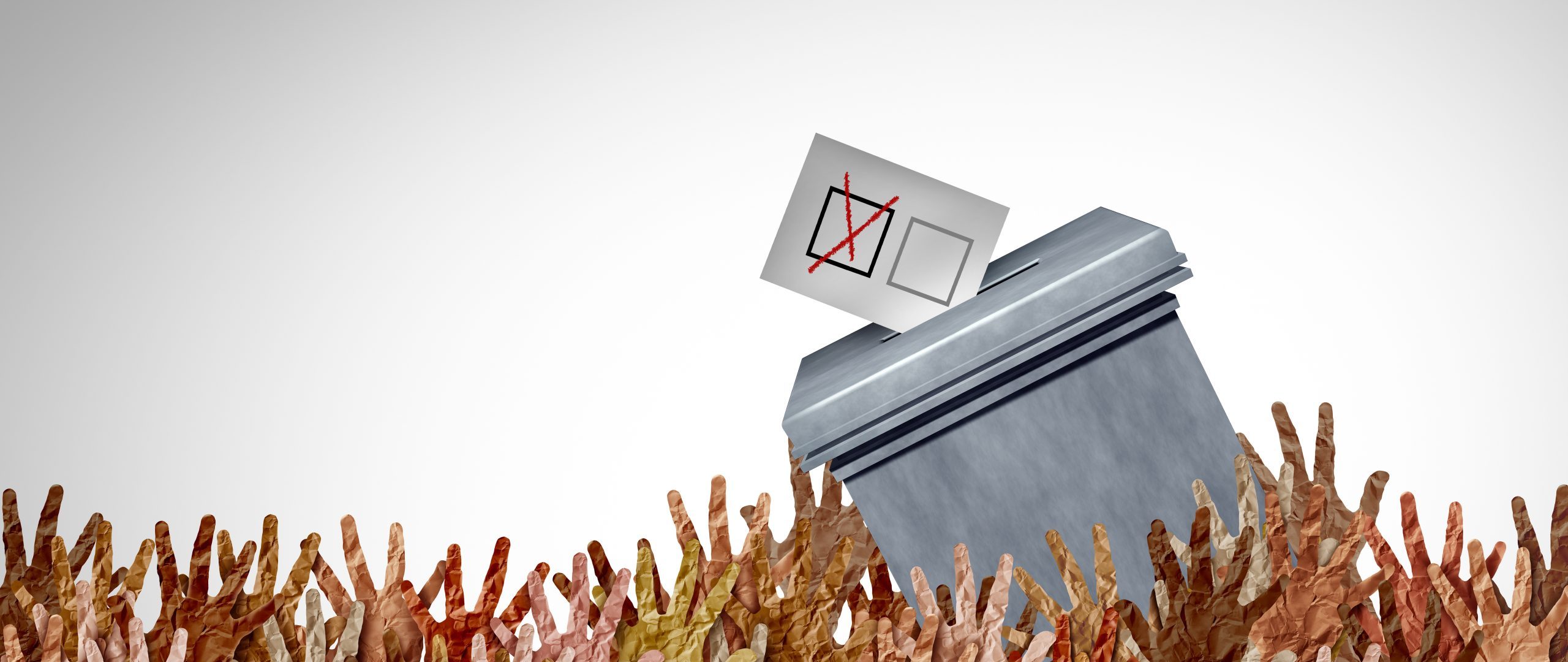
Statement: Voting Rights Rollback in Latest Court Ruling

This is one of the most painful decisions by a Supreme Court that increasingly appears disconnected from the lived realities of millions of Americans.

A voting rights rollback is unfolding in the United States following a recent Supreme Court ruling, raising urgent concerns about the future of equitable representation and democracy. Donald Whitehead, NCH’s executive director, is sounding the alarm, warning that the impact will be felt most by already marginalized communities. Below is his statement in response.

In this moment, we witnessed a crushing blow to the future of minority representation. It is another in a series of decisions that inaccurately imply that discrimination is a relic of the past—that somehow this nation has evolved beyond the need for vigilance, beyond the need for protection, beyond the need for justice. This voting rights rollback is not happening in isolation, but as part of a broader pattern. If this voting rights rollback continues, the consequences for marginalized communities will be severe.

But we know better.

History is not something we escaped—it is something we are still living through. The hard-fought, blood-soaked gains of the civil rights movement were never guaranteed to last forever. They were won through sacrifice, through courage, through people who refused to accept a system designed to silence them. And now, piece by piece, we are watching those gains chipped away under the false narrative of progress.

This is one of the most painful decisions by a Supreme Court that increasingly appears disconnected from the lived realities of millions of Americans. Decisions like this do not exist in a vacuum—they echo a past many of us know all too well. A past where access to the ballot was controlled, restricted, and weaponized. A past that looks uncomfortably familiar when we examine what is happening now.

We have not overcome.

Just look at what is happening in states like Florida, Texas, and soon Tennessee—where policies are being enacted that make it harder to vote, harder to be heard, and harder to be represented. These are not isolated incidents. They are part of a broader pattern—one that seeks to redefine access to democracy in ways that exclude the very communities who fought the hardest to be included.

Voting rights are not just about casting a ballot. They are about power. They are about voice. They are about whether communities can shape the policies that shape their lives.

And when those rights are weakened, it sends a clear message: that some voices matter less.

But we cannot—and will not—accept that.

Because every generation has a responsibility. The generation before us marched, bled, and sacrificed to expand democracy. Our responsibility is to protect it. To defend it. And, when necessary, to fight for it all over again.

This moment demands clarity. It demands courage. And it demands action.

Because democracy does not erode all at once—it erodes decision by decision, law by law, until one day we wake up and realize that what we thought was permanent was always fragile.

We are not powerless in this moment. But we must be honest about what we are facing.

This is not the end of the story.

It is a call to write the next chapter.

The following piece is a speech that was presented by a participant of the Faces of Homelessness Speakers’ Bureau after her trip to Washington, DC:

Someone once said, “Nothing in life is to be feared. It is only to be understood.”

Before DC, my Faces of Homelessness Speakersclassmates and I were just like everyone else, we feared what we did not understand and therefore we did our best to avoid it. We go about our lives ignoring the bad, because we believe it cannot happen to us, but honestly, I don’t think any of us truly believe that.

It is crazy how one moment can alter your entire outlook on life, making you realize that up until that moment, you had not understood life itself. After a day of lobbying in DC, we went to the Thurgood Marshall Community Center to hear a program on homelessness. We would be hearing stories from people who had once been homeless and were now sharing there stories with others.

As a normal teenager, I was thinking, “This is gonna be boring, hopefully I will be able to take a nap.” But, from the moment the first man opened his mouth to speak, I was hooked, and by the end of the program, I found myself in tears. Whether they were tears of sorrow for those people and what they went through, or tears of my guilt in feeling so unaware of what is going on in the world, I knew from that moment I had to help. I know my classmates had that same feeling too. As we walked out of the building to the metro, there was a homeless man sitting on the steps of a restaurant, I opened my wallet along with my other classmates, and put in a dollar. The look on his face was priceless, and from then on, the rest of the trip we all decided to help the homeless, not only by giving them money, but most importantly, by letting them know we cared.

On our last night in DC, about five of my classmates and I along with Rabbi Ed wanted to do one last thing. After dinner, we walked over the pharmacy and bought packs of goldfish, granola bars and Koolaid. We each chipped in about two dollars, and with that we were on our way.

We were on a search to find those people in need, the ones who get ignored on the streets, the ones who are looked at and thought of as lazy and dumb. We were on a mission, that mission was to find those people, and not just to give them the food we had bought, but to make them feel like they weren’t alone in this world, and to let them know there were still people who cared and wanted to help them.

From DC I learned a lot, but I never thought I would view homeless people to be an inspiration. Each morning they awake to nothing, looking for somewhere to go, for food to eat, and shelter for warmth. These challenges all arise to them before we even awake in the morning. We go about our days complaining about our gross school lunches, our lack of sleep, our loads of homework, and much more. But, we never stop to think of how amazing our lives are, and how we should thank our parents for everything they do for us, and how in one moment all of that can be gone. We could have everything taken away from us at any time, our family, friends, house, school. But no, we don’t think about those things. Why you might ask? Because we don’t believe it could ever happen to us. Until now.

So I would like to thank my parents, friends, and Rabbi, for helping me open my eyes to the real world that surrounds me. And lastly, thank you DC, without you I would still be in fear of what I did not understand, but now that I understand it, life seems to mean all the more.

-Jamie Goodman
John Burroughs School