Occupy Homelessness: A News Update

While Occupy movements across the country have been forced to relocate from parks and have become less visible to communities and the media, many Occupiers have been finding creative ways to use their protests to assist community members who are un-housed or at risk of losing their homes.  In December, we asked that the Occupy movement remember the lowest 1%, and we’re seeing the response:

After an April 1st march to preserve the civil rights of people experiencing homelessness, Occupy San Francisco occupied a vacant building, calling for more housing and resources for people in the city without homes.

With so many cities having already passed, or currently considering, legislation to limit the ability of people who are homeless to sleep in public areas, Occupy Nashville held a “sleep-in” to protest an anti-camping law that had been signed by the Tennessee governor in March.

And finally, foreclosures are continuing at an alarming rate.  Occupy Our Homes recently assisted a District of Columbia resident in preventing her eviction.

Homelessness is quickly becoming America’s “forgotten tragedy”. All around us, we are encountering historic levels of economic hardship, childhood hunger, terminal illness, domestic violence, disabled veterans’ languishing on the streets, as well as a rising tide of lethal hate crimes. But we can make a difference.

The National Coalition for the Homeless is proud to announce a new campaign, Crisis Hidden in Plain View, a campaign to encourage outreach and engagement to families and individuals who are homeless or at-risk of becoming un-housed.  Watch the video.

We need your help today!

NCH is working each day to prevent and end homelessness, while ensuring that the needs of those experiencing homelessness are met. We do this by…

  • Bringing America Home. Ending homelessness is a national problem with local solutions: NCH’s is ending homelessness by creating affordable housing; growing living wage jobs; improving access to affordable healthcare; and, protecting civil rights.
  • Protecting the Human Right to Shelter & Housing. Everyone deserves a place to call home. NCH is working to establish and preserve the human right to shelter & housing.
  • Helping Hands. Homeless families and individuals can use support: NCH has placed 60 VISTA volunteers in 24 sites across 6 states, giving people in need a helping hand.
  • Keeping an Eye on Justice. Poverty is not a crime: NCH is protecting workers rights in the courts and in the field and making certain that homelessness can’t be criminalized.
  • Speaking Truth to Power. NCH issues twelve annual reports with in-depth analysis and reviews on housing, healthcare, jobs & benefit income and civil rights.
  • Protecting Voting Rights: Homelessness can feel dehumanizing. NCH is fighting for the right and ability to vote by registering 25,0000 voters living in persistent poverty.
  • Sharing Our Stories: The homeless experience is best told in the first person; NCH’s Speakers Bureau is dozens of speakers, 100’s of thousands listeners, and 30 bureaus.
  • Grassroots Organizing: Homelessness is not community-less. NCH brings homeless stakeholders together to organize, act in their own self-interest and create durable power for many tomorrows.

Your donation today will be matched dollar-for-dollar through a time-limited $30,000 matching contribution.

Contributions to housing the homeless have never been more necessary, and investments today have never more effective. NCH is Bringing America Home and we need your support now.

HMIS Action Alert
(published January 25, 2012)

HUD must only and always report the truth to Congress on Homelessness. Take action now! HUD is accepting comments on final HMIS rules until February 7, 2012. The rules will determine how & when homeless people will be counted, privacy rights, funding levels for local shelters and services. HUD needs to hear from YOU & all local communities. We must balance the needs of the social service community with the rights of those seeking help.

What is the issue?
HUD is seeking comments on the rules for collecting information from homeless individuals at the shelters and aggregating that information to deliver statistics to Congress. Comments due to HUD by February 7, 2012.

Why should you respond?
The final rules will determine the privacy rights for those seeking help. The numbers collected and the outcomes could determine the funding levels for local shelters. The experiences with HMIS at the  local level are important.

What are possible outcomes?
HMIS can be costly to implement locally. A goal of HMIS is to balance the needs of the social service community with the rights of those seeking support. Overall, HMIS should provoke greater incite into solving homelessness.

To respond to the new proposed rules:
Send Comments using the federal eRulemaking Website: http://www.regulations.gov

Docket Number FR-5475-P-01 Title: Homeless Management Information Systems Requirements

Save a copy of the body of your comments and send them to info@nationalhomeless.org for our records at the National Coalition for the Homeless.

Background:
Please use this outline as a basis for submitting comments to HUD regarding the proposed rules for HMIS that were released in  December. It is important to add your local statistics, experiences, and examples to augment this list.

Comments are due to HUD by February 7, 2012 and can be submitted to www.regulations.gov by using the docket
and title of the proposed rules. The National Coalition is urging local advocates, social service providers and those experiencing homelessness to submit comments on these new rules. We believe that HMIS can be a huge burden on a small non-profit trying to provide services to those struggling with their housing, but can have great rewards in coordinating services, reducing paperwork, and providing high quality referrals to those experiencing homelessness.

Here are some comments that you can use in submitting a response to these rules. We urge you to include local activities and examples to support these comments. We believe that HUD officials will listen to local caretakers of the homeless population and your concerns over HMIS.

Comments Regarding HMIS
(Our local group) has accepted the use of HMIS to improve the delivery of services to those experiencing homelessness, but we do not support the use of HMIS as a system to report the extent of homelessness to Congress. We have seen that the statistics are often mistaken for a count of the total number of people homeless in a city or county. No matter how many qualifiers are included in the national Annual Homeless Assessment Report, both elected officials and the media mismanage the data as a complete count of homelessness. There is such wide disparity in how this data is collected that there is no way to compare among service provider and certainly between
cities this case management data. We believe that a voluntary case management system would be worthwhile to collect data, but a mandatory system that attempts to collect an unduplicated count is nearly impossible in such a fractured system.

In a period of tightening budgets and federal cuts, we believe that these resources could be redirected to basic human services or housing assistance instead of the administrative services of counting people. We see the value of one electronic case management system overseen by HUD used by every social service provider in a community. If the eventual goal is to arrive at the number of homeless people in a city or state as stated by Congress, we believe that HUD would receive much better information by funding local experts to conduct a census in representative cities. We believe that local universities or foundations in various size representative cities, suburbs, and rural jurisdictions could develop an accurate estimate of the number of homeless people and then they could use that data to extrapolate a national estimate of homelessness.

That being said we do have concerns about the proposed rules that were released in December 2011.

  1. It should be made clear that there is not a minimum participation rate by clients for the social service provider. The user who is experiencing a housing emergency and refuses to enter data should not result in a penalty or an issue with the performance standards for the local social service provider. [It would be good
    to add a local example of this issue from your community]. If a user refuses to enter their social security number or other personal identifying information that should not result in a reduction in public support or a sanction for the social service provider. The shelter or meal program should be held harmless if their clients decide to withhold personal required in the HMIS database.
  2. We believe that the security standards should emphatically and unequivocally state that law enforcement agencies should not have access to personal identifying information contained within the HMIS data without a warrant signed by a member of the judicial branch of government. We understand that some  communities have the local sheriff maintains the HMIS data.
  3. We believe that the requirement for every publicly funded homeless service provider contribute data to a central management system is an unfunded mandate from the federal government. There should be dedicated resources separate from the Emergency Solutions Grant or Continuum funding to implement this project. [It would be good to add local information on the number of staff dedicated strictly to entering data at your
    facility.]
  4. We believe that there are a number of state privacy laws that make it difficult for local agencies to submit data under these proposed rules. [Many states have strict controls over the use of social security numbers when accessing government services, which could present a conflict for the local provider who also receives federal continuum funding. If you know that this is the case in your state, please site specific local or state law.]
  5. We believe that the HMIS security standards should be subject to HUD oversight and public comment. The security standards, local policies and procedures and grievance process should be posted on an easily accessible publicly available website. Those experiencing homelessness should be able to submit comment
    and have those comments responded to by the local HMIS Lead in an easy and accessible manner.
  6. There are no protections for clients outlined for improper usage or improper release of data especially privacy violations by an HMIS Lead organization. We believe that if there is a break down in privacy at the local level and the policies and procedures break down there should be a way for an individual seeking assistance or currently utilizing a Continuum funded program to file a grievance with a government agency with regard to HMIS. In addition, with the exchange of data among local providers and the transient nature of the population, it is often difficult for a person experiencing homelessness to determine where a security
    breach originated. We believe that a government agency should be the final arbiter of a complaint especially if there are repeated problems with the protection of privacy at the local level. This is especially important if the HMIS Lead organizations are also permitted to be collectors of personal and private client data as service providers as well.
  7. Since this data is being used by the public and Congress for planning and local decision making on the proper allocation of resources, there should be a way for advocates or the public to challenge the data’s accuracy. There should be a way for the HUD to accept challenges to the unduplicated numbers submitted
    as either a significant undercount or an over-count of the actual number of homeless people in a community as is policy for the US Census. These comments should be included with the release of the Annual Homeless Assessment Report.

By Megan Hustings

Good thing I’m not that old, because I’m showing my age. I’ve posted my way through several generations of social networks.  In college, students at my school shared a network of “Plans,” a page that was hosted on the college’s intranet where users could make text only posts (quotes, rants, etc.) and tag their friends. After graduation, I started out on Friendster, which I barely remember now. MySpace was the next big thing, but even as it grew in popularity, other online communities began vying for internet prominence.

Today, Facebook and Twitter seem to reign the waves, but again, new online communities continue to spring up to offer unique opportunities for organizing certain kinds of communities. I can’t even begin to list all the websites that could be classified as social networks, you can look for more on this Wikipedia listing of social networks, or I love to get lost in the “Conversation Prism” – here’s the author’s blog post.

Since starting out with NCH five years ago as an AmeriCorps*VISTA volunteer, I’ve seen the organization’s fundraising and outreach change quite a bit. Back then, we focused on sending out appeal letters a few times a year and writing grant proposals, but had just moved to an online only newsletter. Now, we look for more diverse funding sources, and spend a good amount of time connecting to our supporters and members through online and social media – Twitter, Facebook, the Bring America Home Blog, and many others (Change.org, MySpace, YouTube, Razoo, etc.).

The question I keep coming back to is how do we effectively engage the NCH community in ending homelessness through these networks? Can online advocacy make a difference?

We have raised some funds over the years from Facebook Causes, and have passed along several successful petitions through Change.org. Advocacy in all its forms is hard to quantify, but we know that we have the ears (or screens) of well over 15,000 advocates through various social media websites.

Recently, we sent out surveys on our social networks, Facebook and Twitter, asking you how we could improve our social networking presence. (To all of you who responded, thank you!) Through this experience, we got to know a little about you and how you interact with NCH online. Some of the things we learned were:

  • Many of you first engaged with us through social media to learn more about advocacy for the homeless
  • We Tweet just the right amount, but you would prefer if we posted more on Facebook.
  • You are most interested in the subjects of homeless organizations and services, and homeless services, but those on Facebook would like to see more direct testimonials from people experiencing homelessness
  • Interestingly, most of you work for another organization relating to homelessness

Finally, we learned that only a few of you who engage with us on Facebook and Twitter are active, contributing members of NCH. We know budgets are tight all around, but if you’re able to become a member, this holiday season is a great time to do so!

We have already begun to use this information to (hopefully!) improve our social networking interactions with you. But is there more we can be doing? Are we making a difference by educating with news stories, sharing the faces and voices of those who experience homelessness, or spreading awareness of what our great partners are doing across the country?

We’re always open to more suggestions, or examples of successes you have had in mobilizing your online community. Please feel free to leave your comments or contact me at 202-462-4822 or mhustings@nationalhomeless.org.

Jazz singer, Madeleine Peyroux, is a long time advocate and philanthropist of organizations fighting to end homelessness. She was born in Georgia, but grew up in the cities of New York City and Paris. She was inspired to start singing at age 15 after being inspired by the street musicians in the Latin Quarter of Paris. One year later she joined the Lost Wandering Blues and Jazz Band and toured Europe. In 1996 she released her first album, “Dreamland” and since then has released an addition three albums.

To pursue the playing of music as a career soon after, was for me a continuation of my time in those streets, with the families I had created and the echoes I had left behind.”

The singer, songwriter and guitarist has been compared to the likes of Billie Holiday. She has preformed all around the world. She has toured with big names, like Sarah McLachlan, but has also headlined her own tours around the country and world. Starting in 2005, Peyroux began adding a $1.00 surcharge to her concert tickets to raise money for local homeless organizations. Her efforts have raised thousands for organizations like Real Change in Seattle, Street Roots in Portland and the Emergency Family Assistance Association in Boulder, among many others. She is a strong supporter of the work of the National Coalition for the Homeless.

In addition to her philanthropic commitment, she was recently featured on a CD compilation called “Give US Your Poor.” The album features musicians, such as Bruce Springsteen, and collaborations with currently or formerly homeless musicians. The proceeds from the album benefit the national awareness campaign, Give US Your Poor. Madeleine Peyroux is a musician dedicated to making real change.

By Samantha McClean, Former NCH Intern

*Photo used with permission from Madeleine Peyroux

By: Brian Stone

Today, it seems as though there is normalized acceptance of a segment of our population not having enough food or shelter. The proof is last week’s budget cuts which will push those without food, homes and medical care into deeper despair. It is important that we remember what hangs in the balance. In the past, the anti-hunger and poverty movement has responded in a multitude of ways. One of those is known as a hunger fast (or strike) to draw public awareness to the issues the poor face and create policy change.

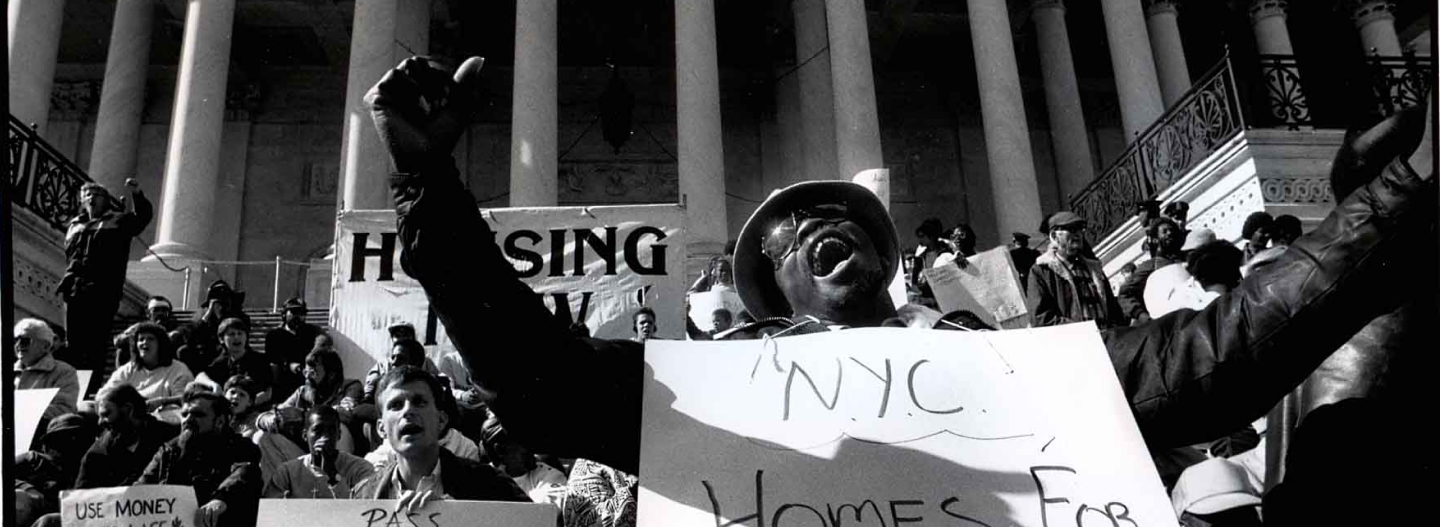
In the 1980’s Michael Stoops, Director of Community Organizing at NCH, and Mitch Snyder, a life-time advocate for the homeless, fasted on the steps of the Capitol Building to pressure President Reagan into signing the first legislative protection for homeless people, which eventually became the McKinney-Vento Act. This act provided blanket protection and assistance to the homeless. Mitch and other advocates also fasted to get the federal government to transform an abandoned federal building in D.C. into a shelter for the homeless. Out of this fast the Community for Creative Non-Violence (CCNV) emerged, and remains D.C.’s largest shelter.

Former Ambassador Tony Hall has an unwavering commitment to poor people and poverty issues. While in Congress, Hall frequently authored legislation with expansive protections for the poor and vulnerable. In 1993, Hall, who was an Ohio Congressman at the time, was dismayed by Congress’s decision to end the bi-partisan House Select Committee on Hunger. This resulted in his going on a 22-day hunger fast. He felt that Congress had lost sight of the issues that our most vulnerable face. The outcome of this fast was substantial. Congress agreed to fund the Congressional Hunger Center, of which I am honored to be a 17th Class fellow; and the World Bank pledged to support efforts to end world hunger.

Eighteen years later Hall feels that Congress has once again lost sight of the plight of the poor, those who stand to bare the brunt of the budget cuts. On March 28, 2011, Hall embarked on another fast to protest the current budget cuts. If you would like to join Tony Hall or get more information on the fast, check out: http://hungerfast.org/.

We must remember that people’s lives hang in the balance. What is more important than cuts made in the name of lowering the deficit is the impact that those cuts will have on a large group of people. Balancing the budget at the expense of the poor and vulnerable is not the answer. This will only prove to further complicate the lives of those who currently don’t have enough, with the likely end result being eventual increases in social support programs.

Hunger fasts, like Michael’s, Mitch’s, Tony’s and many others, have provided protections for the vulnerable and changed policy in the U.S. The time is now. Will you join the circle of protection around the most vulnerable members of our society?

Brian is a Bill Emerson National Hunger Fellow with the Civil Rights division at the National Coalition for the Homeless.