Notes from the Field—Board Member Spotlight Richard R. Troxell

According to George Santayana “An artist is a dreamer consenting to dream of the actual world,” which pretty much sums up the world occupied by homeless activist Richard Troxell who currently resides in Union County North Carolina.

Most of Richard’s work was in Austin, Texas, where he caused the most trouble and left his mark with a sculpture he designed called “the Homecoming” at Community First! Village.  Richard can give you an hour’s long narrative about the chance meeting between the elderly woman depicted in the sculpture and the man and her daughter.  He can give you the military background of the dad and how the elderly woman’s journey led to this place.  This 7 year quest to bring this sculpture from concept to learning how to cast sculptures to collaborating with other artists to finally seeing his creation placed in 2019 is a dream realized for any artist, but the grassroots organizing and assistance offered by Richard to those oppressed by society may be his biggest impact on the world. 

The Homecoming

Richard had a day job helping people navigate the legal and social services network in Austin, but he had a side gig as the face of House the Homeless to twist the arms of city officials to stop pushing around people experiencing homelessness.  Pushing people out of the arts areas of Austin; pushing them away from South by Southwest conference; pushing them off park benches, and pushing them out of sight.  While everyone thinks Austin is some liberal oasis in the middle of a right wing fundamentalist state, sometimes the worst people who strip you of your rights are those with so called liberal beliefs.  In the 1990s, nearly every city in the United States led by “progressive-man-of-the-people” mayors were horrible places to live for those experiencing homelessness. Chicago, San Francisco, Cleveland, and Seattle all had Mayors who were just cruel and heartless to homeless people.  The City of Austin was no different with police sweeps, selective enforcement of certain laws, and attacks of free speech panhandling like the other liberal bastions. Richard found success fighting the “No Camping” ordinance in the courts after five years and argued his case for more humanity from City Hall in the court of public opinion. He fought disorderly conduct tickets for existing as a person without a home and regular attempts to shut down the shelters. Many cities including Austin pass these laws under the umbrella of “Quality of Life” ordinances.  They are more appropriately called “Quality of Life for Mostly White Visitors to the City” ordinances, but they typically targeted the lowest income members of society.  Richard successfully fought against an ordinance that made it illegal for certain people to rest in public which then began a cascade of other similar laws to fall. 

Richard set up a huge fall event for 18 years to give out long underwear and winter gear to those facing a tough cold winter without regular shelter. The Thermal Underwear that  “winterized them” and threw live music parties serving over 600 people, while his wife, Sylvia served them ham with cakes and pies, cornbread and real butter etc. (This event continues to this day.) He passed out hats during heat waves, emergency whistles to fend off serial assaults, and he worked to get those without a roof, some privacy in our society.

Semi-retired and relocated to North Carolina making personal COVID-19 face masks, Richard is now the national field general for House the Homeless and still on the quest to get the Universal Living Wage to be a part of the national discussion.  Richard joined the National Coalition for the Homeless way back in the early 1990s and has always felt that the key to ending homelessness is giving people enough income to be able to sustain themselves free from shifting winds of benevolence from government or the religious sector. Richard wants to see a second statue in Washington DC to memorialize all the homeless individuals who did not survive without a roof over their head.  He has become very interested in pushing for Social Security to be more equitable and not doom a person to a life of poverty if they are disabled. He would like to see social security income, SSI, assistance paired with a housing subsidy that limits the amount a person pays toward rent to no more than 30% of their income or even better 25% of their income as it was during the Nixon administration. In this way, people who cannot work will be able lift themselves off our streets. He will always bring the discussion back to honoring a person’s labor by paying them a wage that provides them the basic standard of living in a community. If Richard attends the meeting, he is going to bring up the need for a universal living wage in America.  I was always surprised that he did not bring a neon sign with the Universal Living Wage logo so that he could turn on and off at various times during the National Coalition for the Homeless board meeting.  

He moved from the state with the highest number of uninsured people in the United States in Texas to the rural county of Union, North Carolina which boasts a large number of uninsured as well at 12.3%.  So, plenty of work for Richard in North Carolina. Child poverty in Austin was around 13.1% when he left with about 12% of the population living in poverty while only 7.3% of the population of rural North Carolina live below the poverty level.  The unemployment rate in Austin is around 6.3% while it is only 5% in Union County North Carolina.  The semi-blue state of North Carolina has a partial postponement of evictions while the deep red state of Texas only has the federal CDC moratorium on evictions.  All other state and local restrictions on evictions have expired during this pandemic in Texas. Austin is the fastest growing metro area in the United States, but it also boasts the widest income disparity of any community.  

Two other goals for Richard that he has been looking at as the new administration begins in Washington include a federal ban on discharges onto the streets as well as more involvement by the US Department of Transportation under the guidance of newly ratified Transportation Cabinet Member, Mayor Pete Buttigieg to include those sleeping under the highway bridges of America in the plan to improve infrastructure.  It is a sad reality in the United States that many sexually based offenders cannot find housing anywhere after they have served their time and often turn to encampments mostly under the nation’s highways.  This is not to say everyone who lives under bridges are sexually based offenders, but there are a disproportionate number.  This has led to absurd situations where offenders register with the County sheriff a highway bridge as their permanent residence, which is certainly not the safest or most effective way to reduce recidivism. In fact, the current method for tracking offenders is probably the dumbest and worst strategy on the planet to keep society safe.  Richard saw the big plans for investing in roads and bridges out of the Biden administration and wants housing to be a part of that plan that would create a lot of well paying jobs. This is not to reward sexually based offenders, but to keep all society safe by reducing risks.

California passed a law Senate Bill 1152 in 2018 which attempts to eliminate hospitals from dumping patients onto the streets, and sets up a training protocol to prevent people showing up at the shelter in cabs with their hospital gown and an IV bag still attached.  Richard would like to see this law expanded to include alcohol and drug treatment programs as well as mental health institutions; given some teeth for a strong enforcement mechanisms, and expanded to every health care facility that receives Health and Human Services dollars in the United States.  He also has toyed with the idea of seeing the same apply to all federal institutions so that there has to be some thought about where an individual will live after leaving the US military, housing subsidized by the Department of Housing and Urban Development or the Department of Agriculture or even those released from a federal penitentiary. Richard demands that we discharge no one into homelessness (with strong enforcement). After a period of extreme cruelty by the United States government where we caged kids and separated them from their family, reinstated the federal death penalty and banned people from entering the country because of their religion, it is time to bring back a government of compassion and concern for the well being of everyone living within its borders.  

Richard is a published author, Looking Up at the Bottom Line: The Struggle for the Living Wage, which carries on through today as he is in the process of publishing his latest book, Short Stories in a Long Journey. He self-published, Striking a Balance (about pending gentrification in East Austin) and Ending Homeless at its Core-Richard’s first e-book. If you are interested in more of his history of activism, you can pick them up on Amazon. He will continue to work toward economic justice as well as civil rights for the most vulnerable in our society albeit in a slightly more compassionate community in North Carolina.  He combines the passions of an artist with the common sense of an advocate and the knowledge of a social worker making him one of the best friends to have if you do not have housing in America. 

By Kelvin Lassiter – Policy Analyst

There’s a huge divide in America. Most believe that divide is either racial, economic, political or a combination of all three. They would be right. What about affordable housing? The heart of the matter lies in who is dominating the conversation regarding what’s affordable. The divide in the affordable housing conversation is racial, economical, and political. Let’s tackle income inequality, for starters, the federal minimum wage. Some would say our nation should explore provide universal basic income. Already underway and is a plus. See the pattern here? The individual, organization, or government entity directing the narrative determines what’s affordable and what’s not affordable. What income level is suitable and what is not. It was refreshing for a change to see the people determine what’s suitable regarding the recent events in Philadelphia, PA. 

For years, the Philadelphia Housing Authority has ignored its most vulnerable citizens. Eligible housing units that the poor can qualify to live in sits empty. This is by design. Developers and housing investors stalk their prey with lobbying efforts to develop something called mixed income communities. America, that’s just a fancy way to disguise “gentrification”. On average, a larger number of poor people that leave their neighborhoods behind never return. Philadelphia is no different. Empty housing just occupies city space while over 40,000 people sit on a waiting list for public housing. This is a normal practice in America. Make the poor sit and wait. Developers, house flippers, and city governments leave out the people that need it most, well, not this time. 

Lawyers, activists, and the unhoused seized on the opportunity to grab the attention of America with advocates that know something about grabbing attention; Black Lives Matter. It’s a marriage that ties housing and justice together. The people taking matters into their own hands may repair fractured relationships between housing authorities and the citizens they are supposed to serve. The journey started out with a simple demand; provide housing or we will take to next steps to provide housing for ourselves.

Well, of course, city hall did not listen, setting the stage for what would happen next. Close to 200 of Philadelphia’s most vulnerable people took over a park at 22nd and Ben Franklin Parkway in a neighborhood known for the lifestyle of the rich and famous. In this same time period, fifteen unoccupied housing authority homes became property of the people. The conditions may not have been ideal; however, it forced the housing authority to look at a much greater problem, humanity. Encampments were strategically set up in various parts of the city to force action. 

After months of political posture, an agreement was reached. The city agreed to turn over 50 public housing units including the fifteen occupied during a citizen take over.  These homes will be in a land trust meaning housing will be affordable for the poor and operated by the people. One of our sources who participated in the negotiations shared the following, something you may not hear with the national media:

Jobs are available through the trade union. Houses are being fixed up in North and West Philadelphia, and the formerly unhoused are welcome and will contribute to keeping the character of the neighborhood. While this is a landmark deal that will have implications nationwide, it comes with a set of challenges as well. The city council still continues the practice of political gamesmanship and owns a graveyard set up for housing policy. While it is much appreciated for the Philadelphia Housing Authority to grant 50 houses, it is still not enough for the estimated 6,000 plus unhoused people that remain in Philadelphia. Finally, the practice of encampment sweeps will continue in the midst of a global pandemic.

The fight for housing, which is a “human right”, has remained an issue since the Fair Housing Act of 1968. Discrimination has reached an all time high in punishing the poor just because they are poor. Will other housing authorities nationwide join Oakland, and Philadelphia using land trust models? Will the people have to take matters into their own hands or can we depend on housing authorities to do the right thing? Have we, or will we finally reach a moment of reconciliation in America? The jury is still out and has not yet reached a verdict. 

Dear Friends,

Megan and Annie at May 14 Poor People's Campaign Rally by @Fightfor15

Megan and Annie at May 14 Poor People’s Campaign Rally by @Fightfor15

Today, Monday June 11, 2018, NCH Director Megan Hustings and Public Education Coordinator Steve Thomas will participate in nonviolent direct action with the Poor People’s Campaign. We plan to risk arrest in solidarity with the thousands of our homeless neighbors who are arrested and fined every day for carrying out life-sustaining activities in public spaces.

We can no longer accept the false narratives that allow for systemic racism to cause such deep inequality and economic injustice in our communities. Co-chairs Rev. Dr. William J. Barber and the Rev. Dr. Liz Theoharis, of the Poor People’s Campaign tell us that to change the narrative, we must change the narrator. NCH has, since its inception, stood to raise the voices of, and take our direction from, the community of people who experience homelessness – those who are most affected by economic injustice.

We envision a world where everyone has a safe, decent, accessible and affordable home. NCH affirms that we can and must end and prevent homelessness. We believe in the dignity of all people; and in housing, healthy food, quality health care, education and livable incomes as basic human rights. We believe that it is morally, ethically, and legally wrong to discriminate against and criminalize people struggling to meet their basic needs. We affirm that public policy makers and elected officials at all levels must be held accountable to end the systemic and structural causes of homelessness, and that structural racism and discrimination are root causes of homelessness and violates human dignity.

This is the 5th week of 40 Days of nonviolent resistance through the Poor People’s Campaign: A National Call for a Moral Revival, focusing on the theme that Everybody’s Got the Right To Live: Education, Living Wages, Jobs, Income, Housing. We call on you, our supporters and partners, to stand with us in challenging the evils of systemic racism, poverty, the war economy, ecological devastation and the nation’s distorted morality.

Over the past two years, the Poor People’s Campaign: A National Call for Moral Revival has reached out to communities in more than 30 states across this nation. We have met with tens of thousands of people, witnessing the strength of their moral courage in trying times. We have gathered testimonies from hundreds of poor people and we have chronicled their demands for a better society. The following moral agenda is drawn from this deep engagement and commitment to these struggles of the poor and dispossessed. It is also grounded in an empirical assessment of how we have come to this point today. The Souls of Poor Folk: Auditing America report reveals how the evils of systemic racism, poverty, ecological devastation, and the war economy and militarism are persistent, pervasive, and perpetuated by a distorted moral narrative that must be challenged.

We must stop the attention violence that refuses to see these injustices and acknowledge the human and economic costs of inequality. We believe that when decent people see the faces and facts that the Souls of Poor Folk Audit presents, they will be moved deeply in their conscience to change things. When confronted with the undeniable truth of unconscionable cruelty to our fellow human beings, we must join the ranks of those who are determined not to rest until justice and equality are a reality for all.”

Please visit https://www.poorpeoplescampaign.org to read the full The Souls of Poor Folk report: Auditing America 50 Years After the Poor People’s Campaign Challenged Racism, Poverty, the War Economy/Militarism and Our National Morality, as well as the campaign’s principles, and demands.

Art thanks to WRAP and artist Art Hazelwood

Art thanks to WRAP and artist Art Hazelwood

Modern homelessness, as we know it today, began in the 1970’s. During the Reagan Administration, affordable housing dollars were cut but almost 75%, leading directly to poor working families experiencing homelessness at alarming rates. Folks began to organize in the 1980’s, this was when our organization was formed. At the same time, a group called the National Union of the Homeless (NUH) developed out of the first resident-run shelter in Philadelphia.

Read more about the NUH:

“In the late 1970s and early 1980s the United States economy underwent a series of changes that led to a sharp rise in homelessness. Homelessness was no longer characterized by down and out individuals living on skid rows. For the first time in US history, families were increasingly becoming homeless, and the shelter system was created to house them.

Out of this common experience of dislocation and dispossession grew a national organization of homeless people that mobilized thousands throughout the US in the 1980s and 1990s. At its height, the National Union of the Homeless (NUH) had over 20 local chapters and 15,000 members in cities across the US.

Most importantly, it implemented a model of organizing involving the poor and homeless thinking for themselves, speaking for themselves, fighting for themselves and producing from their ranks capable and creative leaders. This was contrary to the prevailing stereotypes and misconceptions about homelessness. Almost twenty years after the decline of the NUH, its history offers important lessons for building a movement to end poverty today, in the midst of continuing concentration of wealth among a few and expanding poverty for many.”
(Copied from The National Union of the Homeless: A Brief History, Published July 2011, https://homelessunion.wdfiles.com/local–files/curriculum/BriefHistoryPamphlet.pdf)

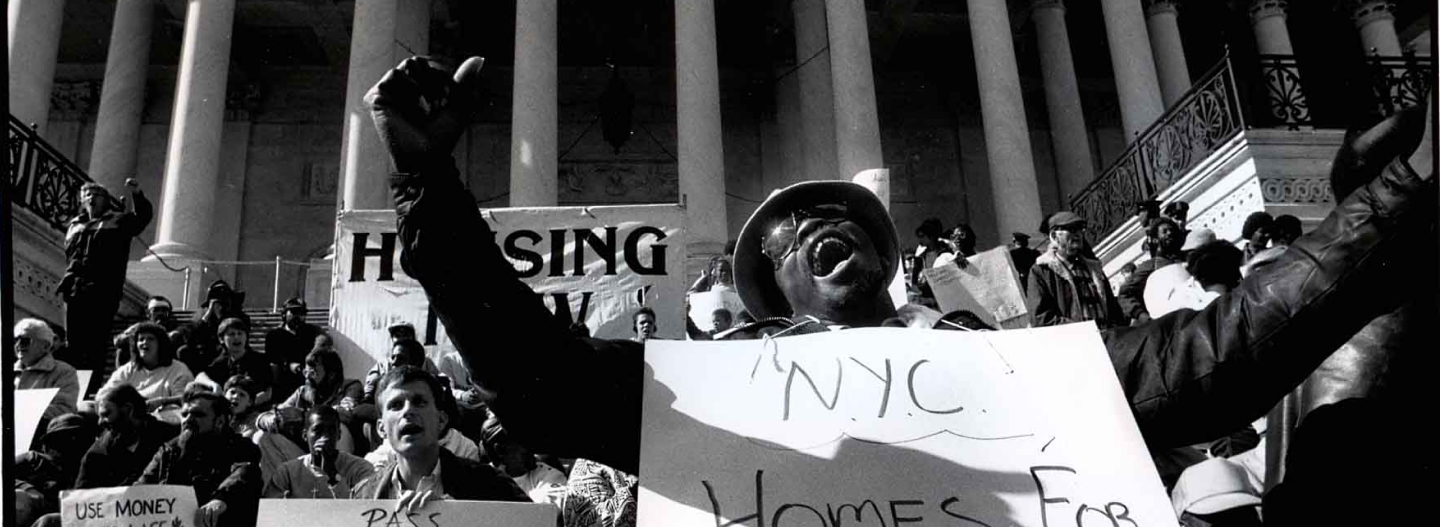
The NUH was active between 1985 and 1993. During this time, NUH mounted several campaigns, first aimed at overcoming stereotypes of who was homeless, then later focused on appropriating housing for its members. Their actions used slogans like “Homes and Jobs: Not Death in the Streets” and “Homeless Not Helpless.” They mounted civil disobedience like the Tompkins Square Tent City (detailed in Tent City Blues, an article in the Sept-Oct 1990 issue of Mother Jones), a national series of housing takeovers (watch in the documentary, The Takeover, from 1990), and the Union organized and participated in the Housing Now March along with the National Coalition for the Homeless and several others.

We encourage anyone reading this to learn more about where our collective work has come from by checking out the above links, and also visiting the Homeless Union History Project and the National Union of the Homeless Wikipideia page.

2020 Update: The Union is back


Do you still #TBT? Many of us have a short-term memory when it comes to policy, social media too perhaps, cause I haven’t seen a #ThrowBackThursday post since Facebook started showing you your past posts.

The National Coalition for the Homeless recognizes that we are at a pivotal moment in our social policy. Modern mass homelessness, as we know it, began, not that long ago, in the 1970’s. But here we are, again facing threats to social programs that are vital for the survival of working families, and now in the midst of unprecedented economic inequality.

In solidarity with the National Low Income Housing Coalition’s Our Homes Our Voices Week of Action (May 1-9) and the Poor People’s Campaign: A National Call for a Moral Revival 40 Days of Action (May 14-June 23), we are going to be posting historical information that relates to current trends, policy proposals, and cultural perceptions of those who experience poverty and homelessness.

To kick us off, we’ve included some more detailed history about how and why our organization was formed, and what we have accomplished over the years.

NCH Historical TimelineNCH’s Story

When modern homelessness first emerged in the late 1970s, hundreds of thousands of homeless were forced to fend for themselves on the streets, and many died or suffered terrible injuries. In 1979 a lawyer named Robert Hayes, who co-founded the Coalition for the Homeless in New York City, brought a class action lawsuit in New York State Supreme Court against the City and State called Callahan v. Carey, arguing that a constitutional right to shelter existed in New York. In particular, the lawsuit pointed to Article XVII of the New York State Constitution, which declares that “the aid, care and support of the needy are public concerns and shall be provided by the state and by such of its subdivisions…” The Coalition brought the lawsuit on behalf of all homeless men in New York City. The lead plaintiff in the lawsuit, Robert Callahan, was a homeless man suffering from chronic alcoholism whom Hayes had discovered sleeping on the streets in the Bowery section of Manhattan.

On December 5, 1979, the New York State Supreme Court ordered the City and State to provide shelter for homeless men in a landmark decision that cited Article XVII of the New York State Constitution.

In August 1981 Callahan v. Carey was settled as a consent decree. By entering into the decree, the City and State agreed to provide shelter and board to all homeless men who met the need standard for welfare or who were homeless “by reason of physical, mental, or social dysfunction.” Thus the decree established a right to shelter for all homeless men in New York City, and also detailed the minimum standards which the City and State must maintain in shelters, including basic health and safety standards. In addition, Coalition for the Homeless was appointed monitor of shelters for homeless adults.

On the heels of the landmark Callahan win, the decision was made to take the work of the Coalition for the Homeless national. Robert Hayes organized a meeting of several local coalitions in San Francisco in April 1982, out of which the National Coalition for the Homeless was established.

We have seen so many movements and actions since the 2016 elections – which means our communities want social and economic justice! We recently recorded a video of solidarity with the March for Our Lives and #NeverAgain campaign for gun reform. We are also partnering with the National Low Income Housing Coalition and the Poor People’s Campaign: A National Call for a Moral Revival on public actions working to fight the root causes of homelessness.

Here is what you can do this Spring:

Our Homes, Our Voices

We hope that you will join us in taking part in the National Low Income Housing Coalition’s Our Homes Our Voices week of action, May 1-8, 2018. Learn more about the event, and how to get involved here.

Poor People’s Campaign: A National Call for Moral Revival

We also hope you will join us in joining the new Poor People’s Campaign: A National Call for Moral Revival. This is a ground up movement being led by faith leaders and people who are struggling with an economic and social system that only benefits the most wealthy among us. The campaign has just launched its list of demands, which outline
how the evils of systemic racism, poverty, ecological devastation, and the war economy and militarism are persistent, pervasive, and perpetuated by a distorted moral narrative that must be challenged.
 The campaign states,
We must stop attention violence and see the human and economic costs of inequality. We believe that when decent people see the faces and facts that the Souls of Poor Folk Audit presents, they will be moved deeply in their conscience to change things. When confronted with the undeniable truth of unconscionable cruelty to our fellow human beings, we must join the ranks of those who are determined not to rest until justice and equality are a reality for all.
Mother’s Day, May 13th, will kick off 40 days of nonviolent action, and we encourage you and your network to join the campaign and take part in changing “not just the narrative, but who is narrating” our national political agenda.

Public Education

Finally, we know one of our biggest hurdles to housing all of our neighbors is public perception and prejudice against both people of color and poor people. To this end, we have created shareable documents that we encourage you to print and distribute: PUBLIC NOTICE for class action lawsuit - DHOL 2018

  1. A list of demands for the American Dispossessed: Created by Denver Homeless Out Loud in support of the Right to Rest and presented as a public notice, it is meant to be posted outdoors in places where our neighbors are forced to live in encampments or on public land. Click here to download

  2. State of Homelessness 2018: A brief (3 pages) overview of why we are seeing increased visible homelessness in our communities, covering everything from housing to HUD funding to criminalization. Click here to download

The National Coalition for the Homeless invites you to join a NATIONAL DAY OF ACTION FOR HOUSING in Washington, DC, and in communities across the country, on Saturday, April 1, 2017. (view and share the flyer)

We are calling on you and those in your community to take action to demand action to fix the affordable housing crisis, address racial inequality in our cities, and end the criminalization of poverty.

On Saturday, April 1, 2017 we will hold a rally and overnight vigil on the National Mall, and at city and state legislative buildings across the country. Bring tents, bring signs, bring your friends and families and stand up for our collective need for safe, decent and affordable housing.

Here is what we are asking:

  1. Preserve funding and create further local, state and national Housing Trust Funds that fund housing solely for extremely low to moderate income households.
  2. Stop ordinances, policies and practices that criminalize and harrass people who are unhoused, promote racial discrimination, and prevent equal treatment of immigrants and those who identify as LGBTQ, especially in access to housing, employment and healthcare.
  3. Ensure that safety net programs like food assistance and emergency housing are available to all of those who experience the loss of stable housing.

By standing together we can make the changes necessary to end homelessness in America!

masthead_2011

It’s quite fitting that we’ve reached the big 1-0-0 during the beginning of a new year!

In four years of blogging about current issues homeless communities face, we have covered stories from the everyday struggle of living without a stable home to celebrating the lives of our friends. While we are proud to have this space where our members, speakers, AmeriCorps VISTAs, interns, staff, and other dedicated advocates can contribute to the conversation regarding our neighbors and friends, we recognize that this conversation has been a long one that needs to end with more affordable housing, accessible healthcare, and living wage jobs.100th Blog Entry-A

As we continue to advocate for these rights, we dedicate this entry to the Top 10 Bring America Home Blog post which represents a diversity of perspectives from our bloggers. We invite you to take a look, be part of the conservation, and join us in our work.

Thanks for reading!

10. Living my Uncle’s Story
Hearing my uncle turn back the pages of his life, recounting his struggles and tragedies, my mind was reeling with empathy and understanding. I have lived my story for 21 years. But for the past two days, I lived his.

9. Is Prison Adequate Housing?
What some don’t realize is that these parole restrictions, combined with the difficulty in finding an employer willing to hire an ex-offender, make it very difficult for people who have served their time to find housing and be productive members of the community.

8. What would Mitch Snyder Do and Say Today?
I just hope that there is a little bit of Mitch Snyder in all of us which keeps our eyes on the prize of stopping this injustice of homelessness in our midst.

7. Voluntary Hunger in Protest of Involuntary Hunger
It is important that we remember what hangs in the balance. In the past, the anti-hunger and poverty movement has responded in a multitude of ways. One of those is known as a hunger fast (or strike) to draw public awareness to the issues the poor face and create policy change.

6. Tourism vs. Homelessness
Rather than providing day and night shelter services during the summer months, tourist cites do their best to move out homeless out of visible downtown locations. Homeless people are seen as bad for both tourism and economic development.

5. Shefights.net: A Sequel to Bum Fights

4. Police Charged with Murdering California Homeless Man
Thomas died because six officers of the Fullerton Police Department didn’t know how to react or respond to a mentally ill person in distress and crisis. When faced with a situation that caused confusion, law enforcement at the scene chose brutal force to subdue Mr. Thomas.

3. State ID Legislation Threatens to Disenfranchise Homeless Voters
This trend is only becoming more and more widespread: according to The Brennan Center for Justice, ‘at least 37 states are considering or have considered voter ID and/or proof of citizenship’ bills in this legislative session alone.

2. Membership Matters
There are very real and important reasons why homelessness in America grew to such crisis levels during our lifetime and why it continues to exist today. There are also a number of basic ways that each of us can help locally to prevent, reduce and end homelessness nationwide.

1. Homelessness: An Issue of Convenience Impacting Others
A special thanks must once again be given to our four wonderful speakers, without whom, we would not be able to effectively carry out NCH’s mission

As the president and executive director of the Massachusetts Housing and Shelter Alliance and a member of the Board of Directors at NCH, Joe Finn strongly believes in the power of an individual’s story. Mr. Finn’s Membership Matters because he supports NCH as an organization that gives homeless and formerly homeless citizens a platform to speak their minds and become advocates.

How did you first become involved with the National Coalition for the Homeless? In what ways do you continue to be involved with the Coalition? 

I first became involved in NCH through the outreach and advocacy of the Executive Director, Neil Donovan.  I wish to continue with my governance responsibility as a board member and I want to stay engaged in focusing NCH’s representing an authentic voice for homeless persons.

How do you interact with NCH? In what ways do you benefit from your membership at NCH?

I interact with NCH first and foremost as a member of the board. I hope I am assisting the CEO and staff toward implementing a broader vision that represents an authentic voice for persons who are or have experienced homelessness. My greatest benefit has been as a VISTA project host site.  The Speakers Bureau has limitless potential in developing the leadership capacity of homeless and formerly homeless persons in affecting real social change as it relates to homelessness.

To support the Faces of Homelessness Speakers’ Bureau and other NCH VISTA projects nationwide, become a member of NCH today! (click here for more information)

Through being a member of NCH, find out how you can help LGBTQ youth deal with the risk of homelessness. Here is some insight from our summer intern, Meghana Sthanam.

This summer, I am fortunate to be able to advocate for a problem I am truly passionate about: the disproportionately large number of LGBT individuals facing homelessness everyday. I’m originally from Birmingham, Alabama, where, almost unsurprisingly, you find a sizable population of LGBT youth without consistent housing. Most live with friends or stay at clubs, hoping to find a bed for the night by whatever means. Although I recognized the problem, after joining NCH, I realized this is a problem that plagues the entire country. In the general population, 3-5% of people self-identify as LGTBQ. Furthermore, studies have shown that the homeless LGBTQ youth population in theU.S.can be as high as 40%, almost half of the entire homeless population. It’s easy to see that young LGBTQ individuals inherently face greater risks of homelessness and discrimination simply by identifying themselves as a different sexual orientation or gender identity. I believe this issue deserves as much attention as other LGBTQ issues, such as gay marriage and Don’t Ask Don’t Tell; we cannot continue with this ‘out of sight, out of mind’ thinking that has pervaded our culture.

There are so many ways our members can help. For those involved with shelters, whether an employee or shelter resident, using positive language to create a safe haven for LGBTQ individuals is essential.  By simply avoiding derogatory thoughts and actions, you can make a person feel more welcome, especially when that person is coming from a climate in which acceptance is lacking. For our youth members still in school: be a friend! The numbers show that an extremely high percentage of homeless LGBTQ have experienced harassment and abuse within their home and school. Thus, reaching out a friendly hand can make a huge difference in someone’s life. For individuals working with law enforcement, LGBTQ youth compose 13-15% of those currently in the juvenile justice system, often because of the school-to-prison pipeline, abandonment by their family or victimization in their schools. Lastly, to all our members: please continue to be an advocate!