
Amicus Brief (pdf)
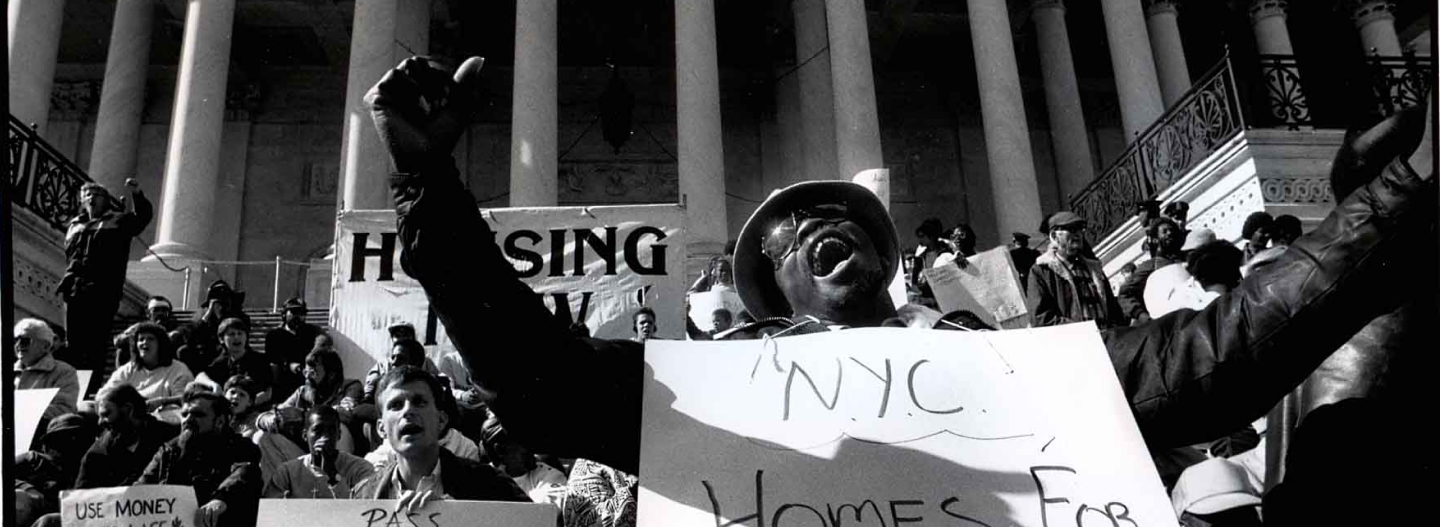
Over 700 people rallied in front of the U.S. Supreme Court during oral arguments on Monday morning, April 22, 2024. Over 30 communities across the country held solidarity events, and nearly 5000 watched livestreams. The atmosphere was electric. (Read more about the Rally, Photo of Donald Whitehead speaking at the rally by Kevin Wolf, AP)
The case being considered by the court, City of Grants Pass v. Gloria Johnson, addresses the legality of using a blanket to keep warm when forced to sleep outdoors.
Regardless of the court’s decision, this case will not create any housing, nor directly address persistent poverty and homelessness. Rather, this case could set a precedent for municipalities to address homelessness and housing insecurity with ineffective and extreme punitive actions.
The case has sparked a national conversation about the intersection of housing policy, poverty, and civil liberties. Laws that prohibit things like sleeping, laying down or even eating in public spaces, are common, yet they reflect discriminatory practices that have led to deep inequities.

Grants Pass, Oregon, was itself a “Sundown Town” – communities that mostly sprang up during the mid-1800’s, where the movement of non-white residents was restricted after dark. Policies that continued through the 20th Century like Anti-Okie laws, Red-Lining and Jim Crow laws have all been collectively understood to be discriminatory and in violation of U.S. civil rights practices.
Yet as the Supreme Court prepares to hear this Johnson vs. Grants Pass, the situation for Americans forced to live outdoors in an increasingly unaffordable housing market sounds similar to how poor and nonwhite Americans have been treated in past centuries. A recently law in Tennessee has made sleeping outside a felony, and the Florida governor recently signed into law banning sleeping or “camping” in public spaces.
A recent study, published in the Journal of the American Medical Association found that ticketing, jailing, and displacing people forced to sleep outdoors can actually lead to significantly higher mortality among folks who are unhoused. Moreover, fines and compounded tickets lead to criminal records for otherwise law-abiding citizens, creating further barriers to getting unhoused Americans back into a home.
“The Johnson vs. Grants Pass case is monumental,” states Donald H. Whitehead, Jr., Executive Director of the National Coalition for the Homeless. “It has the potential to instigate a barrage of draconian policies that cause significant harm to people experiencing homelessness in our country.”
The National Coalition for the Homeless, dedicated to organizing a movement led by those most affected to end homelessness, calls on our communities to invest in proven housing solutions. Hundreds are expected to rally in front of the U.S. Supreme Court building in support of Housing, Not Handcuffs.
The US Supreme Court is deciding Johnson v Grants Pass, which will have a huge impact on local policing of public space. We know that laws are passed and enforced locally. Your City Council, Mayor, and police are the ones implementing anti-homeless policies (such as sweeps) now. So, local actions are really important, in addition to actions in front of the U.S. Supreme Court. This tool-kit is being shared with folks across the country as we organize to send a powerful message to the U.S. Supreme Court: Housing Not Handcuffs!
A Call to Unity in Johnson v. Grants Pass
In the face of ongoing challenges, the resilience of our community—particularly those with lived experience of homelessness—continues to inspire and drive change. One such pivotal moment of change is upon us, as the Supreme Court prepares to hear a case that could significantly impact the rights of homeless individuals across the nation: Johnson v. Grants Pass.
This landmark case centers on the rights of homeless individuals in Grants Pass, Oregon, challenging ordinances that penalize life-sustaining activities in public spaces. At its heart, Johnson v. Grants Pass isn’t just about one town; it’s a reflection of the broader struggle for dignity, respect, and the right to exist in public spaces without fear of harassment or punishment.
The Issue at Hand
For too long, our brothers and sisters without homes have faced legal and societal barriers that criminalize their existence. Sleeping, eating, and performing other necessary life activities in public spaces—their last resort—are met with penalties rather than support. Johnson v. Grants Pass brings these injustices to the forefront, challenging us all to reconsider how we treat the most vulnerable among us.
Your Voice is Your Power
This case is a rallying cry for all who believe in justice and human rights. It’s a reminder that together, we can challenge the status quo and advocate for policies that uplift rather than oppress. Your voice is critical in this fight.
Call to Action
Your involvement signifies more than just your support; it embodies hope, unity, and the unwavering belief that change is possible. Let’s stand together for justice, for dignity, and for the rights of all individuals to live freely and without fear.
Here’s how you can stand in solidarity:
- Sign the Petition: Add your name to the growing list of individuals calling for an end to the criminalization of homelessness. Each signature sends a strong message to policymakers about the public’s demand for compassionate and humane treatment of all individuals, regardless of their housing status.
- Join us for the Housing Not Handcuffs Rally on April 22, 2024, at the Supreme Court: Mark your calendars and make your presence felt. This rally isn’t just about making noise; it’s about showing the strength of our community and the depth of our commitment to change.
- Join with communities across the country in holding coordinated actions on April 22nd! Click here to let us know about your local event, or to learn more about what might be happening in your community. Check out our Organizing Skill Share guide for action inspiration and guidance.
We know that laws are passed and enforced locally. Your City Council, Mayor, and police are the ones implementing anti-homeless policies (such as sweeps) now. So, local actions are really important, in addition to actions in front of the U.S. Supreme Court.
A small group of people can have a BIG impact! Together, we can demonstrate the collective power of individuals united for a common cause.
The Journey Ahead
The path to justice is long and fraught with challenges, but it’s a journey worth taking. Johnson v. Grants Pass is more than a legal battle; it’s a moral one. It’s about affirming the right of every individual to live with dignity and without fear. As we stand on the brink of this historic moment, let’s come together to support those who have been marginalized and to show that humanity and compassion can prevail over indifference and injustice.
Together, We Can Make a Difference
To learn more about Johnson v. Grants Pass and stay informed on the latest developments, here are several avenues you can explore:
- Official Johnson v Grants Pass Case site
- NCH info on Criminalization
- National Homelessness Law Center and the Housing Not Handcuffs Campaign
- National Alliance to End Homelessness
- Supreme Court’s Official Website: The United States Supreme Court’s official website offers access to court documents, including briefs, oral arguments, and opinions related to the case. This is a primary source for accurate and up-to-date information.
- Congressional leaders have unveiled the FY24 THUD spending bill, earmarking significant funding for the Department of Housing and Urban Development (HUD) programs focused on affordable housing and homelessness. The bill allocates $70 billion to HUD, marking an $8.3 billion increase from the FY23 levels. This funding boost is seen as a major achievement for the National Low Income Housing Coalition (NLIHC)’s national HoUSed campaign, advocates nationwide, and congressional supporters such as Senators Brian Schatz and Cindy Hyde-Smith, along with Representatives Tom Cole and Mike Quigley.
Key Highlights of the FY24 Transportation, Housing and Urban Development (THUD) Spending Bill (excerpted from the National Low Income Housing Coalition – Full link https://nlihc.org/resource/despite-tight-topline-funding-advocates-and-key-congressional-champions-secure-increased)
Noteworthy Funding Details:
– The Housing Choice Voucher (HCV) program receives a substantial increase, funded at $32.4 billion, allowing for the renewal of all existing rental assistance contracts and expanding assistance to 3,000 additional households.
– Homeless Assistance Grants see a $418 million increase, totaling $4.05 billion.
– The Public Housing Capital and Operating Funds receive modest increases, with the Capital Fund at $3.41 billion and the Operating Fund at $5.5 billion.
– The Native American Housing Block Grant is boosted by $324 million, reaching $1.1 billion.
– Despite some programs facing cuts, such as the HOME Investment Partnerships Program and the Choice Neighborhoods, significant resources are allocated across various housing and homelessness initiatives.
Analysis of Specific Programs:
– Tenant-Based Rental Assistance is set at $32.4 billion, aiming to renew all existing contracts and expand support.
– Public Housing funding includes slight increases for capital and operating funds, with a total of $3.4 billion for the capital account.
– The bill also emphasizes homelessness programs, allocating $4.05 billion for Homeless Assistance Grants, indicating a focused effort to address the homelessness crisis.
Overall Impact:
The FY24 spending bill represents a significant step towards addressing affordable housing and homelessness challenges in the U.S. While it marks progress, NLIHC and its allies continue to advocate for sustained and comprehensive investment in housing assistance to meet the growing needs of Americans facing housing insecurity.
Written by: NCH Policy Lead, Michele Williams ; Edited by Kenia Mazariegos
Photo by Lara Jameson
Being a member of something is like being a brick in a stone wall – a firm, solid, and supportive piece to the overall structure and integrity. At the National Coalition for the Homeless (NCH), we believe in the strength of unity. We understand the intimate and severely damaging effects homelessness can have on individuals and families struggling to provide basic needs for themselves, all while being marginalized, criticized, and discriminated against.
The lingering aftermath of the global pandemic continues to cast its shadow, with its relentless onslaught having unleashed a surge of homelessness that swept across our communities, stretching the limits of our resources to their breaking point. This strain has left our communities grappling with unprecedented challenges in addressing the escalating needs of the homeless. Every day, individuals experiencing homelessness confront a multitude of battles, where survival is both a blessing for having endured the day and a punishment as they anticipate the trials of the next.
Who is advocating on their behalf? You can! Join us in this fight to protect the lives of those society has cast aside and help us raise awareness of this ongoing issue. We can no longer ignore the cry for help pouring out of every corner of the Nation. It is our duty to protect the unprotected; house the unhoused, and remember those forgotten. We believe housing is a human right. No one should be forced to live outdoors and have to brave the harsh weather conditions, with no more than a blanket, a tent, or a brick wall to protect them. It is imperative that we, as people of the people, hold our elected officials accountable, and knowledgeable of the growing need for resources in their governing areas. We at NCH are dedicated to this mission and invite you to join us in supporting this vital cause.
We greatly value the voice that each of our members brings and all that they contribute. Our Membership allows everyone the opportunity to let their voice truly be heard on what needs to be done to really make effective and long-lasting change. Advocacy is never one person’s job alone. In order to make a mission a movement, there must be a strong wave of individuals and organizations pushing toward the same goal. We strongly believe that with your continued support, we can work together to make America a better country for all its inhabitants.
Written by: NCH Membership Coordinator, Tyler Richardson; Edited by Kenia Mazariegos
On April 22nd, unhoused individuals are heading to DC to deliver a powerful message to the U.S. Supreme Court:
NCH’s full membership is invited to our annual convening April 20-21! The weekend’s meetings will be virtual, and include both time for local sharing, fellowship, community dialogue, and regular organizational business proceedings.
Sign up to be a member to help shape the policy direction of the National Coalition for the Homeless!
The National Coalition for the Homeless is thrilled to announce that we will be partnering with Destination: Home, a California-based housing agency that is committed to taking and building the leadership of people who have lived experience with homelessness, to hold the 2024 National Lived Experience Leadership Conference in San Jose, CA.
More details will be release soon. Call for proposals is live. Submissions are due by July 8, 2024.

