National Coalition for the Homeless Warns HUD’s New NOFO Will Deepen the Homelessness Crisis

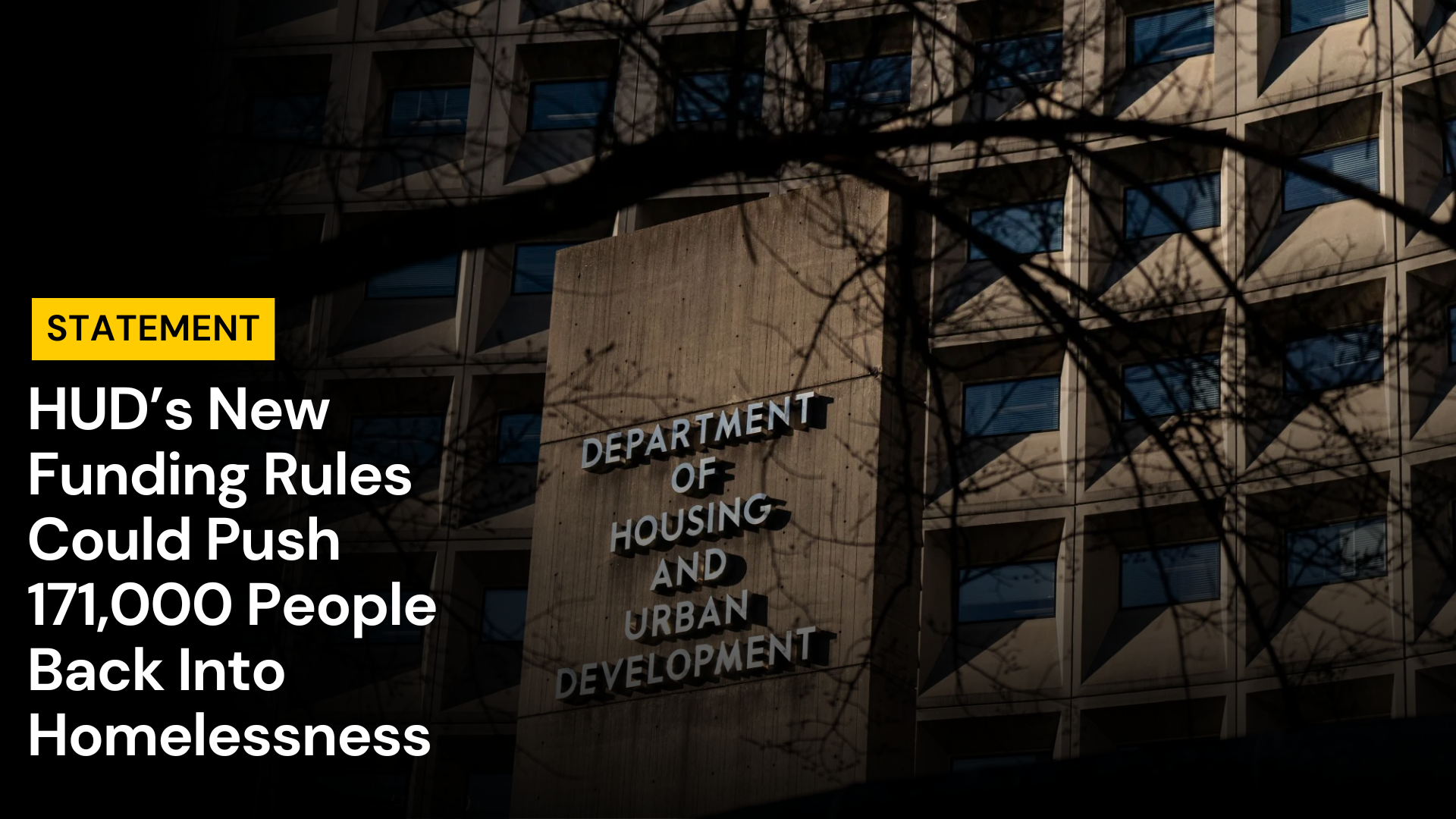
The National Coalition for the Homeless expresses deep concern over the U.S. Department of Housing and Urban Development’s (HUD) 2025 Continuum of Care (CoC) Notice of Funding Opportunity (NOFO). The new NOFO abandons decades of evidence-based practice by limiting all permanent housing, including Permanent Supportive Housing (PSH), Rapid Re-Housing (RRH), and Joint TH-RRH, to just 30% of available funding, forcing communities to cut the housing interventions proven to end homelessness. 

“HUD’s new priorities turn back the clock on everything we know works,” said Donald Whitehead, Executive Director of NCH. “This NOFO will destabilize local homelessness systems and push thousands of people back into crisis. It is a devastating departure from evidence, humanity, and common sense.” 

Independent assessments indicate that up to 171,000 people currently living in permanent supportive housing could lose their homes due to these changes, not because of program failure, but solely because HUD has chosen to defund the most effective solutions. 

Pathologizing Poverty and Ignoring Structural Causes
HUD’s new approach reframes homelessness as a problem of personal behavior, focusing heavily on addiction, mental illness, and treatment compliance. This shift reinforces harmful stereotypes rather than addressing root causes such as the lack of affordable housing, wage stagnation, racial inequities, and the disappearance of low-cost units like SROs. “Most people experiencing homelessness are not dealing with severe mental illness or addiction,” Whitehead emphasized. “They are people who can’t afford rent; workers, parents, seniors, youth, and people priced out by an economy that no longer matches wages to housing costs.” 

Criminalization Is Not a Housing Strategy
The NOFO incentivizes programs that coordinate with law enforcement, enforce camping bans, or require mandatory participation in treatment or employment programs. These tactics echo failed strategies that criminalize homelessness and worsen barriers to stability. “We cannot arrest or coerce our way out of homelessness,” added Whitehead. “Criminalization wastes resources, retraumatizes people, and distracts from the real solution: permanent housing.” 

Permanent Housing Ends Homelessness
For more than two decades, communities across the country have shown that permanent housing paired with voluntary services leads to stability, recovery, and cost savings. HUD’s current direction undermines this proven approach. “Every time we have invested in permanent housing, homelessness has gone down,” Whitehead said. “Every time we withdraw that investment, homelessness rises. The pattern is undeniable.” 

A Call for Federal Leadership Rooted in Justice and Reality
NCH urges the Administration to reconsider the harmful 2025 NOFO and prioritize long-term, evidence-based solutions. “We need leaders who understand that homelessness is a structural crisis, not a moral failing,” Whitehead said. “This nation deserves a federal response grounded in data, dignity, and the lived experiences of the people most affected.” NCH remains steadfast in its commitment to advancing policies that truly end homelessness, and will continue to advocate for federal leadership that prioritizes housing, dignity, and evidence over ideology. 

UPDATES:
Dec. 8, 2025 HUD took down the dangerous Notice of Funding Opportunity (NOFO) ahead of lawsuits
Dec. 10, 2025 Nation’s Mayors Call on Congress to Renew HUD Continuum of Care Grants, Safeguard Housing for Vulnerable Residents

Everyone deserves the safety and dignity of a home. 

We at the National Coalition for the Homeless (NCH) find it reprehensible that last week, a newscaster on a major TV network, publicly advocated murdering people who are unhoused and experiencing health crises.

Negative rhetoric directed at people experiencing homelessness not only breeds stigma and discrimination but can also fuel violence and aggression against vulnerable populations. NCH has documented thousands of alarming instances of violence targeting those facing homelessness, a tragic reality that underscores the profound consequences of dehumanizing language. 

Furthermore, the commentators showed a fundamental lack of understanding of the everyday experience of regular people in this country. There is no community in the country that has enough affordable housing or emergency shelter to meet the need. Our health care system is extremely expensive, and treatment is often either too costly, not covered by insurance, or not even available in a community.

When influential platforms propagate misinformation or violent rhetoric, it normalizes harmful attitudes and emboldens those with violent tendencies. We must hold our journalists and media figures to account for the power of their words and the impact they can have on society. 

We demand that FoxNews apologize, and ‘Fox and Friends’ co-host Brian Kilmeade be reprimanded for suggesting that people experiencing homelessness or mental health crises be euthanized. 

We must strive for a society that prioritizes care, compassion, and comprehensive support for everyone. It is vital that we challenge and denounce rhetoric that dehumanizes vulnerable populations. 

Housing ends homelessness, and the country has more than enough resources to ensure we all have a safe home and that our basic human needs are met.

Trump signs two executive orders aimed at “Ending Crime and Disorder on America’s Streets” that will actually make our cities more dangerous for residents who are poor.

WASHINGTON, D.C. – July 24, 2025 – Today, the Trump administration issued two executive orders that fundamentally misrepresent homelessness as a criminal issue rather than a societal challenge requiring compassionate and systemic solutions. The National Coalition for the Homeless (NCH), dedicated to addressing the root causes of homelessness since the 1980s, strongly condemns these directives as ineffective, wasteful, and a grave violation of civil rights.

The first executive order threatens to withhold Housing and Urban Development (HUD) funding from states that protect individuals from involuntary commitment to institutional care. The second order, contradictory to the first, proposes allowing Medicaid funding for mental health treatment.

“Everyone deserves a safe place to live,” stated Donald Whitehead, Jr., NCH Executive Director. “These executive orders ignore decades of evidence-based housing and support services in practice. They represent a punitive approach that has consistently failed to resolve homelessness and instead exacerbates the challenges faced by vulnerable individuals.”

This administration has a concerning record of disregarding civil rights and due process, as evidenced by recent actions concerning immigrants. These executive orders direct Attorney General Pam Bondi to challenge existing judicial precedents and consent decrees in communities where the civil rights of people experiencing homelessness or mental health crises have been violated.

The assertion that the majority of individuals experiencing unsheltered homelessness are “addicted to drugs, have a mental health disorder, or both” is inaccurate. Furthermore, it disregards the reality that many individuals develop mental health or substance abuse issues after prolonged periods of homelessness due to the lack of safe and affordable housing.

As the executive order itself acknowledges, the Supreme Court has established due process protections that safeguard individuals from involuntary confinement in psychiatric hospitals. Historical attempts at mass institutionalization proved destructive to individuals’ lives and financially unsustainable for states. The original intent of deinstitutionalization in the 1970s was to accompany community re-integration with comprehensive housing and support services—a commitment that, tragically, remains underfunded and unfulfilled, both then and now.

The National Coalition for the Homeless reiterates that the definitive solution to homelessness is housing. Ensuring safe places to live and access to support services is not only a moral imperative but also the most effective strategy for building safer and more equitable communities.

Inviting one and all to the Annual NCH Awards Dinner and Auction – celebrating achievements in advocacy for our unhoused neighbors and raising funds to keep doing the work!

Over the last year, we have made significant progress in mobilizing people with lived experience to combat the costly practice of jailing, fining, and arresting people who are forced to experience unsheltered homelessness due to the lack of shelter.

Come celebrate our awardee advocates and organizations who have made significant contributions to lifting up the first hand experience of those who have been unhoused:

Many nonprofits are experiencing federal funding cutbacks and uncertainty due to changes that strain resources targeted at combating homelessness. The Executive Order signed a week ago will have further disastrous affects for our neighbors forced to sleep outdoors. Our role as the nation’s first homeless advocacy organization is more important than ever.

Please help support our critical work at the upcoming NCH Awards Dinner, which will take place at the Woodmore Country Club, just outside the Capitol beltway, on August 8, 2025, from 5:30 to 8 PM. Our guest MC will be the Honorable Terrence McAuliffe, former Governor of Virginia. Come to hear national recording artist, Shelton Cornelius Price, and enjoy the opportunity to connect, celebrate, and learn more about the vital work NCH and our partners do to address homelessness nationwide.

If you cannot attend, we encourage you to sponsor the event or contribute to helping a member of our speaker’s bureau or someone experiencing homelessness in your community attend. Tickets can be purchased by following this link: https://bit.ly/NCHawards.

Your involvement, in any capacity, will help amplify our mission and make a tangible impact on the lives of countless individuals. We look forward to seeing you there!

A special thanks to our generous sponsors:

We all need a safe place to live. But homelessness and poverty are growing. Instead of funding what works, too many politicians are making these problems worse by passing laws that allow the police to ticket and arrest people who cannot afford housing or the substance use or mental health care they need.

We need leaders who focus on real solutions that help people, like housing and healthcare. Ticketing or fining people for sleeping outdoors when they have no where else to go moves our communities backwards – creating barriers to housing instead of enacting proactive and proven programs that provide housing and services.

We have the solutions!
Click to join our webinar series examining each of the 10 Points.

In place of criminalizing daily survival activities, we offer this 10-Point framework for state and local communities to respond with compassion and proven solutions. 

  1. Affordable and Accessible Housing
  2. Homelessness Prevention
  3. Decriminalization of Poverty
  4. Shelter Standards and Expanded Shelter Options
  5. Employment Programs
  6. Trauma-Informed Care
  7. Treatment on Demand
  8. Encampment Infrastructure
  9. Friendly Architecture
  10. Equity in Impact

The NCH 10-Point Model Homeless Legislation template is designed to complement NCH’s national Bring America Home Now! Campaign, which consists of six policy pillars at the national level and is a grassroots movement to end and prevent homelessness:

  • Housing justice: housing is a basic human right
  • Universal access to health care
  • Livable wages and basic income
  • Education and training
  • Protecting civil and voting rights
  • Recognizing homelessness as a racial justice and equity issue

NCH strongly believes that as localities and states consider the components of this template, it is imperative that people with lived experience of homelessness, mental health challenges, and substance use issues are integral to the decision-making process, program design, and policy and program implementation.

With Congress’s passage of the mega budget deal today, we have witnessed the most disastrous legislation in modern history.  The budget bill steals from the poor to give massive tax cuts to the wealthy. And these tax breaks are such enormous giveaways to the rich that they will increase the deficit by nearly $4 trillion, even with the draconian cuts to health care and food assistance

The Bill will also create a private force as large as most countries to push the cruel anti-immigration policy.  It adds $4 trillion to the national debt.

It does not address the growing concerns of inflation and job loss.  The bill will result in a loss of an average of $1,000 in income for families below the poverty line. 

We fought hard, but the fight is not over.

We must get ahead of the next budget discussion. Today’s blow will be significantly magnified by projected loss of critical housing and supportive services foretold in the Presidential Administration’s “skinny budget” request for next year.

We cannot let elected officials forget who they have harmed by their decision to transfer even more wealth to the ultra rich, on the backs of seniors, people with disabilities, families unable to put food on the table. NCH encourages all of us who will be impacted by this dastardly budget to continue contacting our Congressional members – sharing how their callous decision will hurt their constituents.

We may rest this weekend, but we will keep fighting for true justice, equity, and a permanent end to homelessness.

In Solidarity,
Donald H. Whitehead Jr.
Executive Director

*Art courtesy pf Art Hazelwood and the Western Regional Advocacy Project

Washington, D.C. — In a profoundly disappointing ruling, the U.S. Supreme Court today decided that it is constitutional to arrest or fine homeless individuals for using survival items like blankets or pillows in public spaces when no alternative shelter is available.

“Arresting or fining people for trying to survive is expensive, counterproductive, and cruel,” said Jesse Rabinowitz, campaign and communications director at the National Homelessness Law Center (NHLC). “This inhumane ruling, which contradicts the values of nearly three-quarters of Americans, will make homelessness worse in Grants Pass and nationwide. Cities are now even more empowered to neglect proven housing-based solutions and to arrest or fine those with no choice but to sleep outdoors. While we are disappointed, we are not surprised that this Supreme Court ruled against the interests of our poorest neighbors.”

The Supreme Court decision has set a dangerous precedent, allowing cities to continue to criminalize homelessness instead of addressing the root causes of the issue. People experiencing homelessness should not be punished for their circumstances; all levels of the government have a responsibility to protect the most vulnerable members of society.

Donald H. Whitehead, Jr., executive director of the National Coalition for the Homeless states, “How a society treats its most vulnerable members reflects its values, priorities, and commitment to social justice. Criminalization has consequences. This decision will result in higher costs, more suffering, and death. We are deeply saddened by the Supreme Court’s supreme injustice.”

In Justice Sotomayor’s dissent, the justice states that the ruling, “leaves the most vulnerable in our society with an impossible choice: Either stay awake or be arrested.” Further, Sotomayor says, “I remain hopeful that someday in the near future, this Court will play its role in safeguarding constitutional liberties for the most vulnerable among us. Because the Court today abdicates that role, I respectfully dissent.”

As the dissent states, the Court’s decision today ignores the need to protect people currently experiencing homelessness from harassment, violent attacks, or targeted enforcement of local ordinances.

Housing ends homelessness. The National Coalition for the Homeless, in partnership with the National Coalition for Housing Justice, calls on federal elected officials to invest significantly in housing now. For over 40 years, we have seen federal affordable housing programs decimated, and it is time to transform the trajectory of our housing policy.

As a down payment to ensure that everybody has safe, decent housing that they can afford, we call for:

  • Universal rental assistance for lowest-income households
  • Public housing repair and preservation
  • Full funding of the National Housing Trust Fund
  • Eviction and homelessness prevention
  • Voluntary supportive and emergency services

The long term investment in our communities and country requires a recognition that robust social housing will end homelessness.

Despite this Supreme Court ruling, we know that housing, not handcuffs, solves homelessness, and we will continue our work to ensure that everyone, regardless of race or background, has the housing they need to thrive.

Over the past 23 years, the National Coalition for the Homeless (NCH) has documented nearly 2000 incidents of violence against people who were homeless. Since 1999, at least 588 of unhoused victims have violently been killed just for being unhoused.

These crimes appear to have been motivated by a perpetrator’s bias against people experiencing homelessness, and to have been facilitated by a perpetrator’s ability to target homeless people with relative ease. The crimes are a litany of atrocities: beatings, rapes, mutilations, and murders. The murder victims died in unfathomable ways: not only shot or stabbed to death, but also set on fire, drowned – even beheaded.

This year, we’ve documented shocking levels of law enforcement involvement in attacks against people experiencing homelessness, as well as serial attacks on people experiencing homelessness. Most notably, Oregon saw a whopping 500% increase since the last reported attacks in 2019.

In several states, such as Kentucky, Florida, Missouri, and others, legislation has been enacted that exacerbates the already dire situation faced by those experiencing homelessness. These laws create a vicious cycle of punitive measures that further marginalize and dehumanize people who are already in vulnerable circumstances.

Unfortunately, these injustices have fueled vigilantism and hatred directed towards people who are forced to live outdoors. It is imperative that society recognizes that homelessness is a societal issue and should not be met with violence or unwarranted hostility.

City and county level ordinances also contribute to a perfect storm of dehumanization of people experiencing homelessness that leads to violence. The small town of Grants Pass, Oregon, is one of hundreds of cities nationwide that has passed law banning sleeping outdoors. The Grants Pass ordinance was challenged in court, as there is not enough shelter available in town for everyone who needs it, and the city appealed. On April 22, 2024, the U.S. Supreme Court heard oral arguments in the case, and over 700 advocates gathered on the steps of the court to rally in support of Housing, not Handcuffs for people forced to live outdoors. The decision reached in this case has far-reaching implications for the treatment of individuals who have been displaced from their homes.

The quiet town of Grants Pass was surprised in March of 2022, when an unknown assailant set the tent of someone forced to live outdoors on fire. Unfortunately, we should not be surprised.

While NCH has compelling data on the number and severity of attacks in general, many of these acts remain underreported (in part because people experiencing homelessness tend to live on the outskirts of communities). The Bureau of Justice Statistics found that in 2019 “less than half (44%) of violent victimizations (of people experiencing homelessness) are reported to police.” Furthermore, many attacks were likely even more gruesome than available reports imply.

The National Coalition for the Homeless calls upon all stakeholders, including lawmakers, law enforcement agencies, advocacy groups, and community members, to view consider protecting our unhoused neighbors as a vulnerable population. Further, we urge policymakers to invest in the housing and community supports we all need, and that are proven to end homelessness.

Report (without appendices)
Appendix A: Hate Crimes vs. Vulnerable Victims Status
Appendix B: Protected Class Resolution
Appendix C: Hate Crimes Legislation Resource Guide
Appendix D: Case Research and Citations

Read the full report: https://nationalhomeless.org/wp-content/uploads/2024-Hate-Crimes-Report_for-web.pdf

Over 700 people rallied in front of the U.S. Supreme Court during oral arguments on Monday morning, April 22, 2024. Over 30 communities across the country held solidarity events, and nearly 5000 watched livestreams. The atmosphere was electric. (Read more about the Rally, Photo of Donald Whitehead speaking at the rally by Kevin Wolf, AP)

The case being considered by the court, City of Grants Pass v. Gloria Johnson, addresses the legality of using a blanket to keep warm when forced to sleep outdoors.

Regardless of the court’s decision, this case will not create any housing, nor directly address persistent poverty and homelessness. Rather, this case could set a precedent for municipalities to address homelessness and housing insecurity with ineffective and extreme punitive actions.

The case has sparked a national conversation about the intersection of housing policy, poverty, and civil liberties. Laws that prohibit things like sleeping, laying down or even eating in public spaces, are common, yet they reflect discriminatory practices that have led to deep inequities.

Grants Pass, Oregon, was itself a “Sundown Town” – communities that mostly sprang up during the mid-1800’s, where the movement of non-white residents was restricted after dark. Policies that continued through the 20th Century like Anti-Okie laws, Red-Lining and Jim Crow laws have all been collectively understood to be discriminatory and in violation of U.S. civil rights practices.

Yet as the Supreme Court prepares to hear this Johnson vs. Grants Pass, the situation for Americans forced to live outdoors in an increasingly unaffordable housing market sounds similar to how poor and nonwhite Americans have been treated in past centuries. A recently law in Tennessee has made sleeping outside a felony, and the Florida governor recently signed into law banning sleeping or “camping” in public spaces.

recent study, published in the Journal of the American Medical Association found that ticketing, jailing, and displacing people forced to sleep outdoors can actually lead to significantly higher mortality among folks who are unhoused. Moreover, fines and compounded tickets lead to criminal records for otherwise law-abiding citizens, creating further barriers to getting unhoused Americans back into a home.

“The Johnson vs. Grants Pass case is monumental,” states Donald H. Whitehead, Jr., Executive Director of the National Coalition for the Homeless. “It has the potential to instigate a barrage of draconian policies that cause significant harm to people experiencing homelessness in our country.”

The National Coalition for the Homeless, dedicated to organizing a movement led by those most affected to end homelessness, calls on our communities to invest in proven housing solutions. Hundreds are expected to rally in front of the U.S. Supreme Court building in support of Housing, Not Handcuffs.

We are deeply concerned about the recent findings presented in the Department of Housing and Urban Development’s (HUD) Annual Homeless Assessment Report (AHAR). The report reveals a disturbing 12% overall increase in the number of individuals experiencing homelessness across the nation from 2022 to 2023. This data highlights the pressing need for immediate action to ensure the protection of the human right to housing.

According to AHAR report findings, the number of people experiencing homelessness is the highest since the reporting began in 2007, painting a bleak picture of the current housing crisis. These stark developments are a somber reminder of the inaction and lack of prioritization when it comes to addressing the root causes of homelessness in our country.

We firmly believe that housing is a fundamental human right and cannot overlook the fact that these findings reflect an urgent need for more comprehensive and proactive measures to combat the growing crisis of homelessness in our communities.

As the AHAR report underlines the gravity of the situation, we at NCH urge all stakeholders including government agencies, policymakers, and community leaders to collaborate and redouble their efforts to proactively address homelessness. We call for the immediate allocation of resources and the implementation of long-term solutions that prioritize access to safe and affordable housing for all.

To underscore the need for swift access to housing, communities across the country will commemorate Homeless Persons’ Memorial Day this week (December 21), remembering thousands of neighbors, family members and friends who have passed away prematurely due to lack of permanent and safe housing.

 Today, join the National Coalition for the Homeless, the National Health Care for the Homeless Council, and the National Consumer Advisory Board to remember the lives of those we have lost this year and continue our fight to end homelessness. NHCHC CEO Bobby Watts and NCH Executive Director Donald Whitehead will speak, along with Reverend Dr. Elizabeth Theoharis from the Poor People’s CampaignWarren Magee, NCAB Steering Committee member and Chair of the Consumer Advisory Board at Boston Health Care for the Homeless; Dr. Catherine Crosland, Director of Homeless Outreach Development at Unity Health Care in Washington, D.C.; and Madalyn KarbanBhavana Akula, and Ishaan Akula from NCH’s National Youth Division, Bring America Home NOW.The program will also feature art by artist and advocate Tammy De Grouchy Grubbs and an original spoken word performance from Charlotte A. Garner, Regional Representative, NCAB Board Steering Committee, Chair of the Ellen Dailey Advocacy Committee, and Chair of the Healthcare for the Homeless Houston Change Committee. If your community is hosting a memorial, please register your event here.
On this day, we come together as a community to mourn and remember those we have lost due to homelessness. It is a solemn occasion that reminds us of the dire consequences posed by the lack of stable, secure housing for our most vulnerable neighbors.

Together, let us reaffirm our commitment to upholding the right to housing and work towards a future where homelessness is eradicated, and every individual has a place to call home.
Join us for HPMD