Statement on the Cruelty of Disbanding Homeless Encampments

(WASHINGTON, D.C – February 13th) The Executive Order issued by President Trump to dismantle homeless encampments in the District of Columbia reflects a deeply concerning disregard for the dignity and humanity of some of the most vulnerable members of our society. Disbanding these encampments while the region is experiencing harsh winter conditions, without a comprehensive plan for adequate housing and support services, is not a solution to homelessness but a cruel and inhumane approach that undermines the basic rights of individuals experiencing hardship. The shelter system in DC is currently at capacity; there is no place for people to move to.

Instead of addressing the root causes of homelessness—such as lack of affordable housing, mental health issues, and unemployment—this policy exacerbates the suffering of those affected by forcing them into even more precarious situations. The lack of viable alternatives further endangers their health, safety, and well-being. The shelter system was created by caring and concerned community members who frequently found individuals who had died during similar weather patterns.

We must remember that homelessness is not merely a statistic; it represents real people facing unimaginable challenges. Rather than disbanding encampments, we should be advocating for compassionate solutions that prioritize affordable housing production, jobs that pay livable wages, increased access to mental health resources, and community support services. It is our moral obligation to create a society that uplifts and respects every individual’s right to shelter, support, and safety.

Please call your congressional representative to tell the administration to find more innovative and compassionate, data-driven solutions.

Press Contact: Donald Whitehead, Executive Director of the National Coalition for the Homeless

Additional Responses to the Executive Orders:

NCH’s Stand Against the Federal Grants Freeze | Part II

It was so encouraging to witness the overwhelming support for programs and funding for people and organizations across this country when the administration’s executive order halted funding. People organized immediately—it was a testament to people coming together to fight against injustice.

While I am deeply moved by the outpouring of resistance,I am also hopeful that the same level of energy and resistance will continue as we launch our direct action campaign against criminalization. It is our belief that the criminalization actions we are witnessing across the country are direct violations of the Constitution of the United States.

Please keep your eyes open for information about our efforts to stand up for those who, in some cases, cannot stand up for themselves. If you are someone experiencing homelessness, we need you in this fight, and we look forward to partnering with you to ensure that everyone has a path toward housing justice that does not include a carceral approach.

In solidarity,
Donald Whitehead

“It demands unwavering commitment, concerted efforts, and the courage to challenge the status quo.”

As we reflected on Dr. Martin Luther King Jr. Day, it was imperative to acknowledge the enduring significance of his legacy and the persistent struggle for racial justice and equality. The commemoration of this day served as a powerful reminder of the progress made and the challenges that remained. It was more important than ever to honor Dr. King’s vision by actively working towards a society where justice and equality are accessible to all.

Despite the progress achieved since Dr. King’s time, systemic racism and inequality have persisted in various forms. The recent resurgence of white supremacists highlighted the ongoing struggles faced by marginalized communities. Issues such as disproportionate representation in the unhoused population, criminalization of people experiencing homelessness, police brutality, economic disparities, unequal access to education, and healthcare inequities underscored the need for continued efforts towards racial justice.

As we honored Dr. Martin Luther King Jr. and looked towards the future, it was crucial to recognize that the fight for racial justice and equality was far from over. It demanded unwavering commitment, concerted efforts, and the courage to challenge the status quo. By continuing to pursue Dr. King’s dream of a just and equitable society, we could create a world where every individual is treated with dignity and respect, regardless of their race or ethnicity.

Recently, I witnessed an aura of hopelessness at a time when hope was required to change the trajectory of homelessness, which is at record levels. Housing justice remains the unfinished business of the civil rights movement. Although there was a feeling of despair for many after the election of Donald Trump, we could not waver in our pursuit of housing justice. We needed all of those who believed in housing justice to stand tall and work even harder until the dawn rises. We could not give up; we had to stand up in this moment of uncertainty in our country’s history.

The commemoration of Dr. Martin Luther King Jr. Day and the inauguration of new political leaders served as reminders of our collective responsibility to advance the cause of racial justice. Let us continue striving to be the change-makers who turn dreams of equality into reality, ensuring a brighter and more just future for all.

Authored by: Donald Whitehead, NCH Executive Director of NCH

We are deeply saddened and outraged by the tragic death of an unhoused individual during the recent clearing of a homeless encampment near Ebenezer Baptist Church in Atlanta. This heartbreaking incident underscores the urgent need to rethink and reform policies that prioritize displacement over compassion and true solutions to homelessness.

Encampment clearances—or “raids”—are dehumanizing and dangerous practices that fail to address the root causes of homelessness. Instead, they cause further harm, stripping vulnerable individuals of their dignity, safety, and the only place they can call home. They’ve already lost so much—why take even more, including their humanity? Haven’t they endured enough?

We are grieving alongside the community and extend our deepest condolences to the family and loved ones of the victim. No one should lose their life in the name of misguided policies that treat homelessness as a nuisance rather than a humanitarian crisis. Our hearts ache for the pain and fear this has caused, not only for those directly impacted but for every unhoused individual who now feels even less safe.

This tragedy demands accountability. We stand with organizations like Hosea Helps in calling for immediate transparency and justice.

Homelessness is not a crime, and unhoused individuals are not disposable. This loss must be a turning point—a moment to reject punitive and dehumanizing approaches and instead embrace solutions rooted in compassion, dignity, and real support.

We demand an end to encampment raids. We demand justice for this life cut short. And we demand a future where all people, regardless of their housing status, are treated with the dignity and respect they deserve.

With grief and resolve,

National Coalition for the Homeless


For Press Inquiries, please contact NCH’s Executive Director, Donald Whitehead at DWhitehead@nationalhomeless.org.

This week, justice failed Jordan Neely, a young man whose plea for food and water was met not with compassion but with a fatal chokehold that took his life. The verdict in the murder case against his assailant serves as a heartbreaking reminder of the profound failures of our systems to meet even the most basic human needs.

I can’t help but wonder if the verdict would have been different had the roles been reversed. If Jordan Neely had been housed and Daniel Penny homeless, it’s hard not to believe that accountability for the loss of life would have followed. Jordan Neely was a Black man, and now his name is heartbreakingly added to the long and painful list of Black lives taken without consequence.


As a Black man, I’ve been taught that our first fight was to prove that we were human beings–it’s clear the fight is still ongoing.


The harsh reality of homelessness amplifies the struggles of marginalization and discrimination. Across the country, communities are adopting cruel measures that criminalize homelessness and poverty rather than addressing their root causes.

Since the Supreme Court’s decision in Johnson v. Grants Pass this past June, over 100 laws have been enacted, with more than 68 pending, that make it a crime to sleep outdoors—even when no shelter is available. These laws strip away the dignity of our most vulnerable and further entrench systemic injustice.


Jordan Neely fell through the cracks of the foster care system, the mental health system, the homeless service system, and the judicial system.

Jordan’s death highlights the ridiculous decision in the Grants Pass case, which basically stated that criminalization does not cause harm. There is no greater harm than death. Jordan was arrested multiple times, and not one of those times resulted in housing.

Jordan Neely’s life and death necessitate a broader examination of how society can better care for its most vulnerable members. Our communities need improved mental health services, housing and support, and systemic changes in how crises are handled in public. A more equitable environment is essential to creating a safer community for everyone.


Jordan Neely reminds us why we must never give up the fight for housing justice. He deserved so much more than that subway car—he deserved a safe, stable, and affordable home where his dreams could thrive and his talent could shine.

Jordan should have been dancing through life, not struggling to survive. America, we can and must do better.

Together, we can build a future where every life is valued, every dream is nurtured, and no one is left behind.

Written by: Donald Whitehead, Executive Director at the National Coalition for the Homeless 

The Documentary: A Journey Towards Humanity and Hope

HOMELESS is a powerful documentary that seeks to give a voice to those often silenced by their circumstances: people living without stable housing. The film provides a raw and compassionate look into the lives of five individuals experiencing homelessness, capturing their stories, dreams, and challenges. Created as part of the Let’s Make a Difference project, the documentary’s mission is to raise awareness and funds for solutions to homelessness, making a call for societal change and collective empathy.

Through this cinematic journey, HOMELESS invites viewers to see beyond stereotypes, challenging the ways society often ignores or misunderstands the unhoused. By focusing on personal stories, the film connects us with individuals’ hopes, setbacks, and resilience, reminding us that they are part of our shared community. The National Coalition for the Homeless has praised the film as “impactful, emotional, human,” recognizing its deep commitment to highlighting the humanity of those living without a home.

The Director: Valerio Zanoli’s Vision for Social Change

Behind HOMELESS is director Valerio Zanoli, a graduate of the prestigious USC School of Cinematic Arts, who has spent his career creating socially impactful films. Zanoli’s works, such as Not to Forget and Hopeful Notes, are well-regarded for raising awareness about societal issues and advocating for underrepresented voices. With HOMELESS, Zanoli’s aim is clear: to bring the world closer to ending homelessness by sparking conversations and raising funds.

The documentary premiered at the United Nations’ World Urban Forum, a testament to its global significance, and is now used by UN-Habitat in their World Urban Campaign to promote housing rights worldwide. Zanoli’s storytelling sheds light on the harsh realities of homelessness while infusing the narrative with a sense of hope and urgency.

Synopsis: Stories from the Streets of Las Vegas

Filmed in Las Vegas, HOMELESS explores the stark contrasts of the city—where opulent casinos and resorts exist side by side with desolate streets occupied by homeless encampments. The documentary takes us into the lives of five unhoused individuals who courageously share their journeys. Through their stories, we see the complex factors that led them to the streets, the daily hardships they face, and the resilience that keeps them going.

The voices of housing advocates, including figures like Donald Whitehead Jr. of the National Coalition for the Homeless, and Catrina Grigsby-Thedford of the Nevada Homeless Alliance, further contextualize the urgent need for policy changes. It also features segments with prominent figures like U.S. President Joe Biden, the mayors of Los Angeles and New York City, the FBI Director, and the HUD Secretary.

Las Vegas serves as a mirror reflecting a crisis faced by cities across the U.S. and beyond. According to UN-Habitat, 1.6 billion people worldwide live in inadequate housing, with over 100 million lacking housing entirely. The U.S. alone sees over half a million people without permanent shelter each night. As inflation and rent prices soar, and economic uncertainties deepen, homelessness continues to grow—a crisis Zanoli hopes to shed light on through this documentary.

Critically Acclaimed 

The documentary has received widespread acclaim, described as “a cinematic portrait of everyday life on the streets” by The Flash List, “an exploration of the causes and effects of homelessness” by NY Weekly, and “an honest look at what it’s like to be homeless” by The Good Men Project. Renowned singer Andrea Bocelli expressed his support, stating:

“Home is dignity, it is life, it is the warmth, the comfort, the joy of being able to count on shelter and to offer it to one’s family. […] I believe that each of us has a moral obligation to strive for the well-being of the less fortunate.”  

A Call to Action

HOMELESS doesn’t just tell a story—it advocates for change. The film invites viewers to engage with this humanitarian crisis and participate in finding solutions. Through the support of numerous homeless organizations, influential leaders, and advocates like Andrea Bocelli, who affirmed the moral obligation to “strive for the well-being of the less fortunate,” HOMELESS aims to rally communities and policymakers alike.

As audiences worldwide connect with the film’s message, HOMELESS fosters a deeper understanding and a sense of shared responsibility. Together, with compassion and conviction, we can help create a world where everyone has a place to call home.

For more on how you can help, visit National Coalition for the Homeless and Let’s Make a Difference.

Many of us were filled with the hope that our country would finally break through the glass ceiling and elect the first woman President of the United States. Unfortunately, Tuesday delivered a different outcome. Instead, voters chose a path that has been the same all but once in our country’s history.

Looking ahead, I hope that one day our country will follow the example of others and take final steps toward equality for women. Although some feel disappointment regarding gender equity, many are concerned about the election results and the reflection they provide on our society. The majority of the electorate supported a candidate who has been widely viewed as controversial. Many perceive that these results signify a tolerance for divisive social issues.

Despite our despair, we cannot give up. Our mission transcends any individual or party, and this setback, though difficult, does not change our commitment. We may need time to process this unexpected development, but we have persevered through many administrations, each with differing stances on the issues we advocate. In moments of challenge, we have continued our work on behalf of people experiencing homelessness.

Over the last four years, the number of people on the street has grown, even under a friendly administration, and in the previous four years as well. This experience has shown that change relies not only on leadership within the White House or Congress but on the momentum created by our collective movement. Our work isn’t finished. The challenges ahead are complex, but we are resilient, and we remain committed.

The fight isn’t over. It just became more complicated and critical, but we are fighters, and we must never surrender.


Donald H. Whitehead Jr.

Executive Director | National Coalition for the Homeless

Last week, California Governor Gavin Newsom issued an Executive Order to forcibly remove people experiencing homelessness from state lands. This decision brings with it severe and predictable consequences, reflecting a grave injustice. The National Coalition for the Homeless is taking a stand against this inhumane action. We urge you to read our official statement to understand our position and the critical issues at stake.
 

NCH is profoundly disappointed and troubled by this decision. Addressing homelessness is a multifaceted challenge that demands both compassion and thoughtful care.

 
Donald H. Whitehead, Jr., Executive Director of the National Coalition for the Homeless, emphasizes:
 
“The way a society treats its most vulnerable reflects its core values, priorities, and dedication to social justice. Criminalizing homelessness comes with serious repercussions—leading to increased costs, more suffering, and potentially even loss of life. This decision undermines our collective responsibility and commitment to addressing this pressing issue with the compassion it demands.”
 
Criminalizing homelessness comes with serious repercussions—leading to increased costs, more suffering, and potentially even loss of life. This decision undermines our collective responsibility and commitment to addressing this pressing issue with the compassion it demands.
 
It is essential to approach the issue of homelessness with boundless empathy, compassion, and commitment to finding sustainable solutions that prioritize the dignity and rights of all individuals, which is crucial for survival.
 
Encampment raids and forced evictions are not viable solutions; they only exacerbate the dire circumstances of those experiencing homelessness, who have nowhere else to turn.
 
Resorting to raids is a short-sighted and expensive approach that only exacerbates homelessness and increases the number of individuals forced to live on California’s streets.
 
Instead, Governor Newsom should focus on long-term solutions that tackle the systemic causes of homelessness, such as the shortage of affordable housing, unemployment, mental health challenges, structural racism, and substance abuse.
 
Providing adequate shelter, supportive services, and resources will better support people experiencing homelessness in transitioning to stable housing and improving their overall well-being.
 
NCH and its partners with lived experience are profoundly disheartened by this decision. However, this moment in history will not go unnoticed. While deeply saddened, the advocacy movement views this action as a powerful catalyst for change.

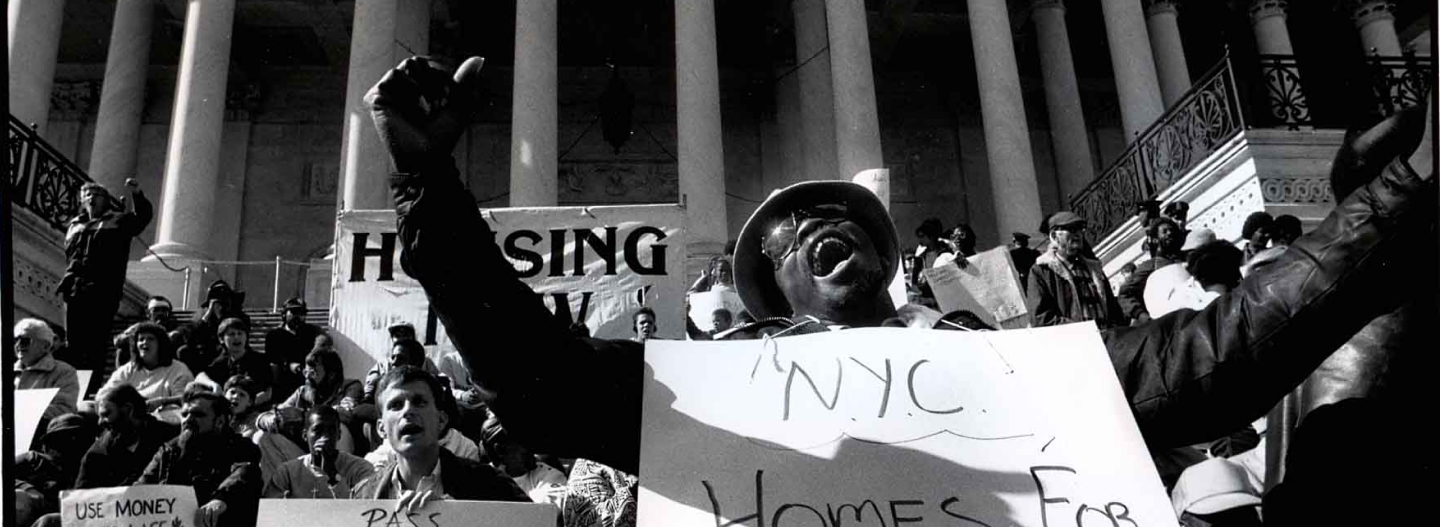
The rally at the Supreme Court impacted me in several ways. I was not unmoved by the underlying reason for being on the steps of the highest court in the nation: protesting the upholding of the right for people to sleep under a blanket if they didn’t have an alternative.

We were fighting extreme bias in a place that has had the most fatal attacks against people experiencing homelessness. Lawyers and elected officials were forcefully attempting to make the case that parks and the appearance of a community were more valuable than the lives of vulnerable and marginalized human beings. In a nation fractured by politics and individualism, there persists a misguided belief that fines, handcuffs, and imprisonment serve as deterrents to homelessness. Yet, tragically, the reality speaks to the improbability of such a notion.

There were many things so I will move on to the numerous positive takeaways.  For the first time in several years, there was this collaboration of advocates who worked on behalf of the unhoused population, those who were once in the population, and those currently working together to speak truth to power.  It wasn’t perfect, of course. We are still making the same mistakes pointed out by Ron Casanova in his book “Each One Teach One.”  We must always make space for people living the experience, not just those with lived experience. I take this critique personally because I had the opportunity to choose speakers.  Although I didn’t make this decision alone, it was a mistake not to lift the voices of those struggling. 

The rally on April 24th brought back a sense of nostalgia for me. The day brought back memories of buddy gray and the people of the Over-the-Rhine beloved community fighting to preserve a neighborhood surrounded by speculators, profiteers, and financial predators. Some people deeply rooted in the late 80s and 90s fights were there: Barb Poppe, Fred Karnas, and Bev Merrill were in the crowd. They know the power of organizing well and its effectiveness when we have had significant victories when we have organized and engaged in direct action.  

Our advocacy during that time brought us victory and stinging defeat.  We won the Cranston Gonzalez Act, The McKinney Vento Act, and the Education for Homeless Children and Youth Act. The losses are also numerous; Over-the-Rhine is no longer a beloved community if you are a gentrifier or partygoer. Every day, we lose a criminalization fight.  City after city resorts to hiding people who experienced homelessness in jails and institutions versus helping them into housing.

 Many longtime residents are long gone, moved to parts unknown, and replaced by fancy eateries and trendy nightclubs. The residents of Over-the-Rhine stopped protesting after the death of our leader, Buddy Gray. The community lost its will on that day. This pattern often happens when movements lose their charismatic leaders, from Dr. King and the civil rights movement to the loss of Mitch Snyder in the homeless movement. The beauty of this movement is that millions of leaders with lived experience can ensure that the Grants Pass demonstration is not a one-off; instead, it can be a harbinger of a new era of resistance. An organized Bring America Home Now Movement!

Written by NCH Executive Director, Donald Whitehead ; Edited by Kenia Mazariegos, Assistant Director of Communications

A Call to Unity in Johnson v. Grants Pass

In the face of ongoing challenges, the resilience of our community—particularly those with lived experience of homelessness—continues to inspire and drive change. One such pivotal moment of change is upon us, as the Supreme Court prepares to hear a case that could significantly impact the rights of homeless individuals across the nation: Johnson v. Grants Pass.

This landmark case centers on the rights of homeless individuals in Grants Pass, Oregon, challenging ordinances that penalize life-sustaining activities in public spaces. At its heart, Johnson v. Grants Pass isn’t just about one town; it’s a reflection of the broader struggle for dignity, respect, and the right to exist in public spaces without fear of harassment or punishment.

The Issue at Hand

For too long, our brothers and sisters without homes have faced legal and societal barriers that criminalize their existence. Sleeping, eating, and performing other necessary life activities in public spaces—their last resort—are met with penalties rather than support. Johnson v. Grants Pass brings these injustices to the forefront, challenging us all to reconsider how we treat the most vulnerable among us.

Your Voice is Your Power

This case is a rallying cry for all who believe in justice and human rights. It’s a reminder that together, we can challenge the status quo and advocate for policies that uplift rather than oppress. Your voice is critical in this fight.

Call to Action

Your involvement signifies more than just your support; it embodies hope, unity, and the unwavering belief that change is possible. Let’s stand together for justice, for dignity, and for the rights of all individuals to live freely and without fear.

Here’s how you can stand in solidarity:

  1. Sign the Petition: Add your name to the growing list of individuals calling for an end to the criminalization of homelessness. Each signature sends a strong message to policymakers about the public’s demand for compassionate and humane treatment of all individuals, regardless of their housing status.
  2. Join us for the Housing Not Handcuffs Rally on April 22, 2024, at the Supreme Court: Mark your calendars and make your presence felt. This rally isn’t just about making noise; it’s about showing the strength of our community and the depth of our commitment to change.
  3. Join with communities across the country in holding coordinated actions on April 22nd! Click here to let us know about your local event, or to learn more about what might be happening in your community. Check out our Organizing Skill Share guide for action inspiration and guidance. 

We know that laws are passed and enforced locally. Your City Council, Mayor, and police are the ones implementing anti-homeless policies (such as sweeps) now. So, local actions are really important, in addition to actions in front of the U.S. Supreme Court.

A small group of people can have a BIG impact! Together, we can demonstrate the collective power of individuals united for a common cause.

The Journey Ahead

The path to justice is long and fraught with challenges, but it’s a journey worth taking. Johnson v. Grants Pass is more than a legal battle; it’s a moral one. It’s about affirming the right of every individual to live with dignity and without fear. As we stand on the brink of this historic moment, let’s come together to support those who have been marginalized and to show that humanity and compassion can prevail over indifference and injustice.

Together, We Can Make a Difference

To learn more about Johnson v. Grants Pass and stay informed on the latest developments, here are several avenues you can explore:

  • Official Johnson v Grants Pass Case site
  • NCH info on Criminalization
  • National Homelessness Law Center and the Housing Not Handcuffs Campaign
  • National Alliance to End Homelessness
  • Supreme Court’s Official Website: The United States Supreme Court’s official website offers access to court documents, including briefs, oral arguments, and opinions related to the case. This is a primary source for accurate and up-to-date information.
  • Congressional leaders have unveiled the FY24 THUD spending bill, earmarking significant funding for the Department of Housing and Urban Development (HUD) programs focused on affordable housing and homelessness. The bill allocates $70 billion to HUD, marking an $8.3 billion increase from the FY23 levels. This funding boost is seen as a major achievement for the National Low Income Housing Coalition (NLIHC)’s national HoUSed campaign, advocates nationwide, and congressional supporters such as Senators Brian Schatz and Cindy Hyde-Smith, along with Representatives Tom Cole and Mike Quigley.

Key Highlights of the FY24 Transportation, Housing and Urban Development (THUD) Spending Bill (excerpted from the National Low Income Housing Coalition – Full link https://nlihc.org/resource/despite-tight-topline-funding-advocates-and-key-congressional-champions-secure-increased)

Noteworthy Funding Details:

– The Housing Choice Voucher (HCV) program receives a substantial increase, funded at $32.4 billion, allowing for the renewal of all existing rental assistance contracts and expanding assistance to 3,000 additional households.

– Homeless Assistance Grants see a $418 million increase, totaling $4.05 billion.

– The Public Housing Capital and Operating Funds receive modest increases, with the Capital Fund at $3.41 billion and the Operating Fund at $5.5 billion.

– The Native American Housing Block Grant is boosted by $324 million, reaching $1.1 billion.

– Despite some programs facing cuts, such as the HOME Investment Partnerships Program and the Choice Neighborhoods, significant resources are allocated across various housing and homelessness initiatives.


Analysis of Specific Programs:

– Tenant-Based Rental Assistance is set at $32.4 billion, aiming to renew all existing contracts and expand support.

– Public Housing funding includes slight increases for capital and operating funds, with a total of $3.4 billion for the capital account.

– The bill also emphasizes homelessness programs, allocating $4.05 billion for Homeless Assistance Grants, indicating a focused effort to address the homelessness crisis.

Overall Impact:

The FY24 spending bill represents a significant step towards addressing affordable housing and homelessness challenges in the U.S. While it marks progress, NLIHC and its allies continue to advocate for sustained and comprehensive investment in housing assistance to meet the growing needs of Americans facing housing insecurity.

NLIHC Budget Chart FY2024


Written by: NCH Policy Lead, Michele Williams ; Edited by Kenia Mazariegos

Photo by Lara Jameson