#TBT – History of Homelessness 1929-1980

Throughout our country’s history, there have been people who suffered from homelessness – but there has not always been the same chronic and extensive homelessness we now face. Over the years homeless individuals have been referred to by a variety of different names. During the Revolutionary War homeless individuals were referred to the “itinerate poor,” a result of a society in need of transient agricultural workers, while around the Great Depression words like “tramp” or “bum” came into use.
Timeline of events 1929-1945Timeline of events 1945-1970

Prior to the 1970s homelessness rose and fell with the economic state of the country. Starting in the 1970s policy’s shifted and a sharp and permeant rise in homelessness occurred. Previously, when there was a downturn in the economy the number of the homeless would increase, but this would be fixed when the economy returned to normal. The largest number of homeless up until that point occurred during the Great Depression, but with the help of the New Deal policies homelessness returned to its previous level.

1970s housing policyStarted in the 1970s, however, a trend of chronic homelessness began to present itself as well as different types of individuals suffering from homelessness—women, families, blue

“Anti-poverty” efforts lead to homeless site dismantlement plans and the destruction of single-room occupancy facilities in urban downtowns. Churches begin to take on the burden of creating shelters, and local coalitions develop. Bank deregulation and the start of the farm crisis widen the gap between rich and poor.

Additionally, mental health consumers began to be deinstitutionalized without providing adequate housing and health care resources for community reintegration. As a result, many people with mental illnesses started to end up homeless or in jail.

Fast forward nearly 40 years and policy has continued to ensure economic inequality at staggering levels. Keep a look out next week for a closer look at the history of homelessness in the U.S. after 1980.

If you live in, or have ever been to, a city like Chicago, or Washington, DC, San Francisco, Nashville or Seattle, you have probably seen a vendor selling a paper that reports on issues of poverty and homelessness. This is a “Street Newspaper,” and there are over 40 of these in print in North America, and over 100 published in 34 countries around the world.

photo credit Do Haeng Michael Kitchen

We’ve shared before about the activism of the 1980’s and 90’s, when our current era of homelessness was just starting to rear its ugly head. People who were becoming homeless were intimately involved in advocacy and services to help folks who were unhoused. By the late 1980’s, homeless advocates realized there was a need for educating the larger public about the issues surrounding homelessness. Street News, first published in NYC in 1989, is credited with being the first street newspaper focused on homeless issues, followed closely by Street Sheet, still published by the Coalition on Homelessness in San Francisco.

Inspired by Street News, the Big Issue was launched as a “social business” in 1991 in the UK, inspiring a further wave of street newspapers across Europe. The International Network of Street Papers (INSP) was created in 1994 and our own beloved Michael Stoops helped to start the North American Street Newspaper Association (NASNA) in 1996. The two networks worked collaboratively until 2013, when INSP became the single global network for street papers on all six continents.

Recent numbers from the INSP Network

Street papers in the US have, for the most part, intended to act as both an advocacy tool and a primary way for people who have been homeless to be active leaders in that advocacy. Today, most papers are run, written, and sold by homeless folks. Many papers offer case management assistance, training and networking opportunities to homeless folks in their communities.

The National Coalition for the Homeless has long supported the advocacy and empowerment outlet that street newspapers have provided. Street papers across the world continue to break down barriers between housed and unhoused people, creating employment opportunities to poor people worldwide.

Read More:

May is recognized as Mental Health Month. It is estimated that 1/3 of the homeless population is suffering from some form of mental illness, though popular mythology will tell us that most, if not all, homeless people are “crazy.”

Former President Ronald Reagan is sometimes referred to as the father of modern homelessness, not just because he oversaw drastic budget cuts to Federal affordable housing programs, but also because he repealed the Mental Health Systems Act, which had the effect of closing most institutional mental health service centers.

From a Salon article from 2013:

President Reagan never understood mental illness. Like Richard Nixon, he was a product of the Southern California culture that associated psychiatry with Communism. Two months after taking office, Reagan was shot by John Hinckley, a young man with untreated schizophrenia. Two years later, Reagan called Dr. Roger Peele, then director of St. Elizabeths Hospital, where Hinckley was being treated, and tried to arrange to meet with Hinckley, so that Reagan could forgive him. Peele tactfully told the president that this was not a good idea. Reagan was also exposed to the consequences of untreated mental illness through the two sons of Roy Miller, his personal tax advisor. Both sons developed schizophrenia; one committed suicide in 1981, and the other killed his mother in 1983. Despite such personal exposure, Reagan never exhibited any interest in the need for research or better treatment for serious mental illness.

5 FACTSMuch of the rhetoric in the 1980’s was about how patients at mental hospitals should have the agency to get the care they need. However,  neither the housing nor support services needed to fully integrate former patients into their communities were provided. The result was that many suffering from mental illness were left to fend for themselves on the streets.

Luckily, today, most of the country understands that mental illness is a disease and that those suffering from a mental illness need and deserve treatment. The popularity of Housing First homeless assistance models rests on the understanding that folks who are chronically homeless, often with a mental illness, need ongoing access to appropriate treatment and care.

In 1996, the Mental Health Parity Act (MHPA) was signed into law, requiring that group health plans provide mental health treatment. Additionally, the Mental Health Parity and Addiction Equity Act of 2008, and the Affordable Care Act in 2010, extended the scope of mental health services insurers were required to cover.

Despite these legislative advancements, it remains difficult to access adequate mental health care. The expansion of Medicaid under the Affordable Care Act has been able to connect many homeless folks to care, but not all states have expanded their Medicaid offerings. Further, current attempts to add bureaucratic and counter-productive work requirements to Medicaid could decrease the number of poor folks who can access adequate mental health care.

Today, 40 years after de-institutionalization of mental illness patients, we still have not fully addressed the mental health needs of our residents, housed or not. See the below links for more:

Art thanks to WRAP and artist Art Hazelwood

Art thanks to WRAP and artist Art Hazelwood

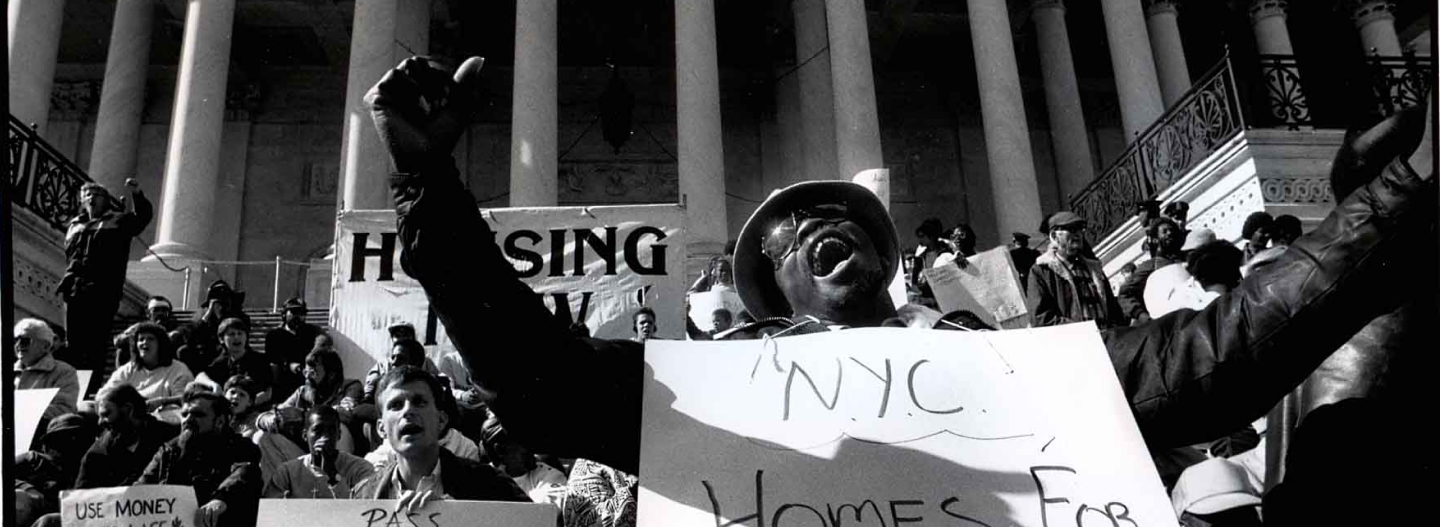
Modern homelessness, as we know it today, began in the 1970’s. During the Reagan Administration, affordable housing dollars were cut but almost 75%, leading directly to poor working families experiencing homelessness at alarming rates. Folks began to organize in the 1980’s, this was when our organization was formed. At the same time, a group called the National Union of the Homeless (NUH) developed out of the first resident-run shelter in Philadelphia.

Read more about the NUH:

“In the late 1970s and early 1980s the United States economy underwent a series of changes that led to a sharp rise in homelessness. Homelessness was no longer characterized by down and out individuals living on skid rows. For the first time in US history, families were increasingly becoming homeless, and the shelter system was created to house them.

Out of this common experience of dislocation and dispossession grew a national organization of homeless people that mobilized thousands throughout the US in the 1980s and 1990s. At its height, the National Union of the Homeless (NUH) had over 20 local chapters and 15,000 members in cities across the US.

Most importantly, it implemented a model of organizing involving the poor and homeless thinking for themselves, speaking for themselves, fighting for themselves and producing from their ranks capable and creative leaders. This was contrary to the prevailing stereotypes and misconceptions about homelessness. Almost twenty years after the decline of the NUH, its history offers important lessons for building a movement to end poverty today, in the midst of continuing concentration of wealth among a few and expanding poverty for many.”
(Copied from The National Union of the Homeless: A Brief History, Published July 2011, https://homelessunion.wdfiles.com/local–files/curriculum/BriefHistoryPamphlet.pdf)

The NUH was active between 1985 and 1993. During this time, NUH mounted several campaigns, first aimed at overcoming stereotypes of who was homeless, then later focused on appropriating housing for its members. Their actions used slogans like “Homes and Jobs: Not Death in the Streets” and “Homeless Not Helpless.” They mounted civil disobedience like the Tompkins Square Tent City (detailed in Tent City Blues, an article in the Sept-Oct 1990 issue of Mother Jones), a national series of housing takeovers (watch in the documentary, The Takeover, from 1990), and the Union organized and participated in the Housing Now March along with the National Coalition for the Homeless and several others.

We encourage anyone reading this to learn more about where our collective work has come from by checking out the above links, and also visiting the Homeless Union History Project and the National Union of the Homeless Wikipideia page.

2020 Update: The Union is back


Do you still #TBT? Many of us have a short-term memory when it comes to policy, social media too perhaps, cause I haven’t seen a #ThrowBackThursday post since Facebook started showing you your past posts.

The National Coalition for the Homeless recognizes that we are at a pivotal moment in our social policy. Modern mass homelessness, as we know it, began, not that long ago, in the 1970’s. But here we are, again facing threats to social programs that are vital for the survival of working families, and now in the midst of unprecedented economic inequality.

In solidarity with the National Low Income Housing Coalition’s Our Homes Our Voices Week of Action (May 1-9) and the Poor People’s Campaign: A National Call for a Moral Revival 40 Days of Action (May 14-June 23), we are going to be posting historical information that relates to current trends, policy proposals, and cultural perceptions of those who experience poverty and homelessness.

To kick us off, we’ve included some more detailed history about how and why our organization was formed, and what we have accomplished over the years.

NCH Historical TimelineNCH’s Story

When modern homelessness first emerged in the late 1970s, hundreds of thousands of homeless were forced to fend for themselves on the streets, and many died or suffered terrible injuries. In 1979 a lawyer named Robert Hayes, who co-founded the Coalition for the Homeless in New York City, brought a class action lawsuit in New York State Supreme Court against the City and State called Callahan v. Carey, arguing that a constitutional right to shelter existed in New York. In particular, the lawsuit pointed to Article XVII of the New York State Constitution, which declares that “the aid, care and support of the needy are public concerns and shall be provided by the state and by such of its subdivisions…” The Coalition brought the lawsuit on behalf of all homeless men in New York City. The lead plaintiff in the lawsuit, Robert Callahan, was a homeless man suffering from chronic alcoholism whom Hayes had discovered sleeping on the streets in the Bowery section of Manhattan.

On December 5, 1979, the New York State Supreme Court ordered the City and State to provide shelter for homeless men in a landmark decision that cited Article XVII of the New York State Constitution.

In August 1981 Callahan v. Carey was settled as a consent decree. By entering into the decree, the City and State agreed to provide shelter and board to all homeless men who met the need standard for welfare or who were homeless “by reason of physical, mental, or social dysfunction.” Thus the decree established a right to shelter for all homeless men in New York City, and also detailed the minimum standards which the City and State must maintain in shelters, including basic health and safety standards. In addition, Coalition for the Homeless was appointed monitor of shelters for homeless adults.

On the heels of the landmark Callahan win, the decision was made to take the work of the Coalition for the Homeless national. Robert Hayes organized a meeting of several local coalitions in San Francisco in April 1982, out of which the National Coalition for the Homeless was established.

Twenty years after “ending welfare as we know it” with the passage of the 1996 Personal Responsibility and Work Opportunity Reconciliation Act, the current administration issued an Executive Order on April 10, 2018 to Reduce Poverty in America by Promoting Opportunity and Economic Mobility.

While the Administration’s Order is more suggestion for Federal departments of government, the National Coalition for the Homeless [NCH] was strongly opposed to the 1996 law and is equally strongly opposed to the direction of the Executive Order, and any attempt to enforce work requirements on social benefits, including food assistance (SNAP) and Medicaid.

The reality is that the 1996 legislation and now the Executive Order goals language is code for reducing the welfare rolls even further by slicing benefits, imposing further work requirements and mandating further time limits on welfare programs.  It is clear that the direction of the Executive Order, and potential work requirements being considered for access to food assistance (SNAP) and Medicaid, is punitive and does nothing to promote self-sufficiency. At a time when our wages are not keeping up with the cost of living, the only direction of economic mobility for many will be downwards, in some cases leading to homelessness.

In 1998 NCH partnered with the Children’s Defense Fund to publish Welfare to What: Early Findings on Family Hardship and Well-BeingThe key findings include:

  • only a small fraction of welfare recipients’ new jobs pay above-poverty wages; most of the new jobs pay far below the poverty line;
  • many families who leave welfare are losing income and not finding steady jobs at all;
  • extreme poverty is growing more common for children, especially those in female-headed and working families;
  • many families leaving welfare report struggling to get food, shelter, or needed medical care; many are suffering even more hardships, including becoming homeless, than before;
  • many families are not getting the basic help they need [for example, child care, medical coverage, food or transportation] that might enable them to sustain work and care for their children on very low wages;
  • many families are denied cash assistance through little or no fault of their own; states often penalize families without assessing their ability to complete required activities.

Twenty years later, the 2018 Farm Bill with significant changes to SNAP [Supplemental Nutrition Assistance Program, or Food Stamps] proposed by House Agriculture Committee Chair Michael Conway is the testing ground for the broader direction of the 2018 Executive Order.

And, just as we said 20 years ago, the Center for Budget & Policy Priorities President Robert Greenstein said in April 2018 that the proposed changes in SNAP would “end or reduce benefits for a substantial number of low-income people… and would widen the nation’s economic divides.”

Clearly the current administrations goal is to “leave no billionaire behind” while punishing low-income people.  We ask the same question of the Executive Order as we did 20 years ago: Welfare to What?

NCH does not believe the current false rhetoric of economic mobility and expanding opportunity.  We know better.  We know that the real direction of work requirements as welfare reform is punitive and the results will be increased poverty and homelessness for children and families, disproportionately impacting people of color, especially African-Americans and Native Americans.

NCH stands ready to partner with local, state and national organizations to demand the real direction of any reforms to welfare results in living wage employment and truly affordable and accessible housing.

-Bob Erlenbusch, NCH Board President
Executive Director, Sacramento Regional Coalition to End Homelessness


Further reading:

We have seen so many movements and actions since the 2016 elections – which means our communities want social and economic justice! We recently recorded a video of solidarity with the March for Our Lives and #NeverAgain campaign for gun reform. We are also partnering with the National Low Income Housing Coalition and the Poor People’s Campaign: A National Call for a Moral Revival on public actions working to fight the root causes of homelessness.

Here is what you can do this Spring:

Our Homes, Our Voices

We hope that you will join us in taking part in the National Low Income Housing Coalition’s Our Homes Our Voices week of action, May 1-8, 2018. Learn more about the event, and how to get involved here.

Poor People’s Campaign: A National Call for Moral Revival

We also hope you will join us in joining the new Poor People’s Campaign: A National Call for Moral Revival. This is a ground up movement being led by faith leaders and people who are struggling with an economic and social system that only benefits the most wealthy among us. The campaign has just launched its list of demands, which outline
how the evils of systemic racism, poverty, ecological devastation, and the war economy and militarism are persistent, pervasive, and perpetuated by a distorted moral narrative that must be challenged.
 The campaign states,
We must stop attention violence and see the human and economic costs of inequality. We believe that when decent people see the faces and facts that the Souls of Poor Folk Audit presents, they will be moved deeply in their conscience to change things. When confronted with the undeniable truth of unconscionable cruelty to our fellow human beings, we must join the ranks of those who are determined not to rest until justice and equality are a reality for all.
Mother’s Day, May 13th, will kick off 40 days of nonviolent action, and we encourage you and your network to join the campaign and take part in changing “not just the narrative, but who is narrating” our national political agenda.

Public Education

Finally, we know one of our biggest hurdles to housing all of our neighbors is public perception and prejudice against both people of color and poor people. To this end, we have created shareable documents that we encourage you to print and distribute: PUBLIC NOTICE for class action lawsuit - DHOL 2018

  1. A list of demands for the American Dispossessed: Created by Denver Homeless Out Loud in support of the Right to Rest and presented as a public notice, it is meant to be posted outdoors in places where our neighbors are forced to live in encampments or on public land. Click here to download

  2. State of Homelessness 2018: A brief (3 pages) overview of why we are seeing increased visible homelessness in our communities, covering everything from housing to HUD funding to criminalization. Click here to download
Natural Disasters and Homelessness Fact Sheet 2009

Click here to view our Factsheet on Disasters and Homelessness

Extreme weather events are a very common cause of homelessness, especially when insurance and other rebuilding resources are limited. Many are still working to rebuild their lives from storms and other natural disasters that occurred years ago.

But as an outreach worker in Houston says, “help for the homeless, often hard to come by under normal circumstances, likely will be even more challenging in the storm’s aftermath.” Moreover, people living on fixed incomes, working poor families, and those who are homeless often do not have the resources to evacuate or even collect needed supplies.

The National Coalition for the Homeless urges all those suffering under extreme weather conditions, or sharing concern for those affected, to consider with assistance and compassion the position of families and individuals who are not able to get out of a storm’s path.

Consider the words of some homeless Houstonians (from this article):

“It’s just rain,” he said, echoing the words of others on the streets.

The camp’s unofficial leader is Stanley Unc, 56…He says even if conditions were worse here, many wouldn’t have blinked — they are toughened by lives lived outside. He said others can’t grasp what their lives are like each day, much less on a day when a Category 4 hurricane hits. “They know what it took them through and we went right in the middle of it,” he said.

Below are some resources for those who are in the path of Irma in Florida, and those affected by Harvey in Texas:

Broward County, Florida:

“Broward County residents who do not have a permanent home or place of safety to reside are especially vulnerable during emergencies, such as a hurricane. When a Hurricane Warning is announced, the Homeless Helpline 954-563-HELP (4357), provides information and referral for homeless services in Broward County, including assistance in finding shelter, support services, or programs for individuals or families who are homeless or on the verge of being homeless.

Additionally, when a hurricane warning is announced or a mandatory evacuation order is issued, Broward County Transit (BCT) buses will offer evacuation transportation from the assigned pick-up points to General Population shelters. Transportation will continue until sustained winds reach 39 miles per hour.

Pick-up Points for Persons Experiencing Homelessness

North Central South
100 West Atlantic Boulevard
Pompano Beach, Fl 33060

(South Side Parking Lot)

Salvation Army Lodge
1445 West Broward Blvd
Fort Lauderdale, FL 33312

954-524-6991

Corner of N. 21 Ave
& Lincoln St.
Hollywood, Fl 33020

(East of railroad tracks)

Corner of N. 21 Ave
& Sherman Street
Hollywood, Fl 33020

(East of railroad tracks)


What to Bring
: Homeless persons are allowed one suitcase, duffel bag or plastic bag of belongings at the shelter. Additional belongings may be left at the nearest feeding program pick-up point until the evacuation order is lifted.

For more information, call Homeless Helpline at 954-563-HELP (4357).​​​

Florida Keys/Monroe County, Florida:

The Monroe County Emergency Operations Center is now operational and the Emergency Information line is up and running for those who have questions about Hurricane Irma. The Emergency Information number is 1-800-955-5504.

Key West Transit will begin hurricane evacuation service at noon Thursday. Buses will be clearly marked “hurricane evacuation” on the destination boards. They will circulate throughout the city, picking up riders at regular bus stops. Riders will be transferred at the Transit Center on Stock Island, and the buses will proceed to the hurricane shelter at Florida International University, picking up riders along US 1.

Evacuees are asked to go to the nearest bus stop, or the Transit Center on College Road. Pickups will continue throughout the afternoon Thursday and resume at 6 a.m. on Friday. Weapons and alcohol are prohibited on the buses.

Regular bus service – Citywide, the Duval Loop and the Lower Keys Shuttle – will end at midnight Wednesday, September 6th.

Manatee County, Florida

Miami, Florida

Orlando, Florida

National Resources

Harvey Recovery Resources


The Longest Period of Growing Homelessness In the History of the United States
Many of us providing services in the early 1980’s to people experiencing homelessness warned our political leaders and faith community that if we didn’t make structural changes, we would be in the mess we are in today.

Yet in 2017 media and society continue to blame people for becoming homeless.

In reality, over 1/3 of our country is 1 to 3 paychecks away from not making rent or mortgage payments, and 50% of our American population has a mental health and/or chemical health issue.

If you have money, you have housing. If you don’t have money, you are at risk of homelessness, especially if you have any personal health issues!

We are all responsible for the moral and structural causes of homelessness in our country. Here are the ten primary reasons why people are becoming homeless today:

  1. Limited moral outcry to love and treat others as ourselves.
  2. Greed: me and my needs are more important than we the people and the common good
  3. Housing is treated as a commodity, not a basic need. In Minnesota, through our tax expenditure budget, we will subsidize primarily white homeowners over next biennium over $1.5 Billion (Mortgage interest, tax, capital gain write offs). We are fighting to just keep $30 Million to address the disparity in homeownership between white and non-white persons. We are the 3rd worst state in the country in this disparity.
  4. Lack of or no enforcement of our civil rights and fair housing laws – Disparities against minorities and across income levels continue to increase.
  5. Wages are not livable incomes (from jobs or public assistance). If you have money, no matter what other issues you have, you can get housing.
  6. Demolition of housing without replacement. Tax code change in 1986: Drove out of business our ma and pa landlords, complicated the housing development process, and required sophisticated and well-funded investors.
  7. Credit Expanded in 1970s – Buy now, pay later became the norm. Debt increases.
  8. Disinvestment in opportunities for people with limited resources in housing, jobs, social services, education, health care. Dismantling the mental health asylums without creating the promised community housing. We capped domestic program spending, and pitted them against each other while we built up war and defense budget tax breaks for wealthiest.  This began in the 1970s, expanded in the 1980s with President Reagan and a Democratic Congress, and has continued to NOW.
  9. Scams in the housing industry with little or no consequences for the perpetrators: our financial institutions, realtors, title companies. We have had over 150,000 foreclosures since 2007 in MN.
  10. To rent housing, a criminal, credit, and rental check is almost always completed. Anything on your record may keep you out of rental housing. Only a credit check is done when you buy a home and that is not done if you buy with cash.

Over the last 4 decades we have continued to experience the ongoing growth of homelessness as we fail to address the structural causes of homelessness. Homelessness is caused by our inequitable structural issues, not just people’s personal issues.

We must invest in equitable solutions, which include a balanced continuation of: Housing and Affordable Housing, Rental and Homeownership, the Common Sense Housing Investment Act HR948, livable incomes (wages and public assistance), accessible, affordable, culturally appropriate health care, human services, and transportation, excellent educational and job training opportunities, and assurance that everyone’s civil rights are respected,  protected, and enforced.

We need to decide:

  • Are we going to continue to blame people for being homeless and manage homelessness through a rapidly growing homeless services industry for another four decades,

or

  • Are we going to be responsible and live out our faith, assist those experiencing homelessness now,

AND 

make the structural changes needed to bring our community, state and nation home and live out our pledge to be One Nation, Under God, with Liberty and Justice For All!


By Sue Watlov Phillips
Founding member of National Coalition for the Homeless (NCH), Vice President NCH Board
Executive Director, MICAH (Metropolitan Interfaith Council on Affordable Housing)

The first thing I did when I became the Director of NEOCH in 1995 was call Michael Stoops at the National Coalition for the Homeless and talked to him about civil rights for those who did not use the shelters.  We were engaged in a series of lawsuits that began before I was a member of the Coalition, so I needed a tutorial.  Michael was a quiet man who was a peacemaker.  He never asked for the spotlight but accepted it to save the National Coalition for the Homeless.  Sitting down and looking for a solution with a group of persecuted homeless people was the way he wanted to spend his afternoons.  Michael Stoops passed away on May Day 2017 after a two year struggle following a stroke.

Stoops grew up in Indiana and moved to Portland, managing a shelter in the 1970s.  Stoops loved sitting in the office and helping to distribute the donated food on Sunday afternoon to the forgotten and downtrodden.  He helped organize the Housing Now march in DC, provided input on the McKinney Vento national funding of shelters, and helped found the National Coalition for the Homeless.  Stoops was a community organizer with a keen ear for listening to homeless people. He had experienced homelessness and hunger and slept at the CCNV shelter in DC in the past.  He knew what it meant to be swept off the streets, and he cared about the intrinsic value of every human being.  He understood that each person had their talents and a place in our society.  He rarely wore a sport coat and was often confused for the homeless individuals that City Councilmembers and Congressional staff walk over on their way into their offices.

Michael loved bringing people together and working to raise the voice of those who slept outside with his quiet but powerful voice.  He stepped up to write grants, send in payroll, complete the 990 tax return and manage a VISTA program because he had to in order to keep the organization functioning.  Stoops met with funders and in his soft spoken style asked them to open their checkbooks to help in a non-traditional manner.  It was not money to buy food, housing, a shelter bed or clothing; he was asking for a donation for social change.  That is the hardest thing to try to get across in an elevator speech, but Michael never lost his thirst for righteousness.

Michael took on the executive director position at NCH when I was a board member.  It was a temporary interim appointment for the summer that lasted for years.  He testified before Congress, always yielding time to others who had slept on the hard sidewalks of America’s streets.   Stoops worked for NCH when it was a large vibrant organization with 20 staff and he helped to unionize that staff.  He saw it crippled by the downturn and the loss of  prestige and influence.  Michael put in place a speaker’s bureau that has become a mainstay of NCH programming.  The speakers under Michael’s guidance taught other formerly homeless people to overcome their nervousness to talk at colleges, high schools and religious gatherings to put a face on homelessness.  We will never know how many shelter workers, volunteers, health care professionals or housing developers were inspired by Michael to work to reduce poverty in the United States.   I met a doctor at the CDC in Atlanta who was inspired to work in the area of TB after listening to Michael Stoops at a college class.

Stoops loved the street newspaper movement and helped to keep many street newspapers in business, planting the seeds of a few others.  The best street newspaper in the United States, Street Sense in DC, was founded by Stoops and NCH’s director at the time, Donald Whitehead.  The paper has remained close to Michael and he continued to act as a mentor to Street Sense and many of the vendors in our nation’s capital.  There are thousands of newspaper vendors who were able to make the rent or pay for dental work because of Michael.  He loved to empower individuals willing to try to sell free speech on the cold, rainy, harsh mean streets of America.

Michael came to Cleveland on a few speaking engagements and to help with the North American Street Newspaper Association conference at Case Western Reserve University in the late 1990s.  He helped to get the Canadian and US papers together and host listening and learning sessions in various cities.  He organized newspaper conferences in Seattle, San Francisco, Cleveland, Boston, Montreal, Edmonton, and Chicago that I was able to attend.  He always helped homeless people attend the conference and hosted a series of vendor competitions to see which vendor would sell the most papers in a foreign city. One of our vendors dressed as a cow (with cow head) on the plane to fly to Edmonton to get that extra edge in the vendor competition. This was pre-September 11th.  You can’t dress as a cow on a plane anymore, but she won.  Even back in the late 1990s and early 2000s it was hard to get homeless people with problematic backgrounds across the US/Canadian border, but Michael handled it.

He lived, breathed and voraciously ate up the news about homelessness and poverty from around the US.  He would read nearly every major newspaper everyday and that dramatically expanded when he got access to the internet.  He knew as much about the sweeps taking place in San Diego as the local Coalition just from the news accounts and the telephone.  He would call us in the field and get an update on the status of a lawsuit or negative encounters with the police when he heard about a problem.  He knew more about the struggles facing homeless people in America than every board member in the 30 year history of the Homeless Coalition in Cleveland combined.

Michael would put us in contact with a homeless person in some of the rural communities two or three hours outside of Cleveland who happened to call the NCH office for help.  Homeless people, advocates and service providers could call Michael day or night and they would get a response.  They could call about being arrested or threatened by the police and he would get them a local contact who might help.  The religious groups would call to tell Michael that the police did not want to serve a hot meal to a homeless person and he would hook them up with a lawyer friend of his. Michael worked with health care advocates to read the names of those who had passed away on the first day of winter.  That somber service is done at every major city in Ohio and hundreds of cities in the United States thanks to Michael and the National Health Care for the Homeless.

Stoops heard about those horrible videos (remember video tapes?) of homeless people fighting that were being sold at major retailers and went to war.  In the most meek and understated way possible, he successfully fought to get every major retailer to stop selling for profit these horrible tapes.  He asked Sean Cononie of Florida to take on Dr. Phil and condemn the awful people who were making money off other’s mental health or addiction issues.  This was one of the benefits of Michael’s long career; he had allies who would support him throughout the country.  Michael appeared on the Colbert Report, CNN and many other news programs.  He was the reluctant face of national homeless advocacy in the United States. Stoops understood the tremendous weight on his shoulders to carry the horrific stories of violence, crime, poverty and a lack of education that people overcame in order to find stability.  I never knew if he was mourning or praying or just trying to process the tragedy that he saw on a daily basis, but he was a deep thinker.

Michael would fly to Florida to testify against a restriction on churches serving food on the beach and then to Austin to argue that disabled people should be able to rest on park benches, then to San Francisco to try to breathe some compassion into a City Council trying to restrict begging for money.  Homeless people living in the big shelters in Boston or St. Petersburg knew of Michael’s efforts, and he tried to bring justice to Covington Kentucky with the forgotten homeless guys sleeping in abandoned farms who were finding it impossible to get into housing with their criminal background.  He gave of himself every day to help those forgotten by capitalism.  Michael was poor of spirit, and was always trying to lift those around him. He did not raise his voice and was merciful even to those he disagreed with or those who he felt were doing harm.

I think that the most significant legacy from Michael’s work came toward the end of his career in 2014: after years of Hate Crimes reports published; after years of publishing Criminalization reports documenting all the municipal laws passed to hide homeless people; and after all the meetings with hundreds of Congressional staff members, the Justice Department added their voice to a police sweeps case out of Boise Idaho. This was important because for the first time someone in the national government put down on paper what we in the field have known for decades: local policies on homelessness are crazy.  How can a city not offer enough beds to everyone who shows up for help, and then turn around and give a ticket to those who sleep on the streets?   The Obama administration said it was immoral to not offer enough shelter and then paradoxically arrest those who cannot find a shelter bed. This was the Bell vs. the City of Boise lawsuit over the police sweeps of homeless people, but it should be called the life’s work of Michael Stoops.

I will miss Michael every day.  The struggle to end homelessness has taken a hit that will be take years to recover.

-Brian Davis
Full post at: http://www.neoch.org/cleveland-homeless-blog/2017/5/1/a-reflection-on-michael-stoops-of-nch.html

Read more reflections:
Street Sense
National Low Income Housing Coalition
Video: Interview with Michael Stoops