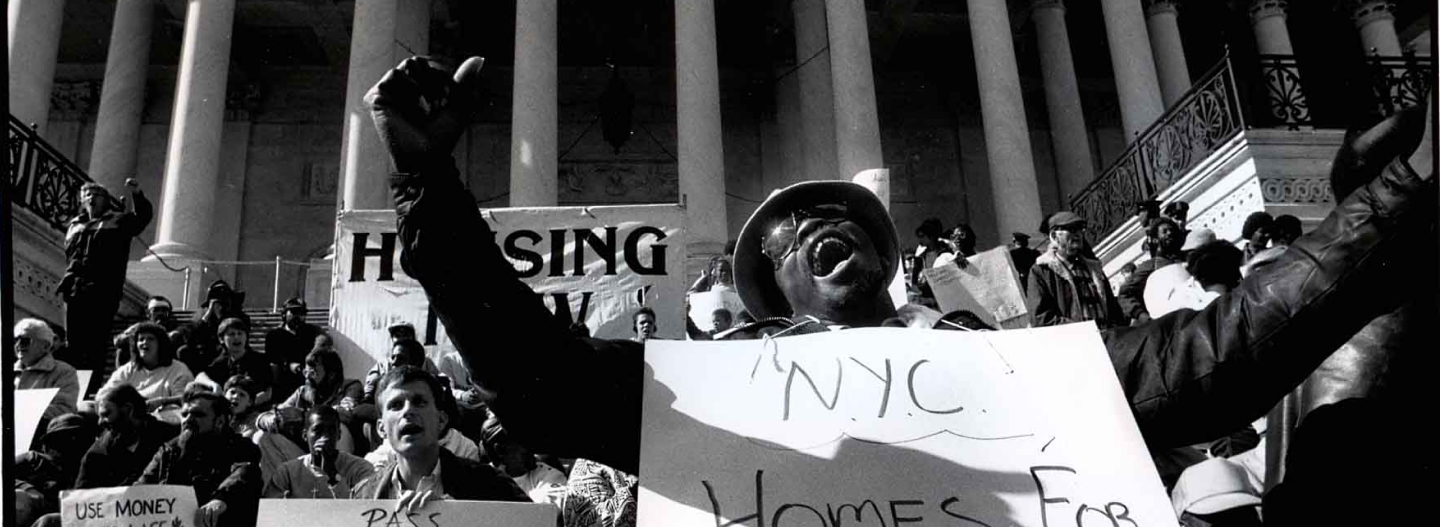
NCH Statement on Martin v. Boise Case

NATIONAL COALITION FOR THE HOMELESS WELCOMES SUPREME COURT DECISION TO ALLOW MARTIN V. BOISE CASE STAND.  CALLS FOR NEW INVESTMENTS TO ADDRESS THE UNDERLYING CAUSES OF STREET HOMELESSNESS

The National Coalition for the Homeless applauds the decision of the U.S. Supreme Court to deny a review of the Martin v. Boise case, leaving in place the decision by the 9th Circuit that people experiencing homelessness cannot be punished for camping or sleeping on public property where there are no adequate alternatives.

The Boise decision remains the law, at least in the states within the 9th U.S. Circuit.  Criminalizing homelessness, in absence of reasonable and acceptable alternatives to sleeping on the streets, is unconstitutional, and cities and states must act to develop adequate shelter and affordable to address homelessness in their communities.

“Today is a victory for people experiencing homelessness”, said John Parvensky, Acting Executive Director of the National Coalition for the Homeless.  “It is not a victory because people can legally sleep on the streets.  Rather it is a victory because it will force communities to address homelessness proactively – through the development of an adequate supply of affordable housing, while providing safe and appropriate emergency shelter in the interim”. 

NCH calls of the Federal Government to immediately and significantly increase its investment in both housing and services for those experiencing homeless as well as in broader pubic and affordable housing for those at risk of becoming homeless.

The recent announcement of the imminent appointment of Robert Marbut as Executive Director of the USICH raises significant concerns about the Trump Administration’s plans to address homelessness.  Rather than building upon evidence based practices like housing first, permanent supportive housing, increased health and mental health services, and expanded affordable housing, the pick portends an expansion of punitive strategies to control, marginalize and criminalize people experiencing homelessness.

Marbut, a self-described “expert” on homelessness, has limited actual experience developing and operating effective housing and service programs to move people experiencing homelessness from the streets or shelters into housing, and connecting them to the employment, health and mental health resources they might need to remain stable in housing.

As a consultant, Marbut has advocated policy and programming approaches that warehouses people in large congregate shelters which are designed to contain and isolate people experiencing homelessness with punitive rules and practices.  Rather than accepting and implementing the evidence based housing first approach, Marbut has claimed he believes in “Housing Fourth”, as if housing is less important to resolving homelessness than other interventions.

He has also called feeding people on the street “enabling them”, as if not feeding them will make the problem go away.

The appointment of Marbut to lead the agency charged with coordinating the response of federal agencies to homelessness is particularly concerning in light of President Trump’s recent complaints about the large increase in street homelessness in San Francisco, Los Angeles and other cities and the release of a report by the White House Council of Economic on “The State of Homelessness in America” in September.  That report used faulty logic, statistics and policy prescriptions to give cover to the President’s recently stated desire to crack down on the homeless by criminalizing and warehousing people experiencing homelessness – not to help end their misery, but to alleviate the impact of street homelessness on real estate investors and businesses.

Rather than proposing new initiatives with adequate funding to proactively address  and end homelessness through evidence based practices, the Administration has repeated proposed cuts to housing and homeless program budgets, food stamps, Medicaid and other programs that provide a pathway out of homelessness for the more than 1 million individuals and families experiencing homelessness across our nation.

What is needed is vast expansion funding to build more affordable housing, to fund additional supportive housing units targeted to persons with disabilities experiencing homelessness, and to ensure that those on the streets or at risk of homelessness have access to health care and support to they need to improve their lives.

While there is much in the existing federal policy on homelessness which can be improved, the approaches promoted by Marbut would likely exacerbate the existing homelessness crisis rather than solve it.

We urge the members of the USICH to oppose the appointment of Robert Marbut and to seek the input of people experiencing homelessness and those housing and serving them in the selection of a leader with the experience, philosophy and competency to move federal policy towards the ending of homelessness.

In what appears to be an escalation on the White House’s war on the homeless, rather than a righteous war on homelessness, the White House Council of Economic Advisers released an unsigned report this week on “The State of Homelessness in America” that is on its face absurd, and uses faulty logic, statistics and policy prescriptions to give cover to the President’s recently stated desire to crack down on the homeless by criminalizing and warehousing people experiencing homelessness – not to help end their misery, but to alleviate the impact of street homelessness on real estate investors and businesses.

The report claims that homelessness is caused by 1) the higher costs of housing due to overregulation of housing markets, 2) permissive policies increasing the “tolerability of sleeping on the streets”, 3) the supply of homeless shelters, and 4) the ineffectiveness of previous federal policies in reducing homelessness.  Finally, in heralds the Trump Administration’s actions to reduce Homelessness without offering any evidence to support the impact of such actions on the reductions of homelessness.

“This report seemingly attempts to give cover to the President’s recent attacks on cities experiencing the crisis of increased homelessness without taking responsibility for the Administration’s own actions which undercut state and local efforts to end homelessness through a combination of housing and health care”, said John Parvensky, Executive Director of the National Coalition for the Homeless.  “The report purports to be an economic analysis of homeless, but instead uses misleading statistics, faulty analysis and spurious conclusions to blame homelessness on those experiencing it, rather than on failure of the housing market and government policy to provide real solutions at the scale necessary to truly end homelessness.”

The report’s simplistic analysis of the effect of regulations on the cost of housing ends with the startling conclusion that a “1 percent reduction rental home prices reduces the rate of homelessness by 1%.”  While the regulatory environment may have a marginal impact of the cost of building housing, the actual cost of rental housing is dictated by the laws of supply and demand (something you would think a council of economic advisors would understand).  The cities with the highest rates of homelessness also have the greatest shortage of affordable housing with rents low enough for those experiencing homelessness to afford. 

When there is a shortage of housing units, owners will set the rents as high as the market will allow, which puts the cost far above what people experiencing homelessness can afford.  The report itself acknowledges that the mean incomes of people experiencing homelessness is about one-half of the poverty level – which equates to $6,445 for a single individual and $12,375 for a family of four.  Yet the 2019 fair market rent in Los Angeles is $1,158 for an efficiency apartment and $2,401 for a three bedroom apartment.  Thus, the average homeless persons in Los Angeles would need spend twice their income to rent an average apartment.  A 1% reduction in rent prices would have no impact on reducing homelessness.  Even a 50% reduction in rent due to deregulation (which even the report’s authors don’t suggest is possible) would mean that the average homeless person would still need to spend all of their income for an apartment.   The solution to high rents is not deregulation, but increased governmental subsidies to bring those rents within the reach of all Americans.

The report’s contention that tolerating people living on the streets increases homelessness is equally absurd.  Talk to any person living on the streets of Skid Row or in any city and you will discover that it is the lack of available, accessible and affordable alternatives that drive people to find refuge on the streets, not tolerance of such refuge.  Alternatively, criminalizing homelessness through camping bans, sweeps, and other means does not reduce homelessness – it only moves people from one place to another and makes it more difficult for outreach workers to engage and connect these people to the limited housing options that may be available to them.

Similarly, the report’s claim that the supply of shelter increases homelessness is laughable.  Building shelters, which are in already in short supply in most communities, no more increases homelessness than building hospitals increases those who are sick.  While building quality shelter may be one effective strategy of reducing street homelessness by providing realistic alternatives to those sleeping on the streets, few people would choose shelter over safe and affordable housing.

Fourth, the report’s critique of previous federal policies does raise serious questions about whether HUD’s contention that homelessness is actually declining in most communities is accurate due to methodological problems and changes in definitions.  However, it’s contention that evidence-based practices of “housing first” and permanent supportive housing are ineffective in reducing homeless is flawed.  Those interventions are designed to end the homelessness of those who have access to such housing, and numerous studies have documented that these approaches do in fact end homeless for 90% of those housed through these approaches.  The problem isn’t the policy intervention.  The problem is that the Federal government has never funded these interventions to the level needed to dramatically reduce homelessness nationwide.

The growth of mass homelessness in our cities did not occur overnight.  It is the result of nearly four decades of federal budget cuts to affordable and public housing programs under both Republican and Democratic administrations beginning in the 1980s.  Indeed, the Administration’s recent budget proposals have called for reductions in funding for strategies that work, not increasing funding to the level needed to truly end homelessness.

This year, HUD provided only $415 million in homeless assistance grants to California, a paltry sum compared to the number of people experiencing homelessness in that state.  Furthermore, only 4.5% of this funding was available to fund new projects to house those currently on the streets or in shelters – the remaining funding was needed just to keep those individuals previously housed through federal support from losing their housing.

Meanwhile, California has recently committed $1 billion of new state funding, and Los Angeles voters approved two $2 billion bonds to address homelessness.

If the Trump administration was serious about ending homelessness in California and across our nation, it would call for a massive new investment of funding for homeless assistance and affordable housing – not increased efforts to criminalize homelessness or warehouse those currently on the streets.

We need to demand that the President and Congress significantly increase its funding for homeless assistance programs — to not only continue to house those previously housed who need continued assistance to remain housed, but also to provide new housing those currently living on the streets.  Incremental increases are not sufficient.  

They must also restore affordable housing funding across the board to the levels necessary so that those experiencing homelessness are not continually competing for limited housing with those living at risk of homelessness, on fixed incomes, or working at minimum wage jobs. 

We know how to end homelessness through a combination of affordable housing, health care, and social supports.  Criminalization and warehousing of the homeless are not the answers.


In an act of hypocrisy that is extreme, even when compared to the serial outrageousness we have come to expect from Washington in recent years, the Trump Administration has taken initial action seeking to criminalize homelessness by relocating people experiencing homelessness from the streets of Los Angeles and other California cities to federal facilities.  While appropriate federal investment is desperately needed to address the growing crisis of homelessness in cities across the nation, federal efforts to criminalize homelessness, or to create warehouses to move the homeless out of sight and out of mind are clearly not the answer.

The Trump Administration is complicit in the continuing growth of homelessness.  While it did not start under its watch, the administration has offered no positive proposals to address homelessness nor its main underlying cause — the lack of affordable housing.  Rather, the administration has proposed significant budget cuts to HUD’s affordable housing and homeless funding every year.   Other actions, such as repeated attempts to repeal the Affordable Care Act, cuts to SNAP benefits, and cuts to housing assistance for undocumented individuals in public housing, all undercut state and local efforts to end homelessness.

The growth of mass homelessness beginning in the 1980’s began with massive cuts to federal housing assistance for public housing and the Section 8 program.  Federal funding to specifically address homelessness has never been at a level commensurate with the need nor adequate to end homelessness.

Currently, HUD holds a yearly national competition for funding to award its Homeless Assistance grants to local communities.  In January, HUD announced the distribution of $2.2 Billion in such grants.  However, the vast majority of HUD funding was needed just to renew existing projects housing formerly homeless persons.  Nationwide, 91.3% of projects funded were renewal projects, with only 5.8% ($126 million) being new housing or service projects.  Of these 71% of renewals (totaling $2 billion) were for permanent supportive housing – applications to keep those who were housed through those projects remain housed.

In California, only 4.5% of the $415 million of HUD grants funded new projects to house those currently on the streets or in shelters – the remaining funding was needed just to keep those previously housed from losing their housing. 

Meanwhile, California has committed $1 billion of state funding, and Los Angeles voters approved two $2 billion bonds to address homelessness.

If the Trump administration was serious about ending homelessness in California and across our nation, it would call for a massive new investment of funding for homeless assistance and affordable housing.

We need to demand that the President and Congress significantly increase its funding for homeless assistance programs — to not only continue to house those previously housed who need continued assistance to remain housed, but also to provide new housing those currently living on the streets.  Incremental increases are not sufficient.  

They must also restore affordable housing funding across the board to the levels necessary so that those experiencing homelessness are not continually competing for limited housing with those living at risk of homelessness, on fixed incomes, or working at minimum wage jobs. 

We know how to end homelessness through a combination of affordable housing, health care, and social supports.  Criminalization and warehousing of the homeless are not the answers.

Across the nation, agencies and communities providing housing and services to homeless families and individuals with federal HUD funding are beginning the annual ritual referred to as the SuperNOFA.  This is not some astrological event.  Rather, it is the funding equivalent of a cross between the Hunger Games and Survivor.  Agencies receiving HUD homelessness funding are required to compete with each other to renew their grants for permanent supportive housing, transitional housing, rapid re-housing or other programs.  The losers will be defunded and “voted off the island.”

While competition for funding can be beneficial to ensure that the most worthy projects having the greatest outcomes housing the homeless are funded, the NOFA (Notice of Funding Availability) is structured in such a complex and convoluted way that it traumatizes not only agencies serving the homeless, but the very people the funding is designed to help — formerly homeless families and individuals who are currently residing in supportive housing funded by these grants.

The funding process requires local “continuum of care” entities designated by HUD to hold local competitions for new and renewal projects serving the homeless, and submit a collaborative application which ranks projects based on HUD and locally determined criteria.  The collaborative applications are then ranked by HUD, and projects prioritized by the local continua will be funded or not based on how HUD has ranked their continuum and how the continuum has ranked the project.

The process involves a three month scramble that starts with reading and understanding an 83 page NOFA issued by HUD which changes each year, the issuance of local continuum processes involving scoring matrices and priorities, the writing of new and renewal applications, the ranking of those applications by the local continua, and the submission of the collaborative application to HUD with ranking of local projects.

HUD then takes approximately three months to review, rank, and make announcements as to which projects will be renewed and which limited new projects will be awarded.

Thus, half of each year, agencies housing the homeless with federal funding are working on getting their grants renewed or worried about the prospects of their grants not being renewed.

This might be chalked up to just the “cost of doing business” if it were not for the fact that the final funding decisions are really not about which agencies are funded and not funded, but whether the families and individuals being housed through these programs will continue to be housed or not.  Indeed, the non-renewal of homeless housing by HUD over the past ten years has led to significant reoccurrence of homelessness by thousands of people previously housed in HUD funded programs.

Simply put, families and individuals housed in supportive housing programs funded by HUD should not have their continued housing put at risk for the sake of HUD managing a competitive renewal process.

To make matters worse, HUD has created a process whereby local continua must rank their projects into two tiers – with 6 percent of funding ranked in the second tier.  Projects ranked in the second tier are least likely to be refunded. 

HUD initially created a two tiered ranking system in 2012, when congressional appropriations for the program were significantly cut through the process known as Sequestration.  However, HUD has continued to use the two tiered ranking even though funding in the past few fiscal years has been sufficient to fund all renewal projects.

A yearly national competition for funding might be justified if there were significant funding for new projects each year.  However, the vast majority of HUD funding is needed just to renew existing projects housing formerly homeless persons.  In the 2018 competition, 91.3% of projects funded were renewal projects, with only 5.8% ($126 million) being new housing or service projects.  Of these 71% of renewals (totaling $2 billion) were for permanent supportive housing – applications to keep those who were housed through those projects remain housed.

There is no other funding process in the federal government that places the housing or services of people in need at risk through a competitive renewal process.  Can you imagine if HUD required Public Housing Authorities housing millions of people through public housing or Section 8 housing choice vouchers to annually compete to continue to receive such funding and keep those currently housed from losing their housing?

To make matters even worse, HUD has devised scoring criteria for the national competition that penalizes communities that are experiencing an increase in homelessness due to factors outside of their control.  For example, they provide incentive points for continua that demonstrate an overall reduction of at least 5% in the number of people experiencing homelessness, and for demonstrating a reduction of “first time homeless”.  Similarly, they provide incentive points to continua that demonstrate a reduction in the length of time people remain homeless, demonstrate a decrease of 5% of chronically homeless persons, or a decrease in family homelessness, and for a reduction in the number of homeless veterans.

While there is certainly merit in rewarding communities for improving outcomes, penalizing communities that are struggling with increased homelessness due to affordable housing shortages, increased population, decreased employment opportunities, and other factors out of their control is not only counterproductive, it exacerbates the problem by reducing the very resources these communities need to reduce homelessness.

In what world would it make sense for the Center for Disease Control to reduce its assistance to communities for treating HIV-AIDS or TB because there were more people in those communities needing such treatment?”  That is essentially what HUD is doing in its scoring process.

HUD claims that chronic homelessness has decreased by 26% since 2007, despite recent evidence of increased homelessness in many communities.  Even if true, at that rate, we will not achieve the end of chronic homelessness until 2050.  That is unacceptable in the richest nation on earth.

To truly help communities reduce and end homeless, significantly more federal funding is needed to help leverage state, local and community efforts.  To rely on only 5.8% of funding to provide new housing for people currently on the streets will not end homelessness. 

We need to demand that Congress significantly increase its funding for homeless assistance programs — to not only continue to house those previously housed who need continued assistance to remain housed, but also to provide new housing those currently living on the streets.  Incremental increases are not sufficient.   We must start with at least a doubling of the current homeless assistance program budget.

Congress authorized in the HEARTH Act of 2009 that funding to renew permanent supportive housing be funded through the Section 8 Appropriations Fund rather than through the more limited homeless assistance funding.  HUD has refused to implement this change.  Doing so now would free up over $1 billion dollars of funding to target the newly homeless.

HUD should also end its practice of requiring annual renewals for desperately needed homeless housing and services.

Finally, Congress must restore affordable housing funding across the board to levels necessary so that those experiencing homelessness are not continually competing for limited housing with those living at risk of homelessness and those working at minimum wage jobs. 

The time to act is now.

Feedback imageHomelessness continues to be a major failing of our social and economic systems. We need your help to strengthen our advocacy to fight the root causes of homelessness, as well as the shortcomings of our current assistance systems.

Here is a link to our brief survey that we very much hope you will answer about what you think our advocacy and policy priorities should be.

We are hoping to hear from:

  • people who have been (or are currently) homeless
  • advocates who work with homeless folks
  • providers of services for people experiencing homelessness

Please take a few minutes to help us to help people who are counting on us! The survey will remain open until the end of March, 2019. When the results come in, we will post them here on our website.

Thank you so much for your help and partnership!

Click to fill out the Survey

The National Coalition for the Homeless has published its annual report on bias-motivated violence against people experiencing homelessness on December 21, commemorated as National Homeless Persons’ Memorial Day. Vulnerable to Hate: A Survey of Bias-Motivated Violence against  People Experiencing Homelessness in 2016-2017, outlines the 48 lethal attacks and the 64 non-lethal attacks that occurred in 2016 and 2017 throughout the United States.

The report discusses the structural violence that has created endemic poverty, and proposes legislative solutions to 36 deaths per daylawmakers and advocates working to protect people experiencing homelessness from violence. Combining statistics and narratives, Vulnerable to Hate provides an in-depth look at the types of crimes homeless individuals experienced in 2016 and 2017, from police brutality to stabbings. The report breaks down lethal and non-lethal crimes by state, and each crime is documented by city, date, and description.

December 21, 2018 commemorates the 28th Annual National Homeless Persons’ Memorial Day, a remembrance of those who have passed away during the year while unhoused. Events are held nationwide to remember thousands who may not have had memorial services. A growing number of cities have been releasing annual reports on the number of community members who have died while homeless. Vulnerable to Hate only documents a fraction of these deaths. As the National Health Care for the Homeless Council points out, life expectancy for someone who is homeless can be 20-30 years younger than the general population. The National Coalition for the Homeless has estimated that annually, there are 13,000 individuals who die on our streets.

This year’s Vulnerable to Hate report marks the 18th year the National Coalition for the Homeless has analyzed bias-motivated violence that leads to many deaths among the homeless community. The Federal Bureau of Investigation (FBI) has documented increases in reported Hate Crimes against federally protected classes since the 2016 elections. The numbers of attacks reported against people experiencing homelessness have decreased during this time. It is likely that as political views have bifurcated, bias against federally-protected classes has become more accepted or promoted in the mainstream culture. Still, the data collected by the National Coalition for the Homeless demonstrates that bias-motivated violence against homeless persons continues to be highly prevalent in our communities.

California saw the most crimes against people experiencing homelessness in 2016 and 2017. In particular, a series of violent crimes in San Diego were committed by serial perpetrator John D. Guerrero, who was arrested for the murder and attempted murder of several homeless individuals. In one instance, a 23 year-old man, Dionicio Derek Vahidy, was doused in accelerant and lit on fire by Guerrero. This example highlights the randomized nature of the hatred homeless individuals experience.

Federal and local legislation could help to prevent bias-motivated violence against people experiencing homelessness, adding housing status as a protected class under hate crimes statutes or vulnerable victims sentencing guidelines. However, as evident from the crimes outlined in Vulnerable to Hate, a cultural shift is needed to change how US society treats and values our homeless population, in order to prevent hate crimes and to build healthy and compassionate communities.


Read the full report.

For nearly three decades, advocates for people experiencing homelessness nationwide have taken one day out of the year to remember those who have passed due to the trauma of homelessness. Symbolically commemorated on December 21st, the winter solstice and longest night of the year, National Homeless Persons’ Memorial Day serves as a reminder of the daily violence experienced by those who are without permanent housing.

Every year, we mourn those we have lost and bemoan persistent homelessness that does not seem to be getting better. DC memorialWe have lost so many of our neighbors due to violence perpetrated by those who see people experiencing homelessness as less than human, or the structural violence that exacerbates easily preventable disease or shortens life expectancy by 20-30 years. I remember my fellow AmeriCorps volunteer and colleague Jesse, whose heart gave out after only a handful of years off the streets. I remember Cliff, the talented photographer and vegetarian, conscripted to eating American cheese sandwiches in the shelter, even as his health failed due to cancer. These, and so many others, were our friends, our colleagues, our family members, who became victims of a lack of affordable housing.

The fact remains that a lack of housing is unhealthy, traumatizing and significantly shortens an individual’s life expectancy. People who experience homelessness have an average life expectancy of around 50 years of age, almost 20 years lower than housed populations. The Center for Disease Control (CDC) states that people experiencing homelessness are at a greater risk of infectious and chronic illness, poor mental health, and substance abuse

They are also more susceptible to violence once experiencing homelessness, a fact confirmed by over 20 years of reports on bias-motivated crimes against people experiencing homelessness showing 1,769 reported acts of violence against people experiencing homelessness, 476 of which were lethal.

In 2017, there were 22 cities that reported the number of people experience homelessness who lost their lives without a place to call home. Out of those cities that reported, 2,525 homeless community members passed away. Consulting reports about deaths of people experiencing homelessness in 2016, we estimate that at least 13,000 people pass away each year while without housing.

Homelessness is the most extreme expression of structural housing poverty. This form of extreme poverty hasn’t always existed at the levels we see today, and doesn’t have to be a permanent state in all of our communities. We need to invest in our shared humanity through investment in publicly affordable housing. We need to build healthier and more compassionate communities, that ensure all residents’ basic human needs are met. May this Memorial Day be a reminder to all of us that working together, we can build our housing infrastructure, and reinforce our safety net of food, cash, medical and housing assistance, so we don’t lose another brother and sister to the streets.

We invite all of you to register your Memorial Day events at https://nationalhomeless.org. If you are not able to host your own event, please participate in a nearby event to memorialize our fallen community members that passed away without the dignity to have a place to call home. Homeless Persons’ Memorial Day is co-sponsored by the National Health Care for the Homeless Council and the National Coalition for the Homeless.

Resentment and fear of the homeless is nothing new. Vagrancy was criminalized in England four centuries before the American Revolution; in 1547, England began branding those arrested for vagrancy with a “V” for “vagabond”. Those arrested a second time could be executed.

Attitudes have shifted over time, as has terminology. While “bum” is a derogatory term for someone without a fixed residence and regular employment, terms like “hobo” and “tramp” conjure up nostalgia that belies the difficulty in their wandering lifestyles.

Copied from the Hobo Times' Hobo Travel Guide by Bobb Hopkins

Copied from the Hobo Times’ Hobo Travel Guide by Bobb Hopkins

“Hoboes” emerged in the U.S. after the Civil War, when many men were out of work and their families displaced. The term emerged in the American West around 1890, though its origins are hazy. Some say it was an abbreviation of “homeward bound” or “homeless boy”; author Bill Bryson wrote in his 1998 book “Made in America” that it may have come from “Ho, beau!”, a railroad greeting.

“Tramps” also came out of the Civil War era, with the term, originally from England referring to “tramping about”, becoming Americanized as a term for a long war march. While the term came into use around the same time as “hobo”, they means different things. Depression-era writer H. L. Mencken wrote, “Tramps and hobos are commonly lumped together, but see themselves as sharply differentiated. A hobo or bo is simply a migratory laborer; he may take some longish holidays, but sooner or later he returns to work. A tramp never works if it can be avoided; he simply travels.”

After their post-Civil War emergence, hoboes and tramps became prominent again during the Great Depression. While we may today think of a hobo as a laid-back free spirit riding the rails with a bindle for a pillow, the mass migration of these laborers was born of destitution and desperation, akin to the life of the Joads portrayed in John Steinbeck’s “The Grapes of Wrath”.

In a 2003 interview, Todd DePastino, author of “Citizen Hobo: How a Century of Homelessness Shaped America”, said, “One famous quip had it that the hobo works and wanders, the tramp drinks and wanders, and the bum just drinks. More accurately the tramp, the hobo, and the bum represent three historical stages of American homelessness. … Hoboes were by and large more organized, militant, independent, and political than [tramps]. The widespread use of the word ‘bum’ after World War II signals the end of this colorful subculture of transient labor.”

The terms “homeless” and “homelessness” came into lexicon in the 1970’s and 1980’s, when modern homelessness began to appear. Terminology used to denote persons living outdoors or in inadequate or inappropriate dwellings continues to evolve, as many in the service sector now choose to say “people experiencing homelessness” or “persons with lived experience.” Whatever the terminology, no one should have to experience homelessness, especially in a country as wealthy as the United States.

hobo poem and other books

**Special thanks to Michael Stoops for helping us to remember our history**

Dear Friends,

Megan and Annie at May 14 Poor People's Campaign Rally by @Fightfor15

Megan and Annie at May 14 Poor People’s Campaign Rally by @Fightfor15

Today, Monday June 11, 2018, NCH Director Megan Hustings and Public Education Coordinator Steve Thomas will participate in nonviolent direct action with the Poor People’s Campaign. We plan to risk arrest in solidarity with the thousands of our homeless neighbors who are arrested and fined every day for carrying out life-sustaining activities in public spaces.

We can no longer accept the false narratives that allow for systemic racism to cause such deep inequality and economic injustice in our communities. Co-chairs Rev. Dr. William J. Barber and the Rev. Dr. Liz Theoharis, of the Poor People’s Campaign tell us that to change the narrative, we must change the narrator. NCH has, since its inception, stood to raise the voices of, and take our direction from, the community of people who experience homelessness – those who are most affected by economic injustice.

We envision a world where everyone has a safe, decent, accessible and affordable home. NCH affirms that we can and must end and prevent homelessness. We believe in the dignity of all people; and in housing, healthy food, quality health care, education and livable incomes as basic human rights. We believe that it is morally, ethically, and legally wrong to discriminate against and criminalize people struggling to meet their basic needs. We affirm that public policy makers and elected officials at all levels must be held accountable to end the systemic and structural causes of homelessness, and that structural racism and discrimination are root causes of homelessness and violates human dignity.

This is the 5th week of 40 Days of nonviolent resistance through the Poor People’s Campaign: A National Call for a Moral Revival, focusing on the theme that Everybody’s Got the Right To Live: Education, Living Wages, Jobs, Income, Housing. We call on you, our supporters and partners, to stand with us in challenging the evils of systemic racism, poverty, the war economy, ecological devastation and the nation’s distorted morality.

Over the past two years, the Poor People’s Campaign: A National Call for Moral Revival has reached out to communities in more than 30 states across this nation. We have met with tens of thousands of people, witnessing the strength of their moral courage in trying times. We have gathered testimonies from hundreds of poor people and we have chronicled their demands for a better society. The following moral agenda is drawn from this deep engagement and commitment to these struggles of the poor and dispossessed. It is also grounded in an empirical assessment of how we have come to this point today. The Souls of Poor Folk: Auditing America report reveals how the evils of systemic racism, poverty, ecological devastation, and the war economy and militarism are persistent, pervasive, and perpetuated by a distorted moral narrative that must be challenged.

We must stop the attention violence that refuses to see these injustices and acknowledge the human and economic costs of inequality. We believe that when decent people see the faces and facts that the Souls of Poor Folk Audit presents, they will be moved deeply in their conscience to change things. When confronted with the undeniable truth of unconscionable cruelty to our fellow human beings, we must join the ranks of those who are determined not to rest until justice and equality are a reality for all.”

Please visit https://www.poorpeoplescampaign.org to read the full The Souls of Poor Folk report: Auditing America 50 Years After the Poor People’s Campaign Challenged Racism, Poverty, the War Economy/Militarism and Our National Morality, as well as the campaign’s principles, and demands.