Report on Austin Sweeps

*Publishing Note*
The below testimony was originally published on Facebook. We have added emphasis, and other readability edits. The Austin area activist who posted the testimony said about the writer,

“This young woman is exceptional, and has lived thru a darker hell than most could even imagine. I admire her strength and poise and intelligence and she is what I fight for everyday. These silenced voices, the woman who disappear, the men who become criminals with wounded hearts, the mentally ill and physically disabled, the youngest and oldest and most vulnerable are why I get up every day.  The second and now third generation unhoused community members here in one of the wealthiest most beautiful cities in America are the people I meet every day. Her voice should be heard. This was written by a young woman named Whitley from a small town Mississippi, who is experiencing homelessness here in Austin. 

By Whitley

After a season of suffering, I really wouldn’t ever wish [this] on anybody, I lived under this bridge between those pillars. I was blessed enough to be the only one who was able to secure transitional housing by sheer luck of the stars and God allowing the right people in my circle that cared.

Stop the Sweeps, Austin

A few weeks later the Prop B/HB1925 sweeps (Austin’s voter initiative to force enforcement of the anti-camping ban) took place from encampments from Great Hills all the way up to Lake Creek.

The folks in these encampments, my own people, [faced] panic, shock, defeat and total and complete loss as they were told [the news of a sweep] after being previously promised by officials [that] they would also be given rehousing in the HEAL Initiative hotels.  City of Austin Government [developed alternatives] for the sweeps (to which many were excited)… only to learn these sweeps were initiated by Office of the Governor Greg Abbott who were offering no less traumatic alternatives. 

There were no counselors or social workers [offered by the Governor]. There were no trauma informed police officers. There were no non profit organizations [sent to offer help]. There was only myself and two ride or die’s J Chain, and S R Love (Austin Mutual Aid) there to assist or offer any support at all whatsoever. I just happened to catch word of the sweeps around an hour after they began and ran into the [two outreach workers] myself on a bike. 

Photo published in the Texas Tribune

I watched my people weep, scream, protest, deflate into defeated hopelessness. [They] carried what they could carry of the only belongings they had left in this world to adjacent medians and [the] gas station parking lots. [Everything they owned were] in tents under overpasses to begin with because they had nowhere to go and no resources to resolve [their housing situation]. 

Some were elderly, some disabled, some were veterans of war, some were teens, some were developmentally disabled, some physically handicapped, and most experienced some sort if not many instances of severe trauma in their life [while living under the overpass]. ALL suffered from some form of mental ILLNESS. 

Photo published by Spectrum News

All of them watched as a trash compactor destroyed their very homes and most of [their worldly] belongings.

All of them were human beings, just like you reading this right now.

I called the Mayor’s Pro Tem Alison Alter/City Council (This is the District 10 City Council member in Austin and this is what she lists as her priorities: managing growth responsibly, protecting open and green spaces, addressing transportation challenges, promoting transparent and effective government, investing in our children, and fostering civic engagement) myself and spoke to a secretary demanding answers and accountability [while I was] in tears. She was kind, but essentially the [City Council] and HEAL initiative were clueless to the sweeps even taking place at all. There apparently is no form of communication or plans in place between the state and city regarding camping bans and their subsequent sweeps. 

[The outreach teams and I] picked up the City’s and the State’s slack where [we could by finding] storage space for belongings that could be packed up. We bought as many tents and camp gear and food and hygiene as we could.  We made sandwiches on the tailgate as 6pm and scoured the earth trying to track folks down [everyone displaced] to make sure they had another form of shelter. I went [back to] home to my hotel room, and I cried until my eyes were swollen shut.

Photo published by the Austin American-Statesman

Half a billion dollars in one city alone was allocated for none of these people to suffer and become re-traumatized by the city as well as the fellow constituents that failed them [by voting for this initiative.] They were already the most marginalized [in our community] and are at risk [every day by living outside]. This could have been avoided. There was ample space and resources allocated so that these people could have been GIVEN hope instead of robbed of it that day. 

Since that day when my friends were pushed into woods, tunnels and gutters away from the eye of the public, [I wonder if there are] organizations that still care enough to help? I’ve witnessed [the trauma] personally including helping to rescue over 6 overdoses. Not 1, not 2, but 3 people I shared life with and loved and cared about have died. And [none of them even] had no funeral. [These were] people who fed me and gave to me when I had NOTHING and nobody. All three are dead. 

Photo published by the Austonian

The next morning [after this sweep] on my bike ride I stopped by the pillar where my makeshift home once stood. [The place] where I was publicly heckled every day by passersby for my living in poverty and [facing insurmountable] loss.  [All this caused tremendous] trauma coupled with the nine months of sexual assault left me with utter rage over the inequality and injustice of it all. It caused me to write across the city’s sign “STOP WAR ON PO’ FOLKS”

I still pass this pillar and this sign every single day months later. 

Today someone added to it, and I wept. Thank you to whoever reminded me today that God who isn’t just of love but IS love, calls the poor heirs to the kingdom of heaven. And that our suffering here for a short while made us blessed for the kingdom to come. 

Praying that my God will bring leaders to this city that won’t overlook this and will do the actual kingdom work to be a TRUE “heal initiative”… or create that in me with the strength that comes with it. 

*RIP to Koi and Guerro, the best Mother’s Day with the most love to mama Sherry Anne who deserved better than she was given – we will make up all the celebrations with you plus tax when you come back home. You were not forgotten today and are so loved.


NCH is calling for a Sweepless Summer.

We all want the same thing: a safe place to sleep. Stop the displacement, and invest in Housing!!

By Eva Lyons, NCH Intern Spring 2022

Similar to many other cities during the pandemic, Pittsburgh saw a large increase in the number who fled the shelters and could not find other housing so began living outside. Much of this trend is out of the cities hand, except for how they choose to react to this crisis or minimize it. Pittsburgh is the largest city within Allegheny County. Allegheny County prioritized those without housing to keep them safe during the pandemic. Other cities such as Cleveland, OH, and Santa Fe, NM, went down the same path, but most other cities adopted a law enforcement strategy to homelessness. Because unhoused individuals have many chronic health conditions they are at higher risks of getting COVID-19. There are far fewer places to isolate, which has caused an increasing number of people living on the streets in freezing temperatures.

Allegheny County took a more hands on approach and worked to keep everyone safe. They utilized every federal resource they could find, assembled unprecedented amounts of funding to get people inside. They adopted a prevention strategy, and tried connecting people to available services. In looking at models from the pandemic, we believe that Pittsburgh can serve as a template for other government entities to model in response to a health crisis as well as a better strategy for dealing with the emergency of homelessness.

Abigail Horn, Deputy Director of the Office of Community Services for Allegheny County, and Andy Halfhill, Administrator for Homeless Services for Allegheny County shared that the Health Department played an important and positive role in protecting their homeless population. The Health Department met regularly with homeless providers to determine best practices. They also sent staff to check out the shelters and determine next best steps following any health checks. Ms. Horn shared that they were very hands-on and active within the community.

Allegheny County tried to take advantage of every single resource they had available to help their homeless population during these troubling times of the pandemic. They worked to be very nimble and to meet any needs that came along. One of Allegheny County’s main successes was their focus on getting the Safe Haven Hotel running and available for isolation and quarantine spaces. Families and youth could utilize these spaces which also included single adults. This effort helped to deconcentrate people from congregate single shelters. Part of these spaces were designated to move people who were deemed “higher risk individuals” into a safer space. They also were able to utilize rooms in the winter for winter shelter overflow. These efforts started within the first year of the pandemic, showing where the county’s priorities rightfully laid.

Another great success from the county involves how they used the funding and resources they had hosted community discussions to figure out the priorities and then used the dollars coming in from the federal government to prioritize the needs. They decided to focus on their most vulnerable community members with chronic health conditions who had no where else to stay. They used their funding to provide hygiene centers and toilets to larger encampments. Furthermore, the county pushed to help get everyone vaccinated and tested. They sent medical professional out to the streets, and they offered a space to isolate and quarantine at the Safe Haven Hotel.

Outreach in Pittsburgh

Rather than clearing encampments and displacing individuals, they brought resources to those sleeping rough in Pittsburgh. County officials passed along essential resources and compassion that they hoped would build trust to bring people inside. Historically, Pittsburgh has been really respectful, working with outreach teams and educating their police on the best ways to interact with the diverse homeless population. Police are paired with street outreach who get to take the lead with issues or concerns facing homeless individuals. Furthermore, police defer to street outreach teams to help with clean up when residents request and to help pick up trash. This helps ensure that people’s belongings are not being thrown out.

The county’s funding was also used to help families with the technology barriers for online schooling. They provided additional resources, such as cellphones, laptops, and hotspot access to those in need. These resources also helped families and individuals access the internet and online services to contact doctors and other essential providers. Additionally, IPads were provided to the Safe Haven Hotel to help the people living there temporarily. Allegheny County has long- term efforts in place to serve their homeless sector, as this crisis was here before the pandemic and will be here afterwards until something major is done.

They keep their street outreach teams active throughout the year doing health checks and connecting people to housing and hygiene services. These outreach teams play a huge role in the county. They helped connect unhoused individuals to the Safe Haven Hotel as needed. Allegheny County has worked to get the emergency resources they were given on the streets as quickly as possible. During the pandemic, they worked to show that they were using the federal recovery dollars in a strategic and meaningful purpose.

Both state and national entities came through strongly to support the county’s efforts, enabling them to focus on supportive services that saved people’ lives. This includes an extremely robust eviction prevention program. This program kept the surge in homelessness that was seen across the nation to a minimum in Allegheny County. This program was essential because it provided more ways to keep people in their affordable housing and prevent them from joining the homeless population.

Ms. Horn shared that it was not the amount of funding that needs to increase if local communities are prioritizing their funding in a similar way to Allegheny County; instead, she shared what would help the most would be for government at all levels to provide more affordable housing. Ms. Horn shared, “It is hard for people to successfully leave the system because they cannot find safe, stable, and affordable housing when they leave, and I know that is the same across the nation.”

There are currently a lot of programs for veterans, youth, and families. This covers many of the subpopulations of homeless people, however, there are huge groups that fall through the cracks. Ms. Horn and Mr. Halfhill shared that the sub-population increasing the greatest are those with long term stays without housing and those with behavioral health issues. They would like to focus next on creating better connections between homeless individuals and behavioral health services. Allegheny County used the resources at their disposal to help keep their homeless population safe before, during, and after the pandemic. The models in Pittsburgh/Allegheny County can work in other cities to keep our homeless neighbors safe and while the appropriate housing is developed to lower the numbers.

The U.S. Government has been providing affordable, permanent housing for over 1.8 million families through public housing. Public housing serves a critical role in the nation’s rental market, providing stable, affordable homes for households with low incomes. The families who live in public housing include some of the nation’s most disadvantaged citizens, including older adults, people with disabilities, and working families with young children. 

Not to be confused with other housing subsidy programs, public housing is housing stock that is owned by HUD (U.S. Government) and administered by local Public Housing Authorities (PHAs). Public housing comes in all sizes and types, from scattered single-family houses to high rise apartments for elderly families. 

In 1998, through the Faircloth Amendment, the U.S. Government created an artificial barrier by limiting the number of public housing units that federal authorities could build and has resulted in many people being left without a home. This amendment prevents any net increase in public housing stock from the number of units as of October 1, 1999. Simply put, the Faircloth Amendment sets a cap on the number of units any public housing authority (PHA) could own and operate, effectively halting new construction of public housing. This prevents policymakers from using a vital tool, building more permanent affordable housing, to address our nation’s growing housing and homelessness crisis.

In the two decades since the Faircloth Amendment passed, rent costs have skyrocketed while average incomes have not. The median inflation-adjusted rent has increased 13.0 percent since 2001, while the median inflation-adjusted renter’s income has only increased 0.5 percent during that same period. This obstacle in creating more affordable housing that the amendment created, is happening while there is a $70 billion backlog in funding for maintenance and repairs to existing public housing stock.

Repeal the Faircloth Amendment Act

There are many pieces of legislation that would Repeal the Faircloth Amendment, overturning the 1998 law so there would no longer be a federal limit on creation of new public housing. These are bills currently introduced in Congress that would repeal Faircloth: H.R. 659, H.R. 7191, H.R. 5385, H.R. 2664, H.R. 4497, S. 1218, S. 2234.

Repealing the Faircloth Amendment would not only eliminate a physical ban, but also:

  • Repealing the Faircloth Amendment would not only eliminate a physical ban that has barred access to affordable housing for more than twenty years, but it would also allow for communities, tenants and PHAs to reimagine how building more public housing with permanent affordability could create opportunities for seniors to rest and families to thrive. 
  • Intentionally designing and planning to have public housing integrated in the community where residents thrive in their neighborhoods, where they have access to opportunity, where there’s jobs, resources and public parks can be accomplished, but first Faircloth must be repealed.
  • While few funds are currently dedicated toward new public housing construction, lifting the prohibition from the Faircloth Amendment lays the groundwork for a net increase in the supply of public housing, a crucial step in increased aggregate housing supply.
  • It is not an either fully fund current public housing OR repeal the Faircloth Amendment to create new public housing, it is an AND. Repeal the Faircloth Amendment to remove the barrier to create new public housing AND fully fund PHAs to properly maintain safe, decent, accessible, and affordable housing units that they currently hold.

Congress should uncuff itself from the restraints that the Faircloth Amendment has put on this country’s ability to create affordable housing. Public housing is critical to addressing the nation’s poverty crisis. As a long-term asset, public housing provides decent housing to the nation’s most vulnerable citizens, connects low-income workers to economic opportunities, and spurs regional job creation and economic growth.

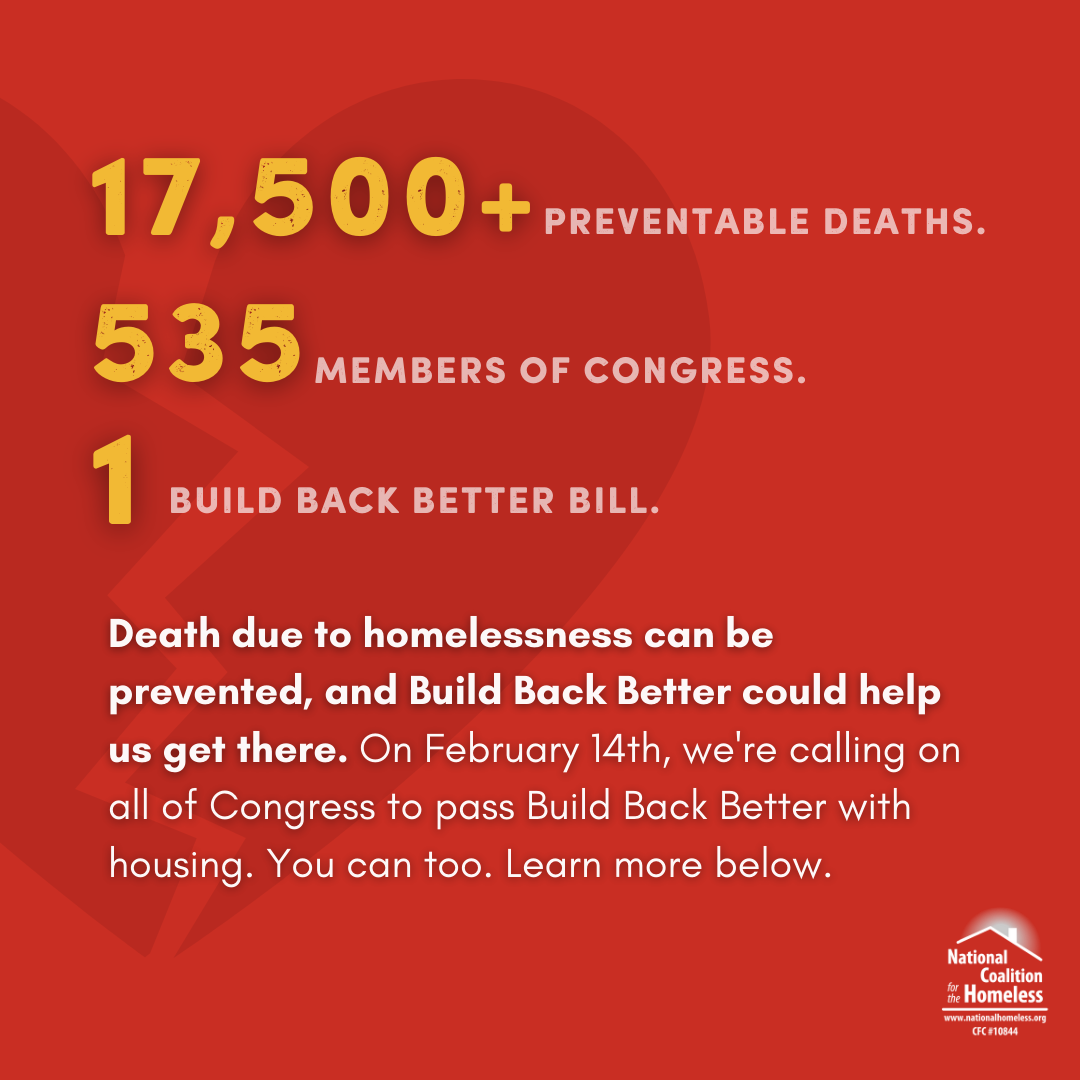
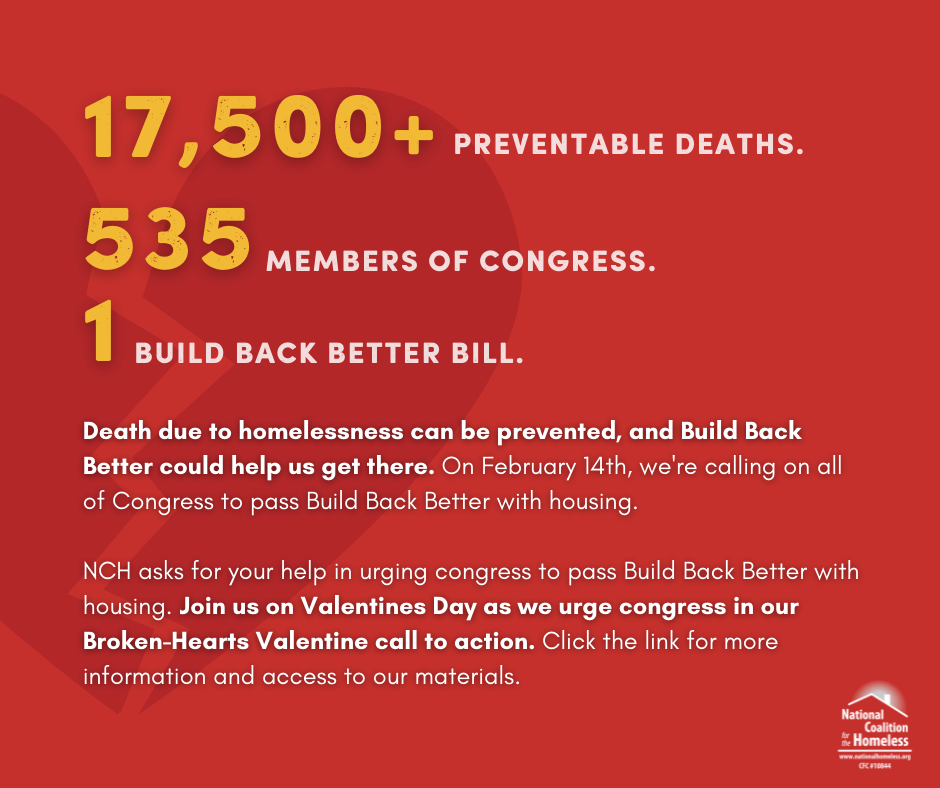
We are Broken Hearted this Valentine’s Day Over the Deaths of our Neighbors whose lives were cut short by Homelessness. Urge our Elected Leaders to Do More to Create and Build More Affordable Housing.

In 2018, National Healthcare for the Homeless estimated that at least 17,500 people experiencing homelessness died without a home. That’s at least 49 mothers, fathers, brothers, sisters or friends dying everyday because they were unable to afford safe housing and adequate health care. How many more people have to die before Housing is a Human Right in this country?  

Those who died were artists, teachers, first responders, those laid off because of the pandemic, and business owners. They were followers of nearly every major religion and spent countless hours volunteering to serve others. They lived in the richest country on the planet and yet died because they did not have the basic income needed to pay the bills or to afford housing or quality health care. Each of their lives counted, even though they were cast aside by their country and communities.

The National Coalition for the Homeless (NCH), and hundreds of partners across the country have remembered their names and their stories for over 30 years on National Homeless Persons’ Memorial Day, held symbolically on the winter solstice. On February 11, 2022, NCH Staff and Advocates who have experienced homelessness will read over 3,000 names of individuals whose lives were cut short due to the effects of unstable housing. 

But we need to do more than remember their names. We can begin by passing the Build Back Better Act, which includes direly needed and historic investments of almost $170 billion in housing accessibility programs. NCH is sending “Broken Heart” Valentine’s Day messages to every member of the US Senate that include the names of constituents who have died without housing. 

We are urging you to send a similar message to your elected leadership in your local, state or national leaders.

Here’s what you can do: 

These are our neighbors and constituents who are not able to be here because they could not afford safe housing and decent health care. Let’s tell our senators – If you pass BBB in their honor, you can undo decades of disinvestment in housing programs that could prevent more of your constituents from succumbing to deep poverty and homelessness.

1. Find your state representatives:

2. Access the list of names we received, by state:

  • Find a list of names in your state by clicking here. 

3. Print these cards and give them to your local or state representatives:

4. Find images for posting: 

Facebook; download image here:  broken heart call to action fb (3).png

Instagram/Twitter, download image here: 13,000 preventable deaths. 535 members of congress. 1 bill..png

5. Post on social media using these sample posts:

  • Does your heart break for the 17,500+ people without homes who die each year? The Senate must pass the critical housing investments in #BuildBackBetter to prevent more unnecessary deaths! #BrokenHeartValentine #HomelessDeaths #HousingNOW #PassBBB
  • My heart breaks for the more than 17,500 people who die without homes each year. We have to do better! We can start with passing nearly $170 billion in critical housing supports in #BuildBackBetter! #BrokenHeartValentine #HomelessDeaths #HousingNOW #PassBBB 
  • Data shows that between 17,500 and 46,500 people die without housing each year. That’ s at least 17,500 people dying due to extreme weather, violence or unattended health conditions. That’s at least 17,500 people dying preventable deaths. #PassBBB #BuildBackBetter #BrokenHeartValentine #HomelessDeaths https://nhchc.org/homeless-mortality/
  • Dear Senator: You have the power to undo decades of disinvestment in housing programs and communities that could prevent more of your constituents succumbing to deep poverty and homelessness. Pass #BuildBackBetter with housing. Save lives, [your state] needs you. #BrokenHeartValentine #HomelessDeaths #HousingNOW #PassBBB

The National Coalition for the Homeless enthusiastically supports the appointment of Jeff Olivet as the New Executive Director of the United States Interagency Council on Homelessness (USICH).

We at NCH always aim to amplify the voices of people with lived experience of homelessness, and Jeff’s tireless advocacy to bridge racial disparities and end homelessness are nothing short of extraordinary, and we are elated that Jeff was appointed this position as USICH Executive Director. We strongly believe that Jeff will use his position to develop a partnership with the advocacy community and those with lived experience homeless in our country.

Jeff has worked in the field of homelessness services in various capacities, and has proven a powerful advocate in each. His experience in outreach and executive levels give him the extensive background he needs to be successful in his new role.

Jeff Olivet, now Director of the UISCH, with NCH Director Donald Whitehead and colleague Kavita Singh Gilchrist

Jeff’s work with NCH’s Bring America Home Now (BAHN) campaign and Lived Experience Training Academy (LETA) has brought irreplaceable knowledge and value to the progression of each. His knowledge of the lived experience is critical to effective advocacy in the movement to end homelessness.

Here are some words from Olivet that exemplify his character and passion for the work:

I believe down to my core that we can end homelessness in America if we come together to scale what is working, eliminate racial disparities, lift the voices of those who have experienced homelessness, and work across sectors to create meaningful upstream solutions,” said Olivet. “I am deeply grateful to Secretary Fudge, Secretary McDonough, the members of the council, and the president for the trust they have placed in me. I look forward to working across the entire federal government and with national, state, and local partners to redouble our commitment to the vision of an America where no one has to experience homelessness.

-Jeff Olivet, USICH Press release

As the fight to end homelessness pushes on, NCH will miss Jeff’s powerful advocacy with the Bring America Home Now campaign, but wish him nothing but success, and look forward to the value and change he will continue to add to the movement as ED of the USICH. 

“I am very excited by the appointment of Jeff Olivet as Executive Director of the Interagency Council.  Jeff’s appointment speaks to the administration’s commitment to the core values of peer involvement and centering racial equity”. said Donald Whitehead,  Executive Director of NCH.

The USICH spent much of 2021 soliciting feedback from the country about the Federal Strategic Plan to End Homelessness. Click here to see what they heard from folks like you!

Overview by Teresa Paterson, Intern Fall 2021

A recent study published in the American Journal of Public Health shows that deaths among people experiencing homelessness (PEH) in Los Angeles County almost doubled from 2015 to 2019, increasing from 741 to 1,267 over the course of 5 years.

The study used Point-in-Time homeless counts (extremely flawed data, but all the public information that advocates have available) to obtain data on changes in numbers of PEH in the County, as well as additional demographic surveys to have a breakdown based on age, gender, and race/ethnicity. They then used medical examiner data in order to estimate general mortality trends among PEH as well as cause-specific mortality trends compared to the general LA County population.

Based on this data, the study found PEH had an almost 3 times higher risk of mortality compared to the general population of LA County. This disparity was even higher when looking at specific causes of death: PEH were 35 times more likely to die of drug overdoses; 15.3 times more likely to die of traffic injury; 14.3 times more likely to die of homicide, and 7.7 times more likely to die of suicide. Additionally, while the study found that White PEH had a higher mortality rate than Black PEH, they also stated that Black people accounted for 34% of homeless compared to 9% of the general population. The authors suggest that both the over-representation of Black people among PEH and their lower mortality rate compared to White PEH were likely a result of racism and discrimination – Black PEH were more likely to become homeless due to socioeconomic conditions tied to systemic racism while White PEH were more likely to accumulate a combination of mental, behavioral, and physical conditions over time before becoming homeless.

Having a better understanding of mortality trends among PEH is crucial for governments to create and implement more effective public health policies that address the dangers of homelessness. LA County used the results of this study to inform the establishment of a homeless mortality prevention initiative. The study demonstrated that drug overdoses increased by 69% from 2015-2019, becoming the leading cause of death in 2017. Given the increased risk of drug overdoses, the initiative decided to prioritize policies that improved substance use disorder services and increased interim and permanent housing options for people receiving treatment for substance use disorder.

If governments want their policies to truly address the needs of PEH in their community and to prevent deaths, they must have accurate data and knowledge of the dangers PEH face as a result of homelessness. Homelessness is a matter of life or death; this study drives home the serious health impacts homelessness has on PEH and the urgency for governments to take immediate action to end homelessness.

November 13 to November 21 is National Hunger and Homelessness Awareness Week

The National Coalition for the Homeless has a series of  events that you can participate in to better understand  homelessness in America.  

  1. Sign up to hear a presentation by one of  our trained formerly homeless speakers  either virtually or in the DC area with a vaccinated speaker. Sign up here
  2. NCH will release a series of videos on  our YouTube page beginning on Nov 15 as  part of H & H Week at 9 a.m. in the areas of  housing, income, racial equity, health care,  education, and civil rights. Each video will  be around a half hour and can be used to  guide a class discussion. They will be on  our YouTube channel.  
  3. Your group can collect items and put them in backpacks for a local Coalition to distribute to those without housing. NCH can provide you a good list of essential items needed and will connect you with a local partner to make the exchange in November or December. Contact Brian Davis @ bdavis@nationalhomeless.org.

By Kelvin Lassister, Income Policy Analyst

With 4.3 million workers electing to leave the workforce in August 2021, employees have taken advantage of the shortage of workers to leverage better pay and benefits. Others have taken advantage of unsafe work conditions to go on strike. The bottom line: the need to form unions is increasing, and becoming more important. 

Billion-dollar corporations like Amazon, and McDonald’s who can afford to pay a livable wage, refuse to listen to their workers. With a failed attempt to unionize their warehouse in Bessemer, AL, Amazon workers at the Staten Island, NY location filed a petition to unionize. Unsafe working conditions, better pay, and paid time off are the reasons for the actions taken against the world’s largest online retailer. 

There are several other companies that low wage workers should consider forming a union as well: Dollar General, and Family Dollar. Both cite not enough staff, and low pay not equivalent to the long work hours. Companies pay potential hires low wages based on their urgency to find employment. People deserve decent wages that allow them to pay for basic living expenses for their families!

According the National Relations Labor Board, companies can select a union with several different methods: 30% of workers must sign a petition, or sign cards, and a majority that vote for a union, the National Relations Labor Board will certify the union as a representative for collective bargaining. 

The American worker now has the chance to capitalize on an opportunity that may not come around again for quite some time. In the days, and times of wage increases for the wealthy, employees must get their fair share, and that begins with Unions and employment stability. 

Living Wage Week 2021

This week (November 15th-21st) is International Living Wage Week! Events are being held worldwide, and United for a Fair Economy is excited to partner with the National Living Wage Network and Living Wage for US to bring this to the United States.

Throughout living wage week, we want to encourage our community to join us in celebrating by lifting up living wages and taking action. We invite you to get involved in a few ways:

  • Sign the pledge to support living wage businesses this week.
  • Shout out your favorite living wage certified businesses on social media with the hashtag #livingwageweek2021
  • See what a living wage is in your community with MIT’s Living Wage Calculator

by Kelvin Lassiter

As the country emerges from the shutdowns surrounding the pandemic, Americans have become inpatient. Promises made regarding voting rights, paid time off, and tax hikes on the wealthy to pay for much needed infrastructure have not come to pass. 

Now, after several months of negotiations, the president’s original $3.5 trillion-dollar spending measure for the infrastructure bill and the social spending package has now been reduced in price tag to $1.75 trillion dollars (read the text of the Build Back Better bill). Some of the highlights of the bill include:

  • 150 billion in housing investments
  • Extension of the Child Tax Credit for one year
  • 100 billion to reduce immigration backlogs
  • Expansion of health care coverage that will save nine million Americans $600 a year on their premiums

Things left out of the final framework:

  • Paid family leave
  • Clean Electricity Performance Program
  • Ability for the government to negotiate with drug companies for Medicare also won’t be allowed.

While the American people appreciate the efforts for the things that will remain in the bill, it is severely underfunded, and will affect our housing insecure population for generations. The cities of New York and Los Angeles combined need at least 150 billion alone to being their public housing infrastructure up to code. Also, eliminating the ability for the government to negotiate drug prices is damaging. Who wants to make the choice to pay for medicine, or pay to survive without medicine?

In his latest remarks, President Biden reminded the country that this bill is historic, and an investment in the American people. Not everybody got everything they wanted including me, but that’s what compromise, and democracy is. While his remarks are true, the American people counted on lower drug prices, lower housing costs, clean air, and paid family leave to survive. Are the American people getting what they voted for? It remains to be seen, stay tuned.

by Donald Whitehead

I was a part of a small group of thirteen- and fourteen-year-olds who often played a lively game of tag football in the Burnet Avenue U.S Post office parking lot in Cincinnati, Ohio. 

I had just scored a long touchdown. As I was finishing my touchdown celebration, I noticed a University of Cincinnati Police cruiser drive by. I saw the woman in the back pointing at some of the people in the parking lot. Minutes later, the parking lot was swamped with police cars. Campus police and Cincinnati officers jumped out in mass with guns drawn, and suddenly we were ordered against the vehicles, and guns were pointed at our heads. We were confused and terrified about what was happening what we had done other than play football on the lot for several hours. Why was there so much anger coming from the police officers? Why did they have their guns drawn?

Donald Whitehead, NCH Executive Director, with Rep. Maxine Waters

I can still hear my best friend say, “let’s run for it.” I sometimes wonder what might have happened if we had taken his advice.  We know from recent history that running would have been a mistake, potentially a fatal mistake.  Luckily one of my brothers who wasn’t placed against the car had gone to get our parents.  Our houses were less than a hundred yards away.  

The white woman in the police car pointing had been robbed and assaulted by a group of black boys, and we fit the description. To her credit, after further inspection, the woman realized that none of our group was involved. The tension faded; however, the damage was done. We were good kids; we went to church every Sunday and sang in the Church Choir; none of us had ever been in trouble. 

This was our first contact with law enforcement ever.

We did not commit the robbery; in fact, it was us that got robbed that day.  We were robbed of innocence, robbed of trust in those that protect and serve—robbed of our belief in a colorblind world.  This is not a unique scenario; it is a lot more common than many would believe.

No child should have to learn such painful lessons with a gun pointed at their head.

That day was the first of many pen pricks of racism that I experienced and still experience to this day.

The incident also taught me not to be silent in the face of discrimination.  Our silence is negligence; we cannot see or experience injustice without protest or at the very least identify it. Our minor protest resulted in season-tickets-for-life to the University of Cincinnati football games.

The other lesson learned for me was the need to understand how and why I fit the description. Why am I suspicious without provocation? Why is my excellence somehow seen as out of the ordinary or achieved through dishonesty or criminality? I immediately wanted to understand history, my history, our collective history. I became a Dr. Martin Luther King fan; unfortunately, this was the only historical figure fully accessible in my post-secondary education.  

I became my own historian, and the more I have learned over the years, the more I have wanted to know.

I have been completely horrified by the middle passage, chattel slavery, black codes, and Jim Crow practices. 

I have also been so proud and grateful to my ancestors.  I am so respectful of their incredible resilience and their ability to survive the unthinkable horrors they endured.  

As my teams and I work to reintroduce the world to our full history, we often encounter the voices of the apathetic or the discouraged. The level of internalized racism is surprisingly significant. I find myself troubled by the thought that nothing will change from some in the community. 

To not believe in change is disrespectful to the many changemakers who have given their lives. Things have changed in many ways, most notably, the end of chattel slavery and the opportunity to gain civil rights have been hard-fought and slow and painful.

In many ways, it does appear that we are going in the wrong direction. From Charlottesville to massive voter depression efforts, it’s easy to be discouraged. It’s easy to ignore the senate election in Georgia or the election of Barack Obama when the Supreme court weakens the civil rights amendment. Watching angry crowds protest students having the ability to learn the unfiltered history of the United States by misrepresenting every attempt as the misunderstood Critical Race Theory, it’s easy to overlook that the Secretary of Defense is a dark-skinned black man.

Our racial reconciliation is recent in history; the first African Americans landed on the continent’s shores in 1619.  Brown versus Board of Education was passed in 1954. For 300 years, we survived on a steady diet of resilience, pride, and hope; we must never abandon those ideals. 

Those discouraged by the current state of our country learn from the setbacks and rejoice about the progress and never stop believing in change. Every living breathing African Americans is a product of success. We are descendants of unfathomable resilience.  Resilience from the 400 years of all of the things I mentioned earlier and resilience from the pen pricks of racism today and those yet to come. The great Booker T. Washington said “Success should not be judged by ones station in life but the obstacles they had to overcome to get there.”

Read more about how centuries of racial injustice affect who experiences homelessness today.