
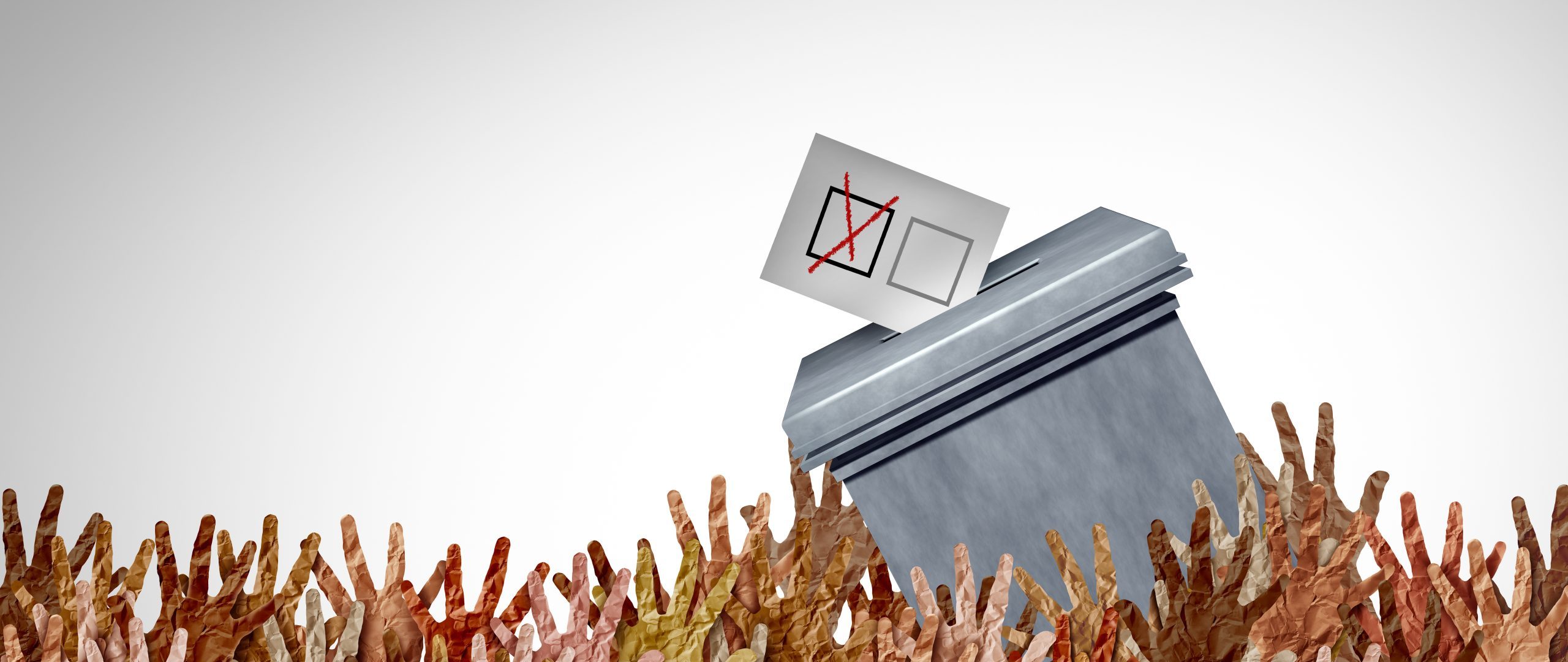
A voting rights rollback is unfolding in the United States following a recent Supreme Court ruling, raising urgent concerns about the future of equitable representation and democracy. Donald Whitehead, NCH’s executive director, is sounding the alarm, warning that the impact will be felt most by already marginalized communities. Below is his statement in response.
In this moment, we witnessed a crushing blow to the future of minority representation. It is another in a series of decisions that inaccurately imply that discrimination is a relic of the past—that somehow this nation has evolved beyond the need for vigilance, beyond the need for protection, beyond the need for justice. This voting rights rollback is not happening in isolation, but as part of a broader pattern. If this voting rights rollback continues, the consequences for marginalized communities will be severe.
But we know better.
History is not something we escaped—it is something we are still living through. The hard-fought, blood-soaked gains of the civil rights movement were never guaranteed to last forever. They were won through sacrifice, through courage, through people who refused to accept a system designed to silence them. And now, piece by piece, we are watching those gains chipped away under the false narrative of progress.
This is one of the most painful decisions by a Supreme Court that increasingly appears disconnected from the lived realities of millions of Americans. Decisions like this do not exist in a vacuum—they echo a past many of us know all too well. A past where access to the ballot was controlled, restricted, and weaponized. A past that looks uncomfortably familiar when we examine what is happening now.
We have not overcome.
Just look at what is happening in states like Florida, Texas, and soon Tennessee—where policies are being enacted that make it harder to vote, harder to be heard, and harder to be represented. These are not isolated incidents. They are part of a broader pattern—one that seeks to redefine access to democracy in ways that exclude the very communities who fought the hardest to be included.
Voting rights are not just about casting a ballot. They are about power. They are about voice. They are about whether communities can shape the policies that shape their lives.
And when those rights are weakened, it sends a clear message: that some voices matter less.
But we cannot—and will not—accept that.
Because every generation has a responsibility. The generation before us marched, bled, and sacrificed to expand democracy. Our responsibility is to protect it. To defend it. And, when necessary, to fight for it all over again.
This moment demands clarity. It demands courage. And it demands action.
Because democracy does not erode all at once—it erodes decision by decision, law by law, until one day we wake up and realize that what we thought was permanent was always fragile.
We are not powerless in this moment. But we must be honest about what we are facing.
This is not the end of the story.
It is a call to write the next chapter.
